
|



New Year, New Metrics: Evaluating AI Search in the Agentic Era (Sponsored)
 |
Most teams pick a search provider by running a few test queries and hoping for the best – a recipe for hallucinations and unpredictable failures. This technical guide from You.com gives you access to an exact framework to evaluate AI search and retrieval.
What you’ll get:
A four-phase framework for evaluating AI search
How to build a golden set of queries that predicts real-world performance
Metrics and code for measuring accuracy
Go from “looks good” to proven quality.
Few people in tech have a clearer view of AI-native engineering at hyperscale than Shah Rahman. As Global Head of Autonomous ML Iteration & Optimization for Ads at Meta, Shah spends his days architecting AI-native infrastructure and multi-agent systems that make ML iteration reliable across one of the largest production environments on the planet.
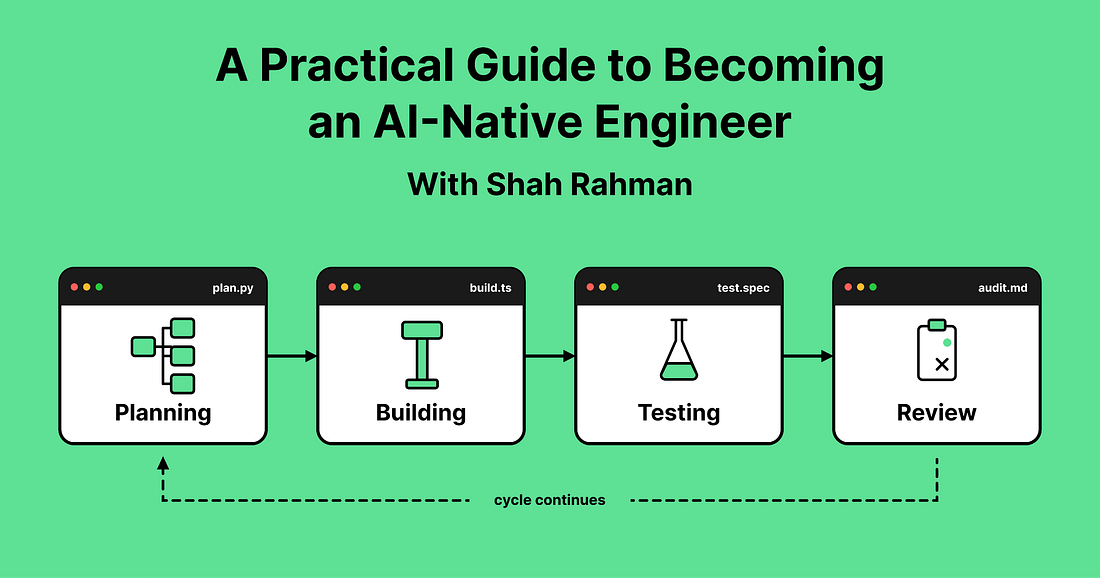
In the piece below, Shah cuts through the “everyone is an engineer now” noise and lays out what AI-native engineering actually requires: context engineering, spec-driven development, critical verification, and disciplined problem decomposition. He walks through the Agentic Development Life Cycle, the journey that separates real 10x leverage from “faster failure,” and the security guardrails that are no longer optional.
If you’re moving your engineering org toward becoming AI-native, this is a strong playbook.
Let’s get into it.
For more from Shah, connect with him on LinkedIn.
 |
AI generates more than 75% of Google’s new code. OpenAI and Anthropic claim that almost every line of fresh code that they produce comes from AI. Amazon recently migrated 30,000 of its production applications from Java 8 to Java 17 in a matter of months, a project that would otherwise have taken an estimated 4,500 developer-years. And Mark Zuckerberg expects that AI agents will be operating as mid-level engineers by the end of 2026.
Reading those statements, we may feel as if we are looking at the last lines being written on the closing pages of an era. Perhaps even the closing pages of a profession.
But here’s the question: If AI writing everything is the answer, then why are most engineering teams shipping more bugs, more incidents, and more technical debt than they shipped two years ago?
In an April article in the New York Times, Mike Isaac and Erin Griffith gave a name to describe what’s happening across the industry. They called it code overload.
The essence of code overload, according to Isaac and Griffith, is that “tech workers are producing so much code so quickly that it has become too much to handle.” Teams that have rebuilt their work around the use of AI agents are drowning in code churn and security holes.
But. Many engineers who have employed AI agents are pulling ahead of the field, achieving real productivity gains. They are using the same models and the same tools, but they are generating very different outcomes. What explains the gap?
It comes down to one decision. Real productivity gains come when engineers decide to make the leap from writing code to orchestrating it. This piece is a working guide for engineers who want to land on the productive side of that split. It will cover the practices, guardrails, and mindset shifts that separate AI-native engineering from vibe coding and from the everyday chaos that most teams are now generating at scale.
From Engineer to Orchestrator
Let me first clarify one thing: engineers are not becoming obsolete. Coding has always been a small part of engineering (20-30% max). This underappreciated reality is more visible when AI agents and tools produce more code, but more code is not necessarily more productive (often it’s less). This is a critical distinction that the industry is blurring dangerously, and I state that as:
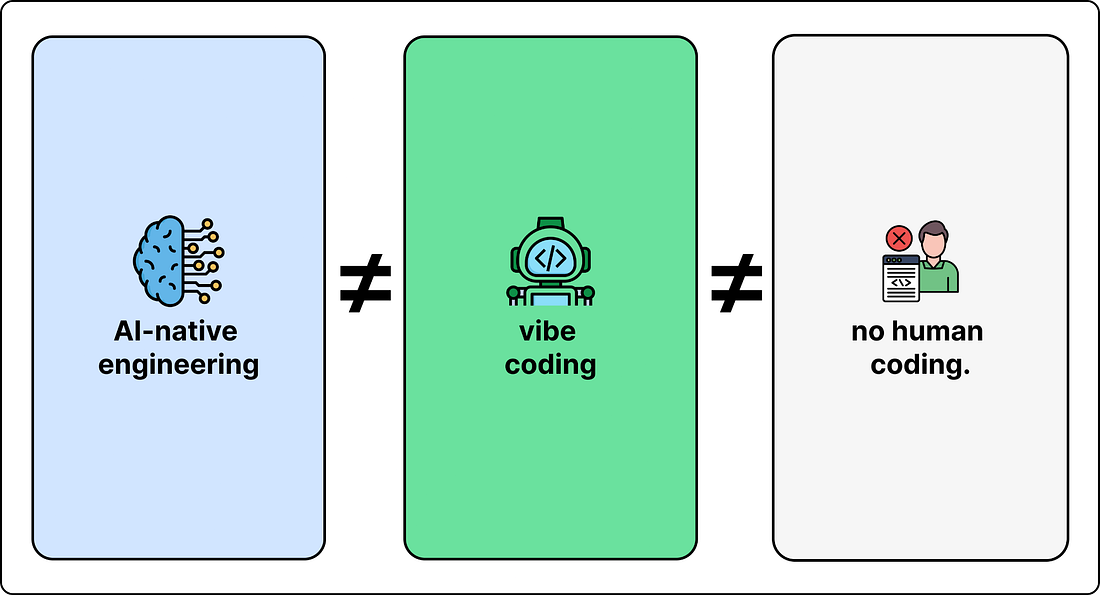 |
When Andrej Karpathy coined “vibe coding” in early 2025, it captured something useful — the ability for non-engineers to build functional software by describing what they want. That democratization is valuable. But it’s categorically different from professional AI-native engineering.
AI-native engineering means commanding and mastering available and emerging AI agents and tools to engineer things that weren’t possible in the pre-AI era. Knowing how to code remains a fundamental expectation. Without that knowledge, you can build systems using AI — and that’s vibe coding. It has its place, but it’s not engineering.
The AI-native engineer operates as an orchestrator — someone who can turbocharge 10x engineering into 100x output through proper orchestration of AI agents. And that bar continues to rise weekly.