Thanks for reading The Briefing, our nightly column where we break down the day’s news. If you like what you see, I encourage you to subscribe to our reporting here.
Greetings!
How is running an AI firm like running for Congress? In either case, you have to spend half your time raising money! Take Google’s surprising announcement on Monday afternoon that it plans to raise a total of $80 billion in equity “as part of its plan to fund investments” in AI. That’s in addition to the $85 billion it has already borrowed in the past year.
Repeatedly raising tens of billions is par for the course for AI firms like OpenAI and Anthropic, whose businesses don’t turn a profit. But Google’s businesses printed $164.7 billion in cash before capital expenditures in 2025, making it one of the biggest cash machines in the world. The fact that Google has to find innovative ways to raise money is a reminder that AI development is as much a financing challenge as it is a technological one.
Google, for instance, has said its capital expenditures will be between $180 billion and $190 billion this year and significantly higher next year. While Google has plenty of borrowing capacity—as we detailed here—the company presumably doesn’t want to push things too far with the debt markets. Hence it is both raising equity and taking steps to preserve cash.
One example of that cash preservation effort was the joint venture it announced last month with Blackstone, in which the private equity firm will put in $5 billion to build new data center capacity using Google’s AI chips. Another example is an element of the equity fundraisings unveiled on Monday: $30 billion of the funds will go to meet tax obligations incurred when employees’ equity awards vest. Google has always paid those taxes for employees, but in the past it has paid out of existing cash. Now it will sell stock to raise the cash.
Shares of Google fell 2% in after-hours trading on news of the fundraising. That’s not surprising given that $10 billion of the funds are coming from a private placement of stock to Warren Buffett’s Berkshire Hathaway at a discount to Alphabet’s current price. Still, Google stock is up 20% this year, so investors can afford the hit. It might be harder for another big tech firm like Microsoft, whose stock is down for the year, to follow suit with a big equity-raising.
But the wording of Anthropic’s announcement made it clear it is not committing to a public debut on any particular timetable. The company noted that the IPO filing “gives us the option to go public after the SEC completes its review.” That’s not usually what companies say they announce confidential filings. For instance, when health-tracking wearable firm Oura disclosed its confidential filing 10 days ago, it simply said that “the initial public offering is expected to take place after the SEC completes its review process, subject to market and other conditions.”
Moreover, IPOs are always dependent on the state of the market (and Anthropic also noted that its proposed IPO would depend on “market conditions and other factors”). It’s quite common for companies to file confidentially and then not proceed. As we’ve noted, a couple of crypto firms—Grayscale and Kraken—did exactly that last year, presumably because of the crypto market’s downturn. Anthropic is stating the obvious by pointing out that the filing gives it an option to go public. So what was the point of the statement? After all, it didn’t need to announce the filing: Many companies that do file confidentially don’t talk about it.
Perhaps Anthropic wants to contrast its IPO readiness with OpenAI’s lack thereof. We and others have reported the ChatGPT creator is also preparing to file confidentially for a public debut. That doesn’t appear to have happened yet, and my colleagues hear OpenAI’s plans remain fluid. It would hardly be surprising, given OpenAI’s chaotic nature, if it simply hasn’t got its paperwork in order.
The problem for Anthropic is that if it backs off in the next couple of months, people might wonder why. To be sure, the reason may be obvious. It takes the SEC a few weeks to review IPO filings. (SpaceX first filed confidentially to go public on March 30, the SEC database shows, but its filing only became public on May 20.) While market conditions right now seem to be excellent for an AI-related public debut, that could change quickly given the war with Iran and uncertainty about oil prices and interest rates.
Then there are the rapid changes in the AI business landscape, including the rivalry between Anthropic and OpenAI. Anthropic may well benefit from moving faster than OpenAI. But it might have been better off if it had moved more discreetly.
In Other News
• Nvidia unveiled a new chip for personal computers alongside Microsoft on Monday, a major step into the PC chip market long led by Intel, Advanced Micro Devices and Apple. The new chip, N1X, will power a new line of Windows computers starting this fall, Nvidia CEO Jensen Huang said during a keynote in Taipei.
• Florida Attorney General James Uthmeier on Monday sued OpenAI and its CEO, Sam Altman, alleging 10 counts of negligence, liability and other state law violations related to safety concerns over OpenAI’s consumer-facing tool ChatGPT.
• Brian Landsman, a 14-year Salesforce executive vice president who leads its global partnerships and app store business, has joined OpenAI as vice president of global partnerships, he announced on LinkedIn.
• SpaceX’s compute rental deal with Anthropic will run for a minimum of six months, according to an amended securities filing on Monday, providing an additional level of detail not included in the company’s public IPO filing in May (more here).
• Chinese AI developer MiniMax on Monday launched a new large language model, M3, saying its coding capability approaches that of Anthropic’s Opus 4.7, released in April.
Today on The Information’s TITV
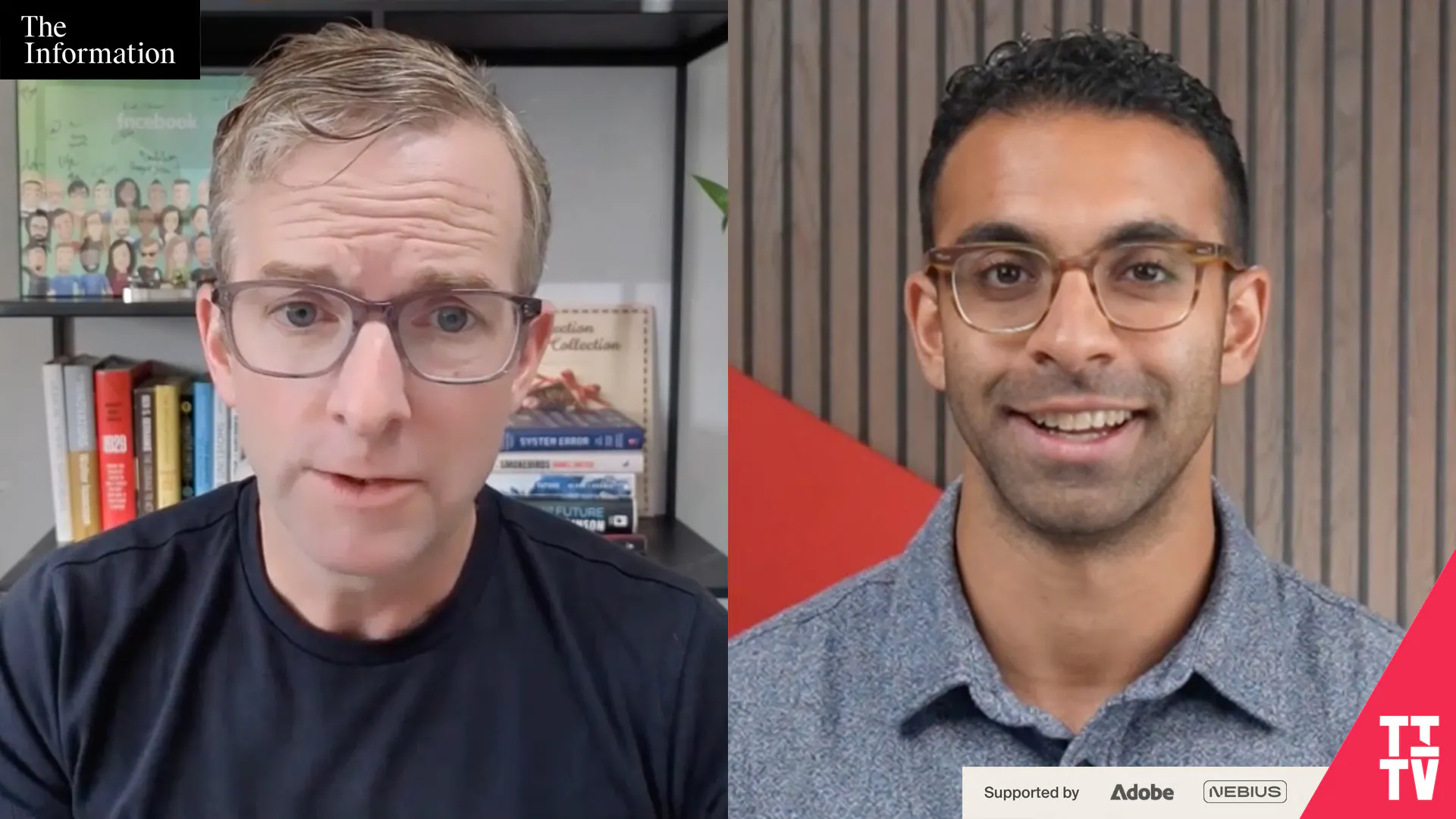
Check out today’s episode of TITV in which we speak with Meta’s former chief technology officer about why he’s betting on AI compute powered by oceans.
Recommended Newsletter
Start your day with Applied AI, the newsletter from The Information that uncovers how leading businesses are leveraging AI to automate tasks across the board. Subscribe now for free to get it delivered straight to your inbox twice a week.
Tickets are on sale now for The Information’s AI Agenda Live in San Francisco. Join top AI leaders for conversations on the future of AI, and secure early bird pricing while it lasts!
Save the Date: The Information returns to Napa Valley October 27-28 to convene senior women across tech, media, and finance. The event will feature two days of intimate, candid conversations with the leaders navigating today’s global shifts.