
|
The way we treat pigs is a sin
The practice of "crating" is torture, plain and simple. Voters want to end it, but Congress might not let them.
|

| |||||||||||||||


 |
I consider myself a pretty good and decent guy, overall. I don’t commit crimes. I’m nice to the people I meet. I help out my friends. I take good care of my pet rabbit, and I donate lots of money to other people who take care of abandoned and sick rabbits. My politics might not always be correct or wise, but I want things like the end of poverty, the end of war, and so on.
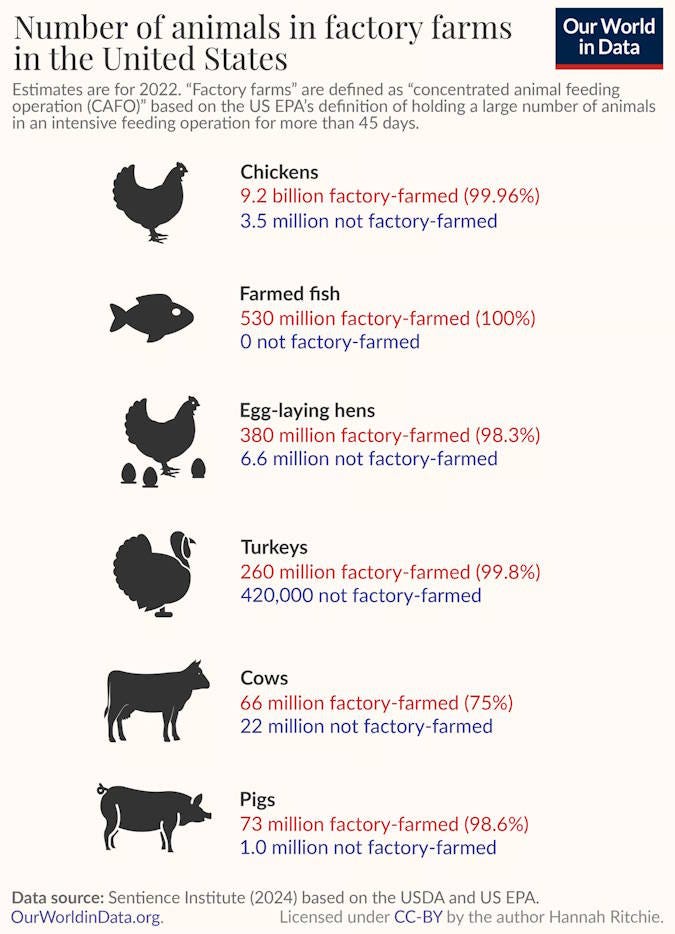
And yet just down the highway from me, there are facilities for the mass torture of animals. In the United States, there are 73 million pigs in “concentrated animal feeding operations”, more commonly known as factory farms:
 |
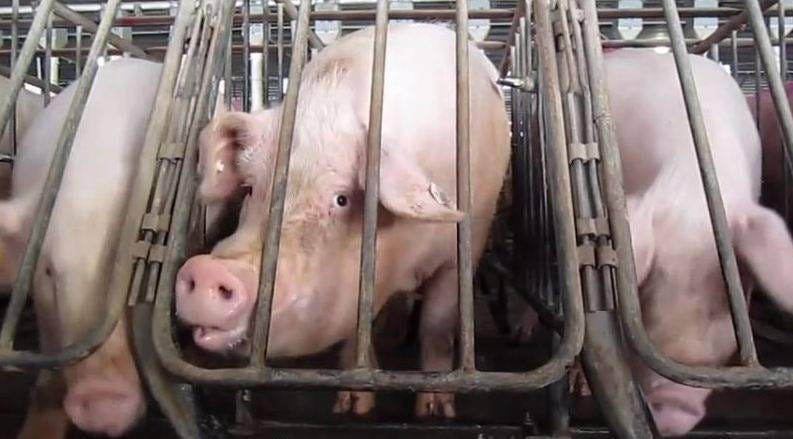
There are many horrors experienced by chickens and other animals on factory farms, but the way pigs are forced to live is probably the worst. For most of their lives, female pigs (sows) are kept in tiny cages — either “gestation crates” when they’re pregnant, or “farrowing crates” when they’re nursing. A sow will spend most of her life in one of these cages.
In a gestation crate or a farrowing crate, sows don’t have enough room to turn around — all they can do is either stand or lie down in a pile of their own feces. Imagine living your entire life in an airline seat, where you couldn’t even get up to go to the bathroom or take your seatbelt off. That’s how these pigs live.
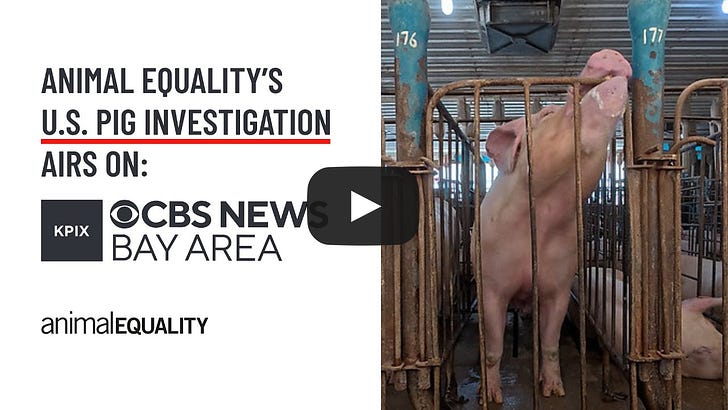
Pigs are social creatures — they exhibit “emotional contagion”, meaning that when one pig is scared or happy, other pigs start to feel the same, and they give comfort and support to other pigs who are in distress. Research suggests that they’re at least as smart as dogs, and probably smarter. But a pig in one of these crates will never get any social interaction in her entire adult life — she can’t even turn around to look at her babies.
This is torture. The pigs who are confined this way bite the bars of their cages, desperate for a freedom that will never come. They have their tails chopped off as babies (generally without anesthetic), so that they can’t chew each other’s tails in anguish. But no relief ever comes — they live out their entire lives and die in these tiny torture-cages.
I have no other word for this except “sin”. This is a sin. If there is a God,¹ and if that God is in any way good and moral, then that God is looking down with disgust on the way my society treats pigs. I go about my daily life — hanging out with my friends, petting my rabbit, going out to eat at nice restaurants — never thinking about the horrible suffering that has engulfed the entire lives of those tens of millions of pigs.
And it’s for my own benefit that those animals are being tortured. When I eat delicious guanciale, sumptuous char-siu, or mouthwatering carnitas, I’m eating the flesh of animals who were tortured for their entire lives so that I could devour their faces and shoulders and bellies for a slightly cheaper price.
OK, so why don’t I just stop whining and become a vegetarian (or a vegan, since milk cows and hens are also treated badly)? Honestly, I should, and the fact that I don’t is monstrous in a way. But simply washing my own hands of this crime feels like a pitifully inadequate response. The vegetarian movement has been around in the West for over 150 years, and very little has changed — meat consumption is probably marginally lower than if there were no vegetarians at all, but abusive factory farming practices have only been refined and expanded. Furthermore, vegetarianism, though morally laudable, has an obvious economic limitation — when one person refuses to eat meat, it lowers the price of meat for everyone else, which raises other people’s meat consumption and partially offsets the vegetarian’s action.
On top of the obvious and demonstrated inability of individual action to solve this problem, it’s insufficient even from a moral stance. Suppose that our society farmed human beings for food. Would simply refusing to eat human flesh be enough to absolve me of culpability? I don’t think so. I would still have a responsibility to try to abolish the evil system.
In fact, “abolish the evil system” is exactly what voters in California and some other states are trying to do. In 2018, by an almost 2-to-1 margin, California voters enacted a law called Proposition 12 that heavily restricted the sale of meat from pigs, hens, and calves that weren’t raised with a minimum amount of space. Crucially, the partial prohibition extended to meat from animals raised inhumanely in other states. This followed on the heels of a similar law in Massachusetts two years earlier.
Courts have upheld the law, but Republicans in Congress are trying to undo it from the federal level. In 2025 they proposed the Save Our Bacon Act, which would ban states from enacting animal welfare laws like the ones voters approved in California and Massachusetts. The Save Our Bacon Act failed on its own, but this year it got incorporated into the Farm Bill, which has passed the House and is now being considered in the Senate:
Companies and industry groups have also worked with members of Congress for over a decade to introduce federal legislation to nullify laws like those in California and Massachusetts. The latest iteration is called the Save Our Bacon Act, originally proposed last year…This effort, which for years went nowhere as standalone legislation in Congress, now has a decent chance at becoming law as part of the new Farm Bill…
In late April, the House of Representatives passed its version of the Farm Bill, which included the language from the Save Our Bacon Act…It’s “really a Save Our Crate Act,” Brent Hershey, a hog farmer who opposes it, told me. “A vote for the farm bill,” he said, “is a vote to cage an animal that can’t walk or turn around.”
Lewis Bollard has a good post explaining what’s at stake. In fact, the current Farm Bill wouldn’t just reverse the recent anti-crate laws in California and Massachusetts — it would roll back much of the progress that has been made in farm animal welfare over the decade, as well as preventing any future welfare laws along similar lines:
The [Save Our Bacon] Act would stop any state or locality from regulating the sale of meat based on how it’s produced in another state. This would likely invalidate state and local bans on foie gras, crated veal, and more…It would also halt future legislative progress. Congress hasn’t passed a farm animal welfare law in decades. State laws are where reforms actually happen. The SOB Act would gut them by mandating they contain a giant loophole for out-of-state imports.
Why should Congress prevent the voters of California and Massachusetts from taking a stand against the evils of factory farming? First and foremost, it’s a case of a concentrated interest group — the pig farming lobby — making headway against a diffuse interest (voters with a conscience). In fact, if you believe the polls, a majority of the country — even a