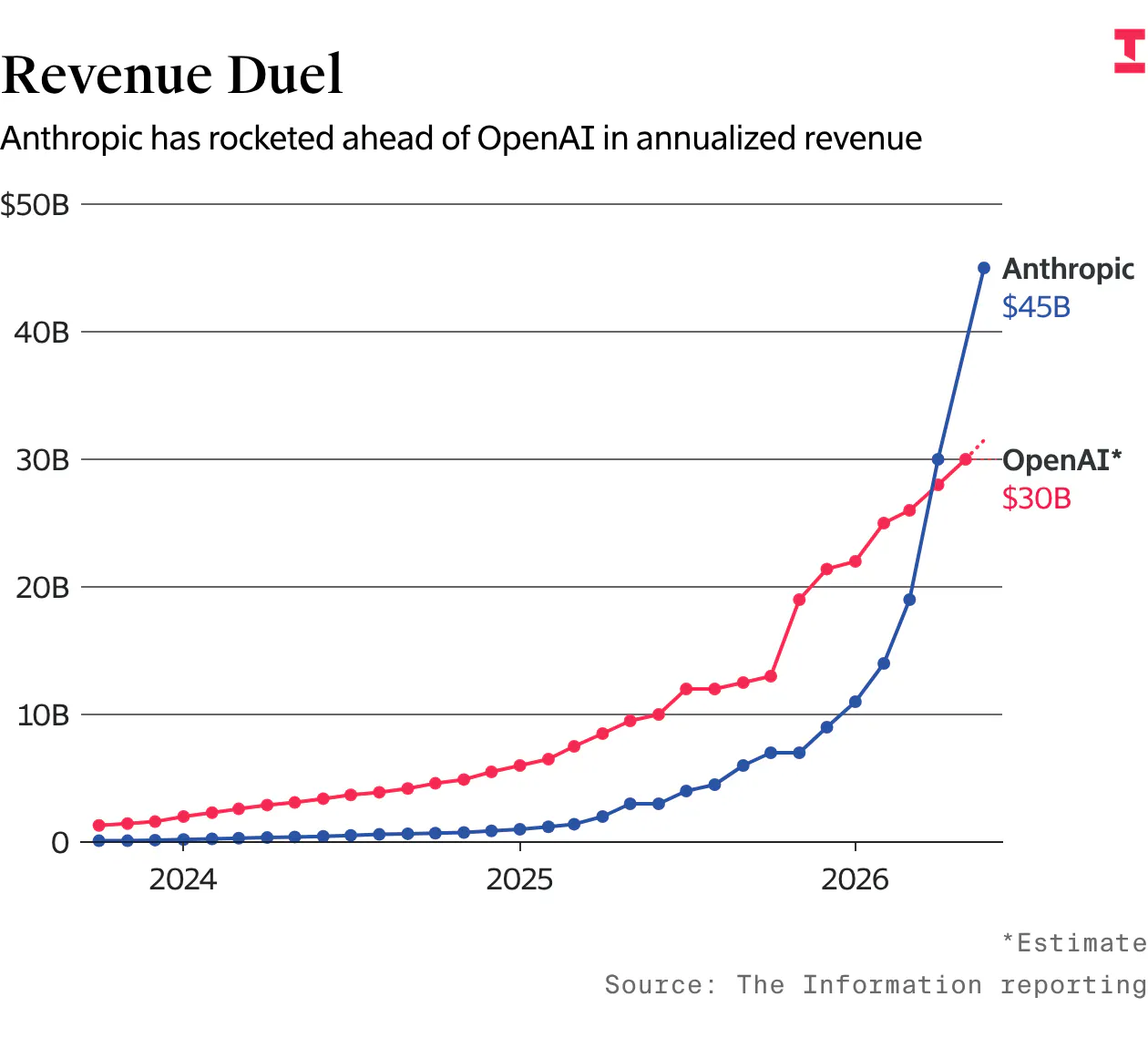
On New Year’s Day, OpenAI leaders would have been happy to hear that the company’s monthly revenue would rise more than 50% over the first five months of 2026, roughly in line with the projections it previously shared with investors. But they’re not likely to feel that way now: That pace looks downright tame compared to that of Anthropic, whose revenue grew five times in the same period, leapfrogging OpenAI’s. Anthropic was recently generating revenue at an annualized rate of close to $45 billion. OpenAI’s current run rate couldn’t be learned but it recently crossed $30 billion, and one person familiar with the numbers said it isn’t much higher now. If we estimate their annualized rate now is around $33 billion, that would mean Anthropic’s revenue is about 35% higher. And things aren’t likely to change anytime soon if OpenAI’s growth rate doesn’t accelerate materially.
Thanks for reading The Briefing, our nightly column where we break down the day’s news. If you like what you see, I encourage you to subscribe to our reporting here.
Greetings! It’s Amir and Sri.
On New Year’s Day, OpenAI leaders would have been happy to hear that the company’s monthly revenue would rise more than 50% over the first five months of 2026, roughly in line with the projections it previously shared with investors. But they’re not likely to feel that way now: That pace looks downright tame compared to that of Anthropic, whose revenue grew five times in the same period, leapfrogging OpenAI’s.
Anthropic was recently generating revenue at an annualized rate of close to $45 billion. OpenAI’s current run rate couldn’t be learned but it recently crossed $30 billion, and one person familiar with the numbers said it isn’t much higher now. If we estimate their annualized rate now is around $33 billion, that would mean Anthropic’s revenue is about 35% higher. And things aren’t likely to change anytime soon if OpenAI’s growth rate doesn’t accelerate materially.
The competitive dynamic between the two firms is a dramatic reversal from the end of last year, when Anthropic was generating $9 billion in annualized sales—less than half what OpenAI was generating at the time, mostly from ChatGPT subscriptions. Since then, Anthropic’s revenue has grown five times while OpenAI’s rose more than 50%, based on our estimate. To put Anthropic’s revenue into perspective, the company is well on its way to surpassing companies such as Netflix, SAP and Salesforce by revenue over the next year.
OpenAI’s smaller revenue and relatively slow growth compared to Anthropic could pose a challenge for its planned initial public offering, especially if Anthropic manages to file its own IPO paperwork and go public first.
While OpenAI primarily generates revenue from chatbot subscriptions and Anthropic makes the bulk of its money from selling access to its AI for coding and other white-collar tasks, both companies still compete head-to-head in both markets. That means public investors will closely compare them.
The difference in operational efficiency between the two companies is likely even more dramatic: Anthropic has projected a $559 operating profit in the second quarter, with an operating margin of about 5%, based on our analysis of its figures. OpenAI is likely to lose money in the current period: In the first quarter, it had a negative operating margin of 122%, The Information reported, and that was even excluding substantial items such as stock-based compensation. That implies it lost at least $7 billion in the quarter.
But given OpenAI’s recent growth rate and substantially higher headcount costs than Anthropic’s, it is likely to stay unprofitable for a while.
OpenAI subsidizes the cost of running a consumer chatbot for hundreds of millions of nonpaying users, which is currently dragging down its results. It plans to monetize those users through ads, which it recently launched and which will undoubtedly improve its margins.
An OpenAI projection earlier this year said the company would burn $25 billion this year, in large part due to its hefty AI server rental cost of $32 billion for developing new AI models and products. It isn’t clear whether it still plans to spend that much, and it has recently pulled back on some server-heavy efforts such as AI video model Sora.
The two companies’ revenues differ in some ways. Anthropic counts the total sales of its models by other cloud providers, including the share of revenue it hands back to those providers as part of their agreements with Anthropic. The company likely would also share billions of dollars in revenue with its cloud partners.
OpenAI, meanwhile, owes 20% of its total revenue to Microsoft through 2030. That could amount to $6 billion if OpenAI generates the $30 billion in revenue it previously projected for this year.
• Dropbox founder and CEO Drew Houston said he plans to step down as CEO. Dropbox executive Ashraf Alkarmi will become co-CEO with him during a transition period, after which Houston will become executive chairman.
• ServiceNow Chief Marketing Officer Colin Fleming said Tuesday that he is leaving the IT services software giant for OpenAI, where he will assume the role of CMO for its business segment.
• American Airlines plans to start adding SpaceX’s Starlink satellite internet service to around half of its main aircraft fleet beginning early next year.
• Nathan Allman, 32, the founder and CEO of Ondo Finance, the biggest tokenized stock provider, has died unexpectedly, the company said.
Today on The Information’s TITV
Check out today's episode of TITV, in which we discuss the current state of OpenAI’s advertising business.
Recommended Newsletter
AI Agenda by Stephanie Palazzolo separates hype from reality and explains how AI is transforming industries. The 4x/week newsletter details the innovation and disruption happening in AI, from the AI startup funding frenzy to the major technological breakthroughs that will set the agenda for decades to come. Sign up today.
Tickets are on sale now for The Information’s AI Agenda Live in San Francisco. Join top AI leaders for conversations on the future of AI, and secure early bird pricing while it lasts!
Save the Date: The Information returns to Napa Valley October 27-28 to convene senior women across tech, media, and finance. The event will feature two days of intimate, candid conversations with the leaders navigating today’s global shifts.