
|
Buying a New Car Every 5 Years Is a $540,000 Lifestyle Choice
The average new-car payment is now $748/month. Skipping that habit is one of the most reliable wealth-builders in America.
|

| |||||||||||||||


Quick question for you. What if I told you that one decision — a single, repeating, lifestyle decision — costs the average American household more than half a million dollars over their working life?
It’s not eating out. It’s not subscriptions. It’s not even the house.
It’s the car. Specifically, the cycle of buying a new one every 4 to 5 years, financing it for 6 to 7 years, and rolling the leftover loan balance into the next purchase.
The numbers, fresh from 2025
Average new-car transaction price (Q4 2025): $50,318 (Kelley Blue Book).
Average new-car monthly payment (Q3 2025): $748 (Experian).
Average new-car loan term: 69 months — almost 6 years.
Roughly 1 in 5 new-car buyers in 2025 took an 84-month loan (Edmunds).
The total cost of owning a typical new vehicle, all-in (depreciation, insurance, fuel, maintenance, financing) is now $11,577 per year — about $965 a month, per AAA’s 2025 Your Driving Costs report. And modern cars built with reasonable maintenance routinely run 200,000+ miles. The Toyota Camry doesn’t know how old it is.
Two paths, same monthly outlay
Imagine two people. Both spend $750/month on transportation.
Person A buys a new car every 5 years. They are perpetually mid-loan, always paying $750/mo. Their investment account from this decision: $0.
Person B buys one reliable car. Pays it off in 5 years. Drives it to 200,000 miles (~15 more years). Then repeats once. During the years they’re not paying a car loan, they invest the $750/mo at 7%.
Same monthly transportation budget. Same number of cars purchased over 30 years (just two). Here’s what their investment accounts look like by year 30:
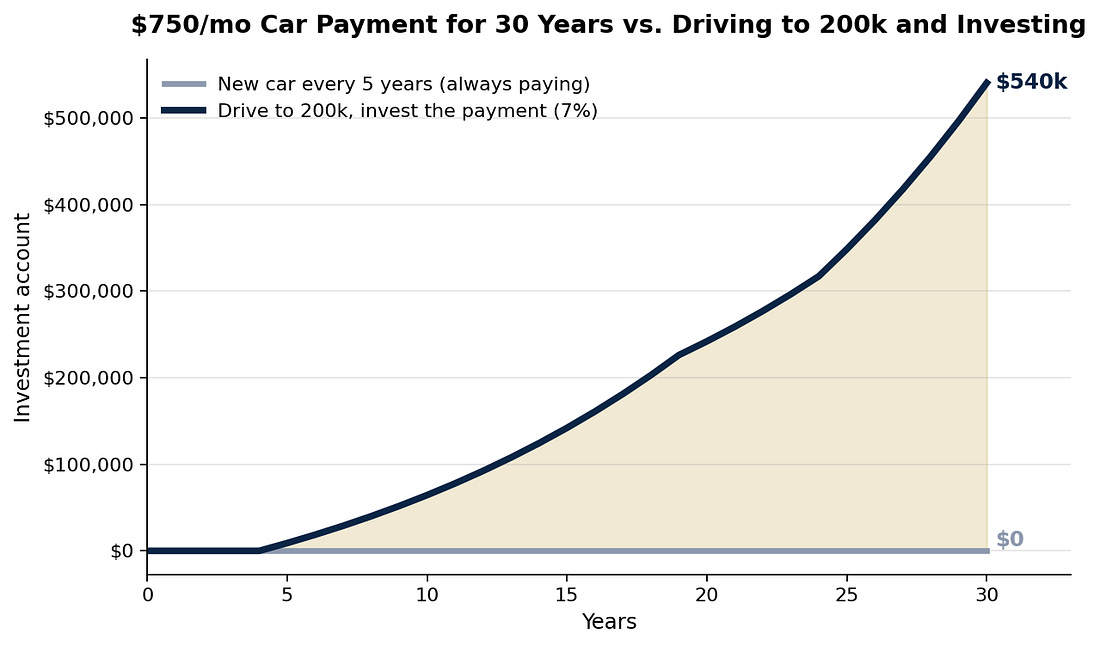 |
That gold space is a half-million dollars of difference between two people who spent the same money each month, the only variable being how often they replaced the car.
“But I need a reliable car for work”
This is the argument that funds Lexus dealerships. “Reliable” is not the same as “new.” A 2018 Honda CR-V with 60,000 miles is one of the most reliable transportation devices ever built — and it costs less than half what a 2026 model costs. The depreciation cliff on a new car is brutal: roughly 20% in the first year, 55% over the first five years, per Kelley Blue Book.
You are not buying transportation. You are paying for the privilege of being the one to absorb the depreciation.
Action this week: Look up your car’s value on Kelley Blue Book or Edmunds. If it’s paid off and runs reliably, congrats — you own one of the most underrated wealth-building tools in America. Don’t replace it because of mileage; replace it when repairs exceed roughly 50% of replacement value. Every month you skip a $750 payment, that’s $9,000/yr that can quietly compound.
The behavioral trap
New cars don’t sneak up on you. You see them every day — your neighbor’s, your coworker’s, the one in the commercial. Status is the most expensive product on the market, and the auto industry has perfected its packaging.
The wealthy person quietly driving an 8-year-old Camry isn’t being cheap. They’re running the math the rest of us refuse to.
The one-line version
You don’t get rich from picking better stocks. You get rich from refusing to repeatedly drive a $50,000 asset off the depreciation cliff.
Sources
Kelley Blue Book — Average new-vehicle transaction price (2026) — https://mediaroom.kbb.com/2026-02-10-Kelley-Blue-Book-Report-New-Vehicle-Prices-Climb-Higher-in-January-Automakers-Cut-Incentives-to-Help-Protect-Margins
Experian — Average car payment, Q3 2025 — https://www.experian.com/blogs/ask-experian/average-car-payment/
Edmunds — 84-month car loans hit record share (Q1 2025) — https://www.edmunds.com/industry/press/1-in-5-new-car-shoppers-committed-to-an-84-month-loan-in-q1-2025-according-to-edmunds-experts.html
AAA — Your Driving Costs 2025 ($11,577/yr) — https://newsroom.aaa.com/2025/09/aaa-new-vehicle-costs-drop-to-11577/
Kelley Blue Book — 5-year cost of ownership — https://www.kbb.com/new-cars/total-cost-of-ownership/
Disclaimer
Affluent Notes is for educational and entertainment purposes only. Nothing in this newsletter is financial, tax, legal, or investment advice. The numbers, charts, and strategies discussed are illustrative; your situation, tax bracket, plan rules, and risk tolerance are different. Past performance does not guarantee future results. Talk to a licensed CPA, CFP, or attorney before acting on anything you read here. The author may hold positions in securities or accounts mentioned.
Affluent Notes is free today. But if you enjoyed this post, you can tell Affluent Notes that their writing is valuable by pledging a future subscription. You won't be charged unless they enable payments.
|