
|
Conservative Politics in Revolutionary Times
Three books make the case for conservatism amid times of revolution and societal upheaval.
| |||||||||||||||


 |
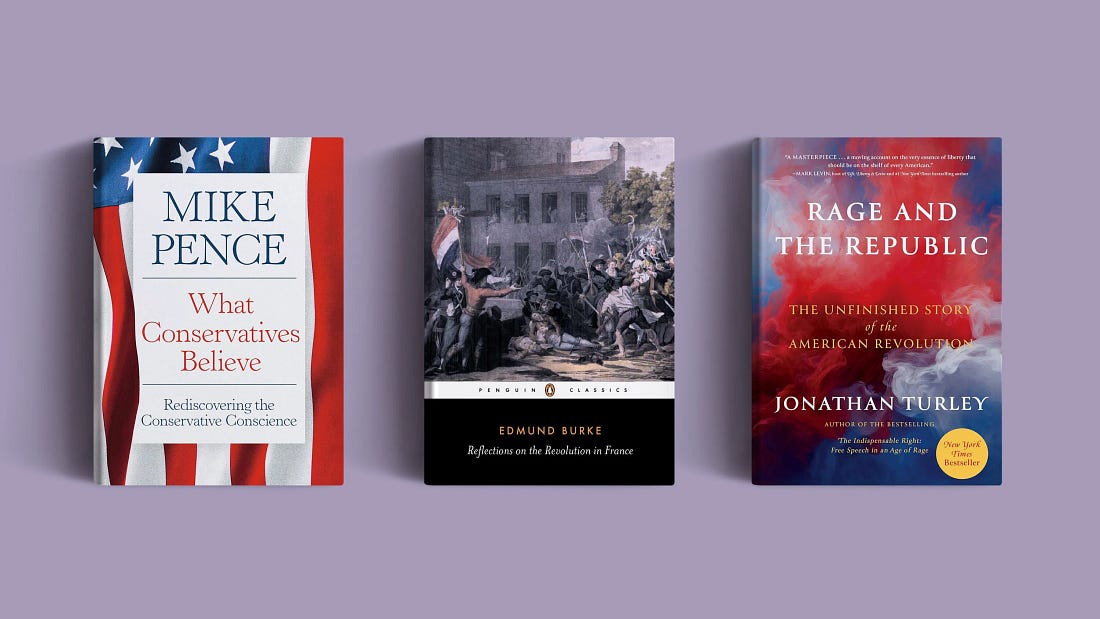
The older I get, the more I’ve come to appreciate the wisdom of context. Knowing what has been said and done before is vital to making wise decisions in the future. In this week’s reviews, my colleague Harvest Prude provides valuable context for our own political moment. Across three books, she traces conservative political theory from an early formative work by Edmund Burke—written amid the French revolution—all the way to former vice president Mike Pence.
Happy Reading,
Taylor Berglund
Senior Features Editor, Christianity Today
A portion of this newsletter appeared as a column at Christianity Today. Join CT for full access to all our journalism.

 |
Three Books on American History
Jonathan Turley, Rage and the Republic: The Unfinished Story of the American Revolution (Simon & Schuster, 2026)
George Washington University law professor Jonathan Turley’s latest book is well timed for America’s 250th anniversary. He invites readers to ponder how the colonies’ revolution succeeded while similar attempts (most notably in France) ran aground. How did Americans build a republic while avoiding the dangers of autocratic reign or democratic despotism?
In an in-depth history tour, Turley examines a handful of particulars that made the difference, including the tempering effect of some of America’s more cool-headed framers. Turley contrasts the more moderate James Madison with the fiery Thomas Paine, whose galvanizing writings worked to great effect on both Paris and Philadelphia’s uprisings.
Turley contends that our revolution is ever an unfinished experiment, and one that will be tested anew in the coming age of artificial intelligence. Self-destruction is an ever-looming risk, and the challenge is putting away the bayonets once the revolution has run its course. America has so far been docked in a safe harbor thanks to its constitutional guardrails, but those guardrails are not permanently soldered on.
So will American democracy survive?
Turley is at his best during the history retelling portion of the book, which fortunately is the book’s majority. The book is weaker when he fast-forwards to modern times, and he seems less clear-sighted than when he looks to the past. While he identifies challenges America faces in a coming robotic age, from job displacement driven by AI to increasingly bitter factionalism, he is less eloquent on the remedies to these ills.
To Turley, on the left are the new Jacobins, though not (with perhaps an implicit yet) to such a murderous degree. He notes some faults on the political right, but his primary targets are academics, democratic politicians, and CEOs who undervalue America’s robust constitutional protections. These targets are unsurprising from the conservative academic. But in our particular political age, if populist rage and a desire to throw off constitutional guardrails is a characteristic marking only one side of the aisle, I have yet to learn of it.
Mike Pence, What Conservatives Believe: Rediscovering the Conservative Conscience (Center Street, 2026)
Former vice president Mike Pence came to conservatism in a roundabout way: His parents, Irish Catholics, passed on their Democratic affiliation for the first part of his life. It wasn’t until later, after President Ronald Reagan’s 1980 victory, that he found his way to what would become his political home as a conservative Republican.
A key part of that journey was the writing of conservative giants: William F. Buckley Jr., Russell Kirk, and Edmund Burke tutored him in right-of-center political thought. But reading Barry Goldwater’s The Conscience of a Conservative sealed the deal. Pence wrote his book, What Conservatives Believe, in hopes he will similarly inspire young people—particularly those who don’t remember the Republican Party before the ascent of President Donald Trump and the current populist nature of the party—to embrace what he sees as true conservatism.
Every chapter in What Conservatives Believe lays out his