
|



Warren Buffett set the bar very high.
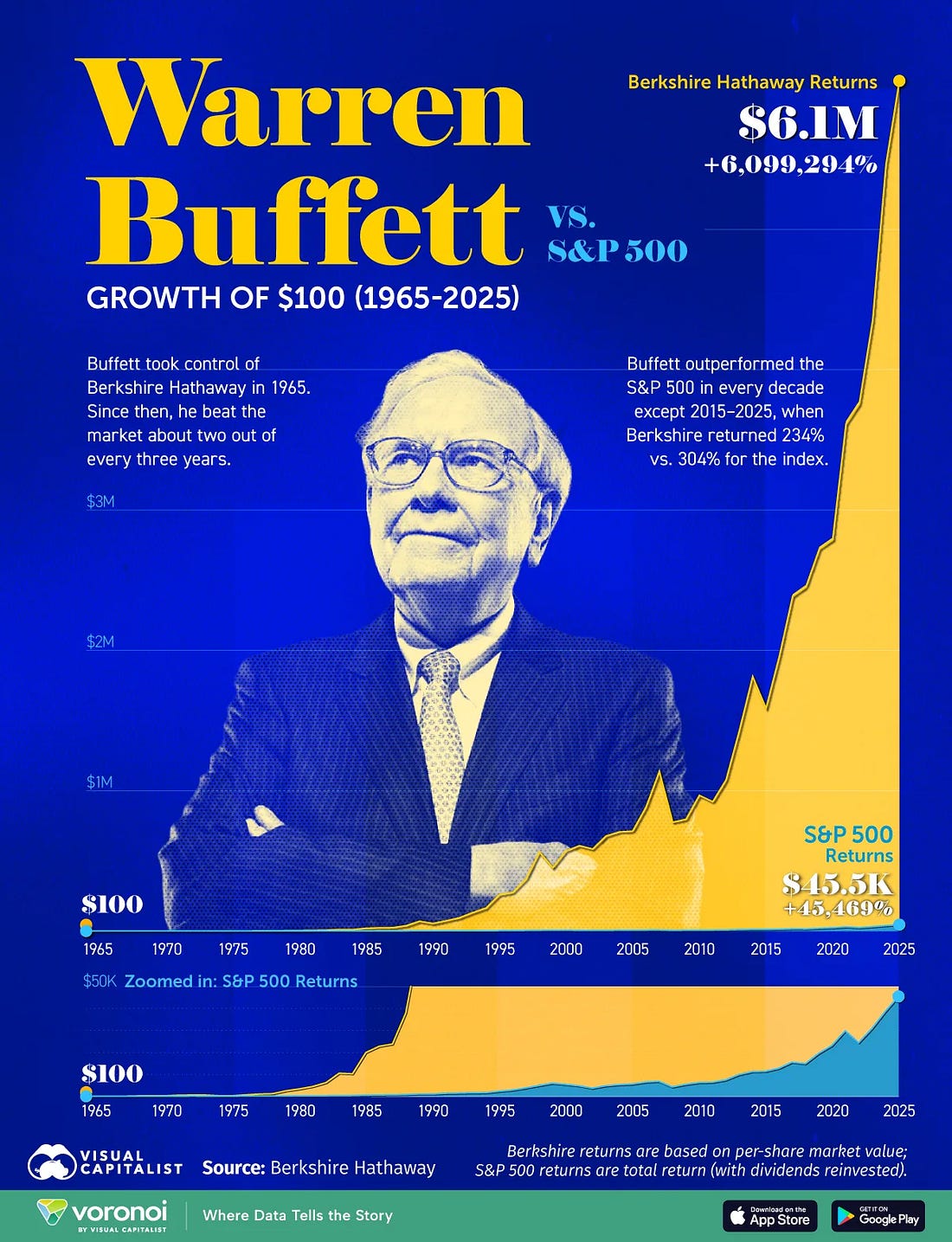
It would be hard for anyone to deliver a 5,000,000% return in 60 years.
That’s an average return of 20% (!) per year for 60 years.
That’s nearly double the returns you get from the S&P 500.
And did you know?
91% of fund managers fail to beat the Index.
No wonder Berkshire CEO, Greg Abel, said, Buffett is a tough act to follow.
I’ve been thinking about this since I returned from the 2026 Berkshire AGM.
Just look at the numbers in the chart below.
It shows your returns if you had invested $100 in Berkshire 60 years ago.
Indeed, in his prime, the Oracle was one tough customer.
Institutional investors found it nearly impossible to match his performance.
However, there’s one area where you could easily emulate Buffett.
I’m talking about collecting a steady income from Dividend Growth Companies.
The irony is that Buffett’s company, Berkshire, maintains a no-dividends policy.
 |
However, a significant portion of his wealth is driven by dividend payouts.
If you start with his favorite sectors, you could enjoy reliable cash flows for decades.
Here are some examples to begin with (payout profiles included).
A Consumer Staple.
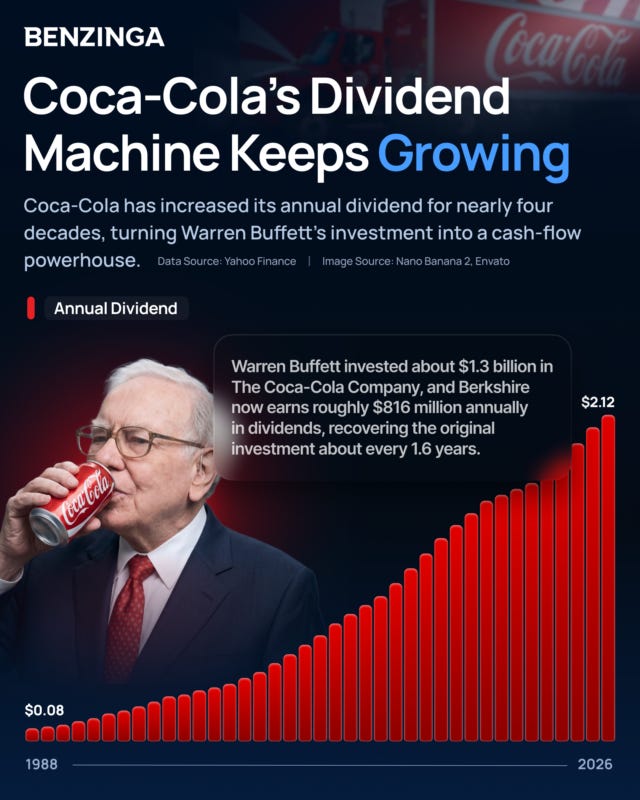
Buffett began buying Coca-Cola (KO) stock in 1988.
He accumulated 400 million shares at a total cost of $1.3 billion.
This gave the Oracle a cost basis of roughly $3.25 per share.
At the time, Coca-Cola offered a standard market yield of approximately 3.0%.
If you bought the stock today, you would get a similar yield.
However, Buffett locked in his low purchase price decades ago.
As of 2026, the beverage giant has increased its dividend for 64 consecutive years.
These continuous hikes have driven Buffett’s yield on cost to over 65% annually.
The KO payouts now generate over $800 million in annual dividends for Buffett’s company.
Moral of the story?
You do not need a high starting yield to build lasting wealth.
Instead, just focus on high-quality companies capable of growing their payout year after year.
These are sound companies that tend to do well even during economic downturns.
Their ability to consistently increase payouts is driven by solid business fundamentals.
Some of these are industry dominance, low costs and high profitability.
And while a 3% starting yield may seem small to most investors…
It’s usually a different story when it comes from a world-class Dividend Grower.
Why?
Because over time…
The steady increase in payouts compounds your wealth significantly.
Let me show you another example from Buffett’s portfolio.
 |
Tech Royalties.
Yahoo Finance published an article with this headline:
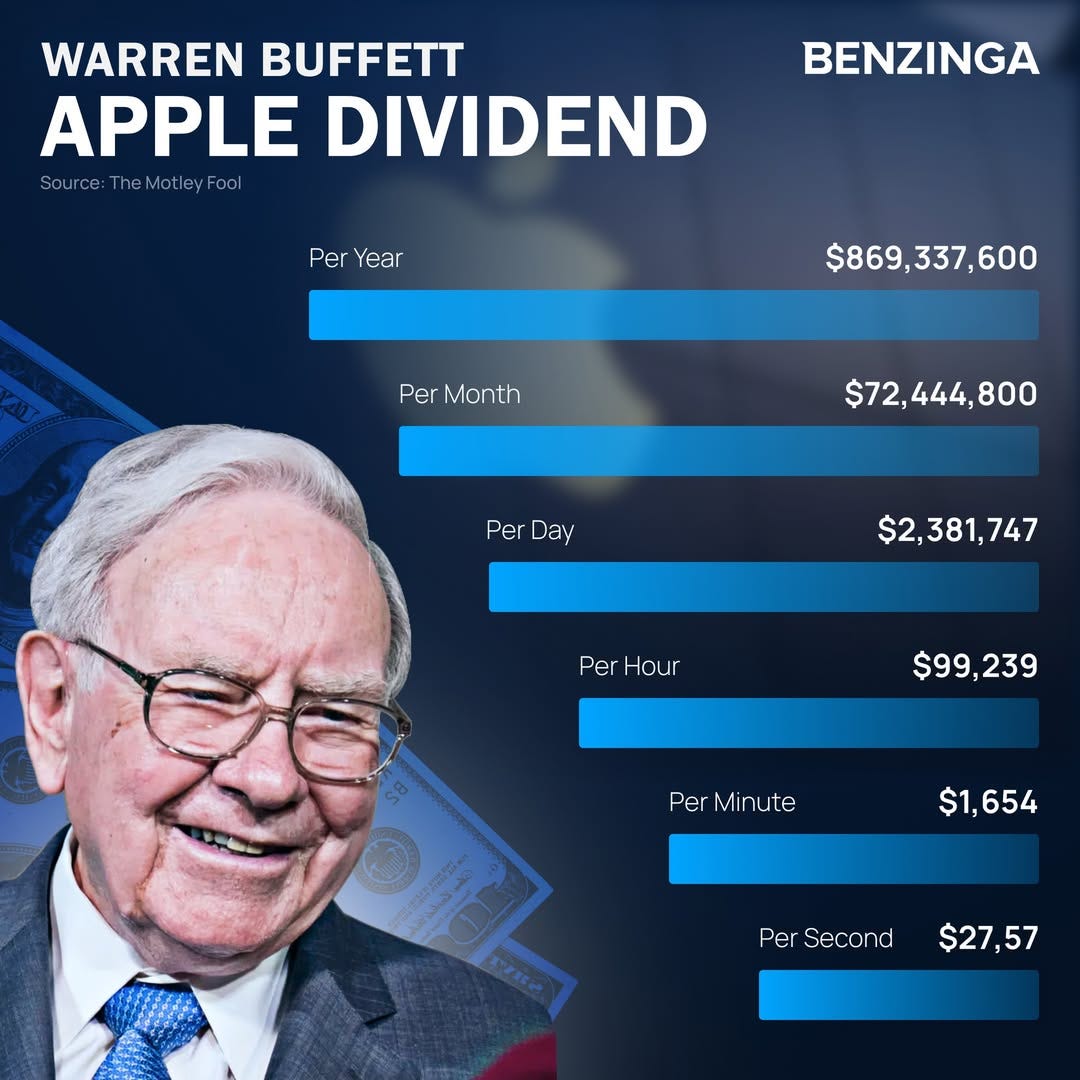
You Won’t Believe How Much Money Berkshire Hathaway Gets From Apple Dividends
Let’s look at the numbers.
Buffett initiated Berkshire’s position in Apple in early 2016.
Since then, Apple has consistently increased its payout, resulting in significant dividend growth.
Now, Apple’s current dividend yield is low.
It is around 0.4%–0.5% at current market prices.
However, the yield on Berkshire’s cost basis is much higher.
Berkshire’s average purchase price is around $36 to $40 (split-adjusted).
Apple’s current annual dividend payout is over $1 per share.
So the yield on cost for Buffett and Berkshire is over 2.5%.
The result?
Despite selling a large portion of the stake…
Berkshire still collected roughly $280 million in dividends from Apple in 2025 alone.
Bottomline:
Apple’s yield may seem unimpressive compared to the broader market.
However, two powerful forces make it a top-tier income generator for Berkshire.
Steady dividend growth paired with astronomical capital appreciation.
In addition, Apple aggressively buys back its own stock.
As such, Berkshire’s stake, and its share of the payout, grows automatically.
As an income investor, you should look for smaller, cash-rich companies on a similar trajectory.
 |
A High-Yield Energy Play.
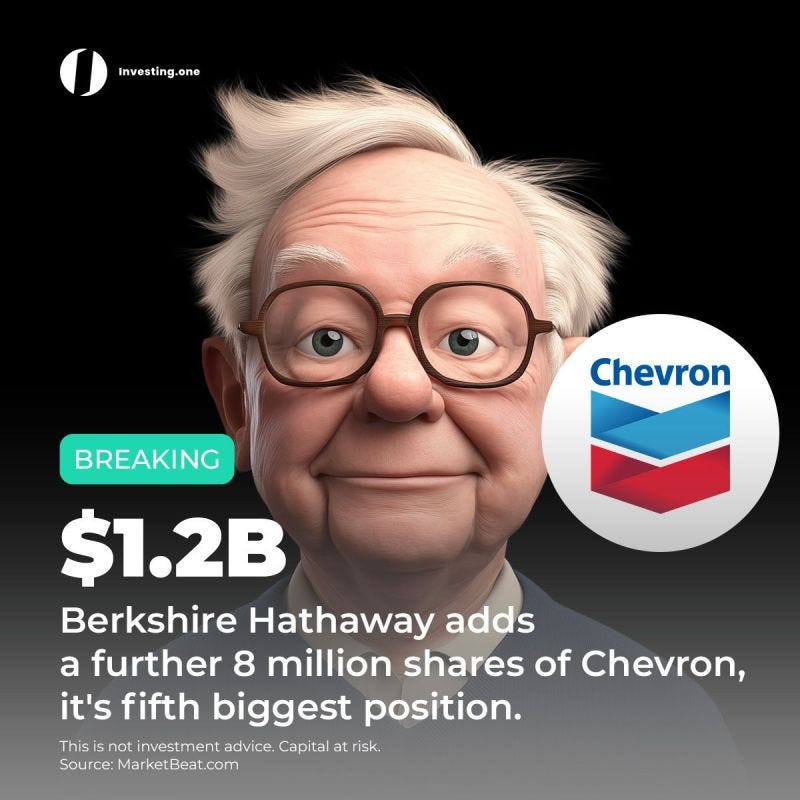
In late 2020, Berkshire began building a major stake in Chevron.
Around this time, the company was navigating the COVID meltdown.
However, its dividend yield was also approaching 8%.
Since then, it has consistently compounded…
Rewarding shareholders with high-yielding income.
In early 2026, the oil and gas giant marked its 36th year of raising dividends.
That’s partly due to two benefits from its acquisition of Hess Corp.
It caused an increase in production and significant cash flow growth.
These factors strengthen the company’s ability to raise dividends.
Further, it continues to maintain a low break-even price of around $50 per barrel.
This allows it to buy back shares aggressively, boosting total value for shareholders.
Over the past five years, Chevron has increased its dividend by 5%–6% per year.
And like Coca-Cola, it remains a key high-yield component of Berkshire’s portfolio.
 |
Now, of course, Coca-Cola, Apple, and Chevron are high-quality stocks.
However, they have drawbacks for income-focused investors.
Coca-Cola has limited growth potential
Apple offers a low dividend yield (often below 0.5%)