
|



The AI notepad for people in back-to-back meetings
 |
Most AI note-takers just transcribe what was said and send you a summary after the call.
Granola is an AI notepad. And that difference matters.
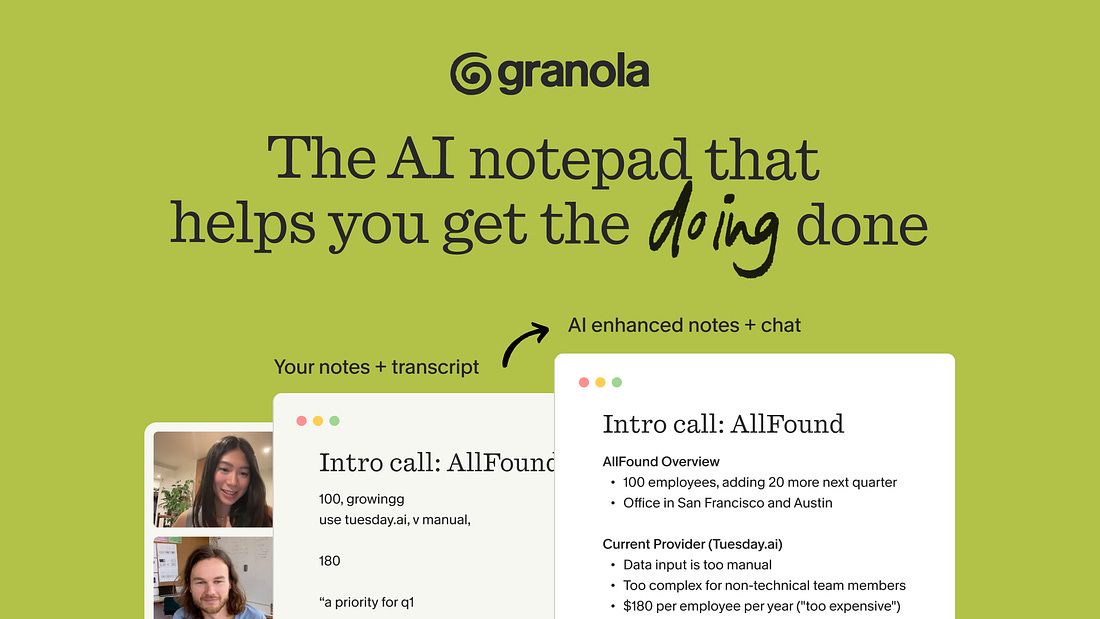
You start with a clean, simple notepad. You jot down what matters to youand, in the background, Granola transcribes the meeting.
When the meeting ends, Granola uses your notes to generate clearer summaries, action items, and next steps, all from your point of view.
Then comes the powerful part: you can chat with your notes. Use Recipes (pre-made prompts) to write follow-up emails, pull out decisions, prep for your next meeting, or turn conversations into real work in seconds.
Think of it as a super-smart notes app that actually understands your meetings.
Free 1 month with the code SCOOP
As artificial intelligence systems become more advanced, database technologies must evolve to handle increasingly demanding workloads. AI applications process petabytes of data, require ultra-fast response times, and depend on reliable infrastructure for real-time intelligence. These growing demands introduce several technical and operational challenges for software engineers.
Managing Massive AI Data Volumes
AI systems continuously generate and process enormous datasets from user interactions, IoT devices, cloud applications, social media platforms, and enterprise systems. Traditional databases often struggle to manage these workloads efficiently.
AI Data Pipeline Diagram
   Data Sources
        |
        v
+----------------+
| Data Ingestion |
+----------------+
        |
        v
+----------------+
| Data Storage   |
+----------------+
        |
        v
+----------------+
| AI Processing  |
+----------------+
        |
        v
+----------------+
| Predictions    |
+----------------+
To solve this problem, organizations increasingly adopt distributed database architectures capable of scaling horizontally across cloud environments. Technologies such as Apache Cassandra, Bigtable, and Snowflake allow AI systems to handle high ingestion rates and massive analytical workloads.
Real-Time AI and Low-Latency Requirements
Modern AI applications depend on real-time decision-making.
Examples include:
Autonomous vehicles
AI-powered fraud detection
Smart healthcare monitoring
Voice assistants
Recommendation engines
These systems require databases capable of delivering low-latency performance. Even a delay of milliseconds can negatively impact user experience or operational safety.
Redis, DynamoDB, and vector databases are commonly used to reduce latency and accelerate AI inference.
Real-Time AI Architecture Diagram
 User Request
       |
       v
+---------------+
|  AI Model API |
+---------------+
       |
       v
+---------------+
| Vector Search |
+---------------+
       |
       v
+---------------+
| AI Response   |
+---------------+
Vector Databases and Generative AI
One of the most important innovations in AI infrastructure is the rise of vector databases.
Traditional databases store exact values such as text, numbers, and records. However, generative AI systems rely on embeddings, which are numerical vector representations of text, images, and other forms of data.
Vector databases are optimized for storing and retrieving embeddings efficiently.
Popular vector databases include:
Pinecone
Weaviate
Milvus
ChromaDB
Qdrant
Vector Embedding Concept Diagram
      "Artificial Intelligence"
                 |
                 v
   [0.21, 0.54, 0.89, 0.12 ... ]
                 |
                 v
        Vector Database
                 |
                 v
      Semantic Search Results
These databases power:
ChatGPT-like assistants
Semantic search engines
AI copilots
Personalized recommendation systems
Retrieval-Augmented Generation (RAG)
Without vector databases, modern large language model applications would struggle to retrieve relevant contextual information efficiently.