Thanks for reading The Briefing, our nightly column where we break down the day’s news. If you like what you see, I encourage you to subscribe to our reporting here.
Greetings!
This was quite the day. OpenAI is jumping up and down about its unhappiness with Apple (it’s doubtful Tim Cook is shaking in his boots). Big telecom threw down the gauntlet to Elon Musk and Amazon (not that they should worry). We get to both news items lower down. But first…the AI trade on Wall Street is booming, as demonstrated by today's public debut of AI chip design upstart Cerebras Systems.
Shares of Cerebras jumped 68% from the IPO price to close at $311.07, valuing the company at about $94 billion. That’s rich for a company projected to lift revenue 57% this year to about $800 million and next year to $3.2 billion, as my colleague Cory Weinberg reported this week. (For details of the investors that won big on the IPO, see here.)
Consider that Nvidia, the dominant AI chipmaker, whose chips remain in extremely short supply, is trading at 15 times forward sales. Its revenue this year is expected to grow 72% to $372 billion, according to S&P Global Market Intelligence, faster than Cerebras. The projections imply the upstart’s growth will accelerate sharply next year. But there’s plenty of risks—in particular, Cerebras is very reliant on OpenAI as a customer.
Of course, this is Cerebras’ first day. Things may well change in a week or a month. Whatever happens to Cerebras, though, investors’ enthusiastic response should send a message to Anthropic and OpenAI: now would be a good time to go public.
OpenAI vs. Apple
Sam Altman is miscast as a tech executive: He should write soap operas for a living. Ten months after Elon Musk’s xAI sued Apple and OpenAI for allegedly colluding to squash competition in AI, OpenAI is now complaining that Apple hasn’t been a good partner!
The good news for OpenAI is that Musk may find it harder to prove collusion between two feuding companies (this OpenAI-Apple suit is separate from the older Musk suit against OpenAI that has been tried in court over the past few weeks). The bad news is that complaining about Apple doesn’t seem likely to enhance OpenAI’s reputation as a reliable business partner.
It won’t be lost on anyone that OpenAI has long had a contentious relationship with Microsoft, its original cloud partner and early investor, with tensions surfacing over various issues. Things came to a head over OpenAI’s deal with Amazon Web Services, prompting an overhaul of their deal. And who could forget the abortive Stargate venture struck between OpenAI, Oracle and SoftBank, which ran into disagreements between the partners over structure and “who would do what”?
Since releasing ChatGPT to the public in 2022, OpenAI has been host to a seemingly never-ending series of dramas. That likely hasn‘t helped OpenAI’s business, seeing as rival Anthropic seems to be rocketing ahead.
Still, the biggest beneficiary of OpenAI’s constant turmoil may be the tech news media. Suddenly, OpenAI’s acquisition of tech video show TBPN makes sense: OpenAI is vertically integrating. It creates drama and then via its media arm benefits from the coverage. Brilliant!
Big Telecom vs. Musk and Amazon
You don’t expect comedy from the big cellular carriers. But today’s announcement that AT&T, Verizon and T-Mobile are teaming up in a new joint venture to “end dead zones” qualifies as comical. Imagine these three bitter rivals trying to convert this “agreement in principle” into a working joint venture?
To be fair, it’s possible the companies have no intention of following through. One interpretation is that they simply want to present a united front against possible competition from either Amazon or Elon Musk’s SpaceX.
The carriers have some reason to be worried. The cellular market in the U.S. is saturated. The costs of maintaining networks are substantial. The real value of cellular communication lies with internet applications—those operated by Meta Platforms or Google. The carriers are essentially dumb pipes, which their generally dismal stock performance lately reflects. Ceding any part of the mobile market to satellite firms would only make things worse.
But it’s unclear how much of the market either SpaceX or Amazon wants, beyond offering a niche satellite-delivered offering to give consumers connectivity in national parks. SpaceX’s $19.6 billion purchase of cellular spectrum from EchoStar last year suggested Musk is keeping his options open while still seeking to partner with existing carriers.
Amazon CEO Andy Jassy, however, made comments late last month that suggested he might be more ambitious. On a call with analysts after the last earnings report, he explained the company’s planned purchase of satellite firm Globalstar partly by pointing to the “very large demand” Amazon sees from consumers for a direct-to-device satellite phone service.
“Increasingly, what we’re finding with consumers and enterprise and governments is that they don’t like to have any periods where they don’t have connectivity.…Even in metropolitan areas, we all hit certain parts of the highway or certain roads where you can’t get connectivity,” Jassy said.
You can just imagine Amazon launching a cellular service bundled with Prime, possibly in partnership with an existing carrier.
Whatever the case, the carriers’ announcement today drew an amused response from SpaceX president Gwynne Shotwell. She posted on X, “I guess Starlink Mobile is doing something right! It’s David and Goliath…all over again—I’m bettin’ on David.”
In Other News
• Chinese Premier Li Qiang met with more than a dozen American executives on Thursday in Beijing, telling tech and corporate leaders that the U.S. and China “can and should continue to be friends, partners” (more here).
• U.S. Treasury Secretary Scott Bessent said in an interview with CNBC that the U.S. and China will discuss “AI guardrails” during President Donald Trump’s state visit to China this week.
• A key piece of crypto legislation passed the Senate Banking Committee on Thursday, moving one step closer to becoming law and handing a win to the crypto industry in a political battle against the banking lobby.
• The Commerce Department has cleared Nvidia’s sales of its H200 chips to around 10 Chinese companies including Alibaba, Tencent, ByteDance and JD.com, Reuters reported. Despite the relaxation, Nvidia hasn’t yet made a single delivery of the chips to those firms, Reuters said. That’s because Beijing has put its own restrictions on Chinese companies’ purchases of H200 chips.
• Figma stock rose more than 8% in after hours trading as the design-software firm reported revenue for the March quarter rose 46% to $333 million, higher than the 40% jump in the previous quarter and the 38% increase in the period before that.
• Joshua Kushner’s investment firm Thrive Capital has bought roughly $100 million in Shopify shares, Bloomberg reported Thursday, framing the move as a bet on how AI will lead to gains in e-commerce.
Today on The Information’s TITV
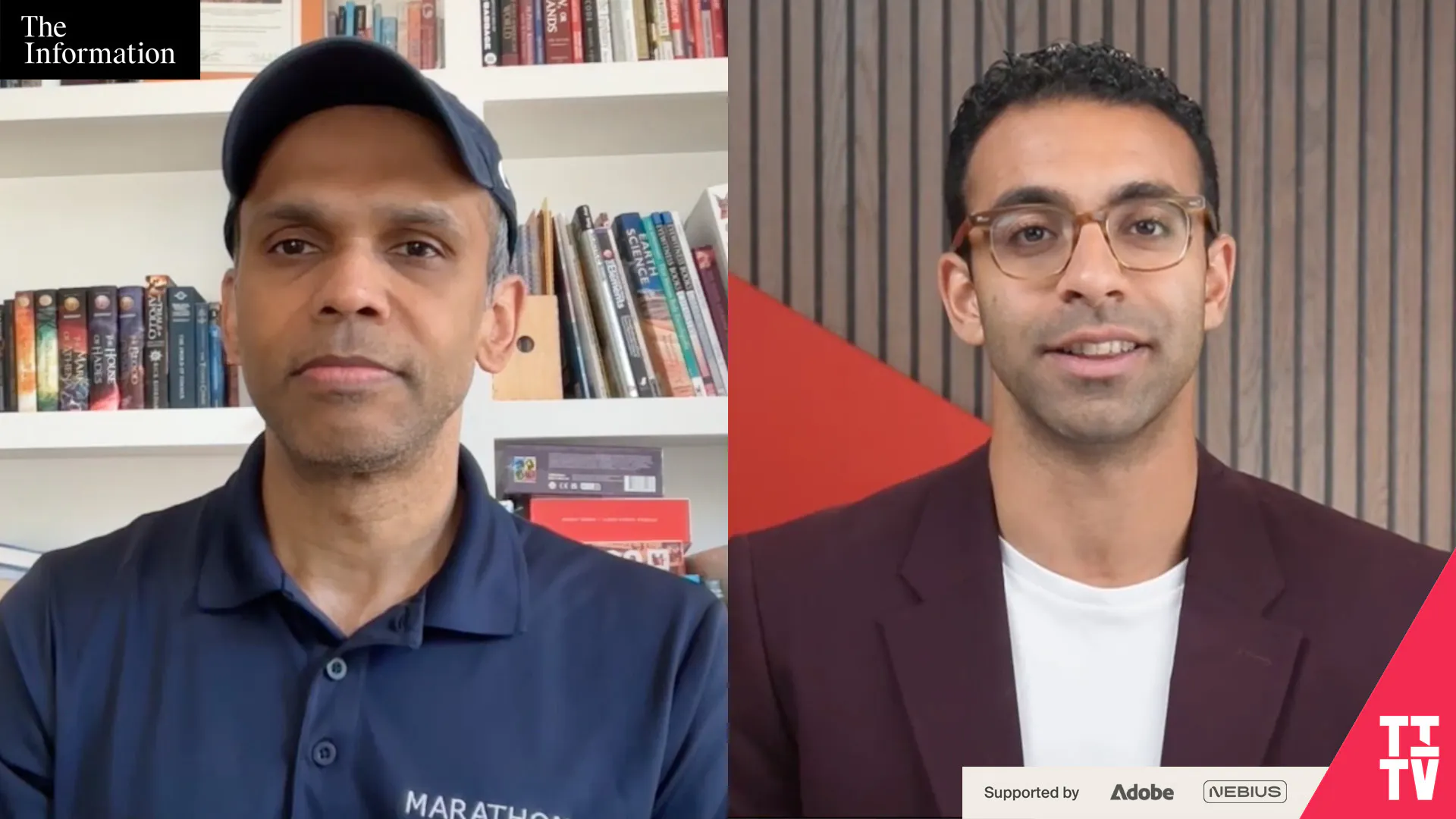
Check out today’s episode of TITV in which we speak with a Coinbase and Pinterest board member about the crypto bill moving through Congress and the state of AI chatbot advertising.
Recommended Newsletter
Start your day with Applied AI, the newsletter from The Information that uncovers how leading businesses are leveraging AI to automate tasks across the board. Subscribe now for free to get it delivered straight to your inbox twice a week.
Join The Information's Ken Brown and Anissa Gardizy as they discuss the global AI compute shortage with OpenAI’s Sachin Katti, Amp founder Anj Midha, and SemiAnalysis analyst Jeremie Eliahou Ontiveros.