
|



The AI notepad for people in back-to-back meetings
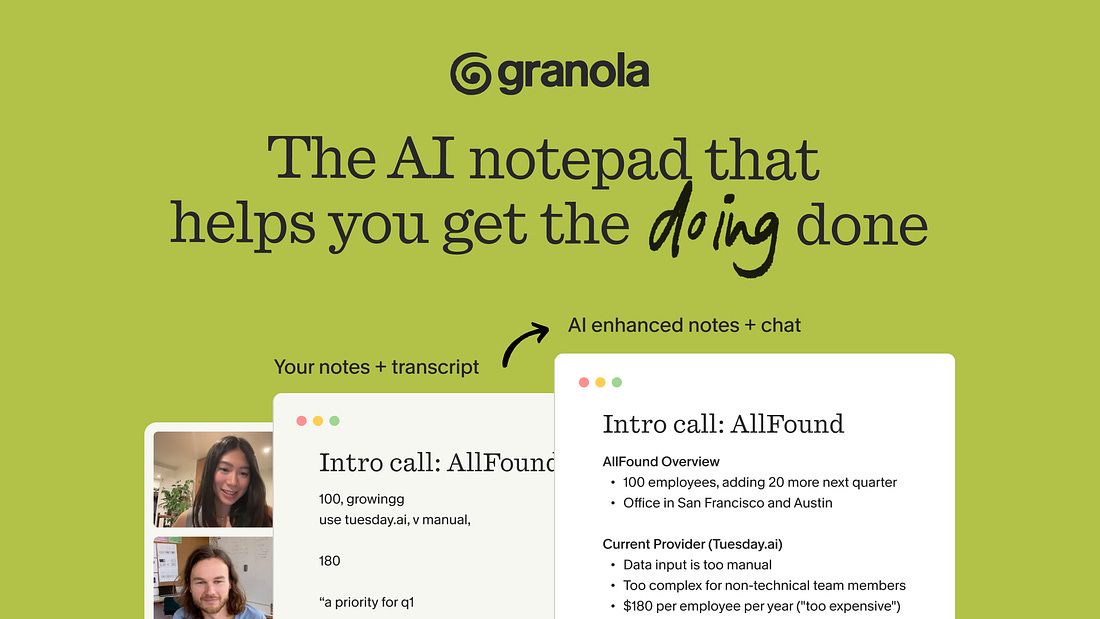 |
Most AI note-takers just transcribe what was said and send you a summary after the call.
Granola is an AI notepad. And that difference matters.
You start with a clean, simple notepad. You jot down what matters to you and, in the background, Granola transcribes the meeting.
When the meeting ends, Granola uses your notes to generate clearer summaries, action items, and next steps, all from your point of view.
Then comes the powerful part: you can chat with your notes. Use Recipes (pre-made prompts) to write follow-up emails, pull out decisions, prep for your next meeting, or turn conversations into real work in seconds.
Think of it as a super-smart notes app that actually understands your meetings.
Free 1 month with the code SCOOP
Artificial Intelligence (AI) is transforming modern software engineering by enabling applications to learn from data, automate decision-making, and deliver intelligent user experiences. From recommendation systems and autonomous vehicles to generative AI tools and predictive analytics platforms, AI applications rely heavily on efficient data management. At the core of every successful AI system lies one critical component: the database architecture.
In AI-powered software engineering, choosing the right database is far more than a storage decision. Databases directly affect model training speed, real-time inference performance, scalability, reliability, and the overall intelligence of the application. AI systems process enormous volumes of structured, semi-structured, and unstructured data, including text, images, sensor readings, vectors, and user interactions. Because of this complexity, developers often use multiple specialized databases to support different AI workloads.
As AI adoption accelerates, software engineers must understand how database technologies align with machine learning pipelines, real-time analytics, big data systems, and intelligent applications. Choosing the wrong database can slow model training, increase infrastructure costs, reduce scalability, and negatively impact user experience.
Why Database Selection Matters
Database selection is one of the most important architectural decisions in software development because databases form the foundation of nearly every application. The database determines how efficiently data can be stored, queried, updated, and secured.
When developers choose a database that aligns with the application’s requirements, the system becomes more responsive, scalable, and maintainable. However, using the wrong database can create severe limitations that are difficult and expensive to fix later.
For example, an AI-powered fraud detection platform requires strict consistency and real-time analytics to identify suspicious transactions instantly. A relational database like PostgreSQL may manage transactional records, while Apache Cassandra processes high-volume streaming data. In contrast, a generative AI recommendation engine may prioritize scalability and vector search performance, making NoSQL and vector databases such as MongoDB, Pinecone, or Weaviate more suitable.
Database selection also affects:
Application performance
Scalability and availability
Development speed
Operational cost
Security and compliance
Disaster recovery capabilities
Future maintainability
As organizations increasingly rely on cloud computing, artificial intelligence, IoT, and big data analytics, database decisions have become even more significant in software engineering.
Different Database Types
1. Relational Databases (SQL)
Relational databases are among the oldest and most widely used database systems in software engineering. They organize data into structured tables with rows and columns and use Structured Query Language (SQL) for managing and querying data.
Popular relational databases include:
PostgreSQL
MySQL
Oracle Database
Microsoft SQL Server
Key Characteristics
Relational databases are known for:
Structured schemas
ACID compliance
Strong consistency
Complex query support
Referential integrity
Relational Database Structure Diagram
+----------------+
|    Customers   |
+----------------+
| Customer_ID PK |
| Name           |
| Email          |
+----------------+
         |
         | One-to-Many Relationship
         |
+----------------+
|     Orders     |
+----------------+
| Order_ID PK    |
| Customer_ID FK |
| Total_Amount   |
+----------------+
AI Use Cases
Relational databases are best suited for:
AI-powered financial systems