President Trump and the first lady are uninjured after a shooting incident at the White House Correspondents' Dinner yesterday in Washington, D.C. The U.S. Secret Service has taken a suspect into custody, according to their statement. The president said during remarks from the White House that a Secret Service agent is "doing great" after a bullet struck their bulletproof vest. The shooting happened at a security screening area inside the venue near the entrance to the main ballroom, where the dinner was taking place, the Secret Service said. Trump has posted photos of the assailant, which show the man shirtless with his eyes closed and lying face down on a carpet. Acting Attorney General Todd Blanche said that charges would be filed against the suspect soon. Here’s what else we know at this time:
Nathan Howard/Getty Images
➡️ The suspect, who was armed with a shotgun, a handgun and multiple knives, was believed to be a guest of the hotel, law enforcement said.
➡️ The man is being charged with using a firearm during a crime of violence and assault on a federal officer using a dangerous weapon, with more charges likely, according to Jeanine Pirro, the U.S. Attorney for the District of Columbia.
➡️ The suspect is currently at a local hospital being evaluated. He was not struck by gunfire, according to law enforcement.
‘A disease of moments’
by Marc Silver, Global Health and Development digital editor
When my wife, Marsha, was diagnosed with dementia, I couldn’t have imagined I would want to write about it.
In the past, I have brought personal experiences into my writing. My book Breast Cancer Husband was inspired by my wife’s cancer diagnosis (and my initial inept response).
Dementia is different — so painful and private and so hopeless. There’s an ongoing decline euphemistically referred to as “disease progression.”
Then in 2023 I faced a dilemma that made me think about a personal essay. My wife had moved to a group home that offers memory care (another euphemism). I visited just about every day. I also wanted to visit my grandchildren in Utah.
Maria Fabrizio for NPR
Would it be okay to be away for nearly a week? Would Marsha even be aware that I was absent for multiple days? It was a decision I wrestled with. And that I couldn’t discuss with my wife. But when my grandson asked if I would come to his house, I knew I should go. I thought: Marsha would agree.
I wanted to write about that situation. But I couldn’t ask Marsha for her approval. She had lost most of her words. Our two daughters and I conferred and thought that if Marsha was okay with my writing Breast Cancer Husband, she’d probably be okay with this essay.
NPR published the story. Writing it was therapeutic. It helped me sort through all the issues and, in the end, feel that I did the right thing. As our amazing nurse practitioner advises: “Dementia has taken away her life, don’t let it take away yours.”
Sharing my family’s experience resonated with readers who are also facing unimaginable questions as they cope with a relative’s dementia. It is a disease that lives in the shadows. And it’s hard to find time to meet with a support group to figure out what to do. I hope, in some small way, that my essay has helped others.
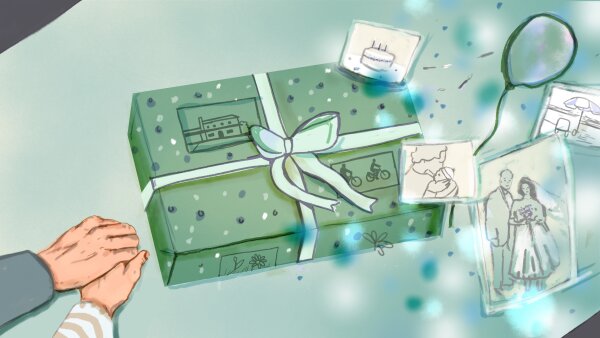
And now I’ve published a storyinspired by a sweater in a store window. My wife’s birthday was imminent. I knew she would not be aware. We celebrate with cake and the “happy birthday” song. But I knew that I had a pass when it comes to gifts. Then … I saw that chic sweater. It was so Marsha. Even though she really didn’t need a new sweater (and I have a terrible track record for sizing clothing), I decided, Why not?
When our daughters and I gave her the sweater, she gave us a beautiful smile. It was a reminder that dementia is, as our nurse practitioner says, a disease of moments. There are moments that are sorrowful, depressing and stressful. This moment made us feel as if we were doing what we always do as a family — enjoying an intimate and lovely birthday get-together. And that was the best birthday gift of all.
Check out more great reads from the NPR network you may have missed:
➡️ For Mariam Allawiya and Kafa Wehbe, the wreckage of southern Lebanon is more than a headline — it has become a recurring chapter in two lives defined by Israeli invasions. The displaced grandmothers are currently living in a vacant building in central Beirut with 35 of their relatives. It's not how they expected to grow old. Allawiya says her experience makes herwary of the temporary ceasefire President Trump announced between Israel and Lebanon earlier this month.
➡️ After two decades at Thomson Reuters, Billie Little paid a price for challenging her company’s multi-million dollar Immigration and Customs Enforcement contracts: her career. As masked ICE agents mobilized throughout Minneapolis earlier this year and the U.S. reeled from the deaths of Renée Macklin Good and Alex Pretti at the hands of federal agents, Little and other colleagues grew alarmed that ICE agents could be abusing Thomson Reuters' investigative tools. Little was part of a committee of employees who sent a letter to company management in February, flagging that ICE might be using the company's products unlawfully. They requested more transparency about the company's oversight of its contracts with the Department of Homeland Security and ICE. Shortly after this effort became public, Thomson Reuters fired Little. Now, she is suing the company, arguing that her dismissal violated a law in her home state of Oregon that prohibits employers from firing whistleblowers.
➡️ Social media is inspiring Americans to relocate to Vietnam and Thailand. TikTok videos showcase attractive destinations and a quality of life that feels unattainable in the U.S. The viral videos highlight the ability to live a more luxurious life for a fraction of Western prices. While these expat content creators frame their moves to Southeast Asia as a path to financial freedom, their videos don't tell the full story: Making a living locally is challenging.
➡️ The Department of Homeland Security has initiated deportation proceedings for a woman whose loved one died in the Baltimore Key Bridge collapse. NPR's Ximena Bustillo broke this story, heard on Morning Edition on Friday. The deaths of six workers put a spotlight on the U.S. construction industry's reliance on immigrant and unauthorized labor. After the tragedy, the Biden administration sought to provide immigration protections for about 30 people with immediate connections to the victims. Under Trump, those protections are being undone. Federal authorities have moved to deport Zeila Guerra Sandoval, the friend of José Mynor López, who was the last Key Bridge victim recovered. She and López never married, but maintained a close friendship as they coparented their daughter, who is a U.S. citizen. Sandoval's case is a stark example of how immigration policy can drastically change with each administration, transforming immigrants' lives.
Newsletter continues after sponsor message
Pod Club
Illustration from "The Story of Evangelina Cisneros" by Frederic Remington, Thomas Fleming, and Others
Thanks for tuning in last week toThe Indicator from Planet Money episode "Can you really do what you love?" The hosts spoke with a tech investor about what he believes you need to make passions pay. Listener Brian Morgan said he agrees that “finding a field of work that you can truly love is complicated.” Morgan said a key factor to loving a job is the people you work with and serve. Listener Cheri Najor said, “What I loved about the podcast is that it gave realistic hope for anyone who drags themselves to work every Monday.”
Today, we're listening to an episode of Throughlinethat's all about “clickbait.” The term isn’t meant as a compliment. But if newspaper tycoon William Randolph Hearst were living today, it’s more than likely he’d approve. You could even call him "the original clickbait king." At a time when most papers merely reported events as they happened, Hearst knew readers found it hard to resist a spicy story. His papers sent reporters out to perform daring rescues, solve sensational murders and even meddle in geopolitics. This episode dives into Hearst's impact on journalism. Listen to the episode or read the transcript.
Love podcasts? For handpicked episode recommendations every week, check out Pod Club — a newsletter written FOR podcast fans BY podcast fans. Subscribe here!
And, on this week's episode of The Sunday Story from Up First, reporter Laurie Stern explores a category of special education for children who struggle with what's known at the federal level as "emotional disturbance." These children have trouble regulating their emotions and are often placed in separate schools or classrooms. Stern followed one student for nearly two years and shares how this disability label has impacted his educational experience.
Blank to blank
NPR
It's time for the Sunday Puzzle! For this week’s on-air challenge, every answer is a familiar three-word phrase. The first and last words of the phrase are the same, and the middle word is "to." For example, if you are provided the phrase “Like a lease that has no expiration date,” the answer would be “Month to Month.” Test your skills here. Check the page later to hear the answers, or catch them live on Weekend Edition at 8:41 a.m. ET.
This week's online challenge comes from Gordon Legge, of South Minneapolis, Minn. Name an animal whose first five letters in order spell a religious figure. And if you change the animal's next-to-last letter, its last five letters in order will spell another religious figure. What animal is this? Submit your answer here, and you could win a chance to play next Sunday's on-air puzzle.
You received this message because you're subscribed to Up First emails. This email was sent by National Public Radio, Inc., 1111 North Capitol Street NE, Washington, DC 20002