Thanks for reading The Briefing, our nightly column where we break down the day’s news. If you like what you see, I encourage you to subscribe to our reporting here.
Greetings!
We’re in a tech layoff era again—although a more accurate term may be an “employee replacement” phase. Meta Platforms told staff on Thursday it plans to lay off 10% of its staff, or about 8,000 people, next month. (The next few weeks won’t be fun at Meta!) The latest layoffs follow Meta’s cuts of about 2,000 people earlier this year and a spate of such cuts elsewhere at Snap, Amazon and Microsoft.
Most companies herald these moves as a sign of cost discipline—something Wall Street wants to hear—but if history is any guide, they’re not necessarily cutting their overall numbers much. This time might be different, thanks to AI, but in the past big layoffs have been an exercise in switching out people for more specialized talent—who are quite possibly more expensive than those they’re letting go.
That’s evident over the history of the past four years. Take Google: Its workforce at the end of last year was 190,820, higher than at any point in its history, despite the layoffs of 15,000 people in 2023-24. After cutting its workforce to 179,582 by mid-2024 from 190,711 in early 2023, new hirings simply replaced the people who left. (See more here.)
Something similar can be seen at other companies. Meta slashed its workforce from above 87,000 in the fall of 2022 to as low as 66,185 in the fall of 2023 but hirings lifted it back to 78,865 in December. Today’s news and earlier cuts this year suggests that number will shrink closer to 68,000 in the near term. But Meta has forecast 40% higher expenses this year, due partly to employee compensation—including “2026 hires to support our priority areas, particularly AI.” In other words, Meta may not get much of a cost-cutting benefit from all these layoffs, at least in the short term.
Longer term, it may be a different story, particularly assuming companies replace humans with AI tools. But that won’t necessarily reduce expenses overall, as AI is expensive to run.
Broadcom Makes the Big Kids’ Table
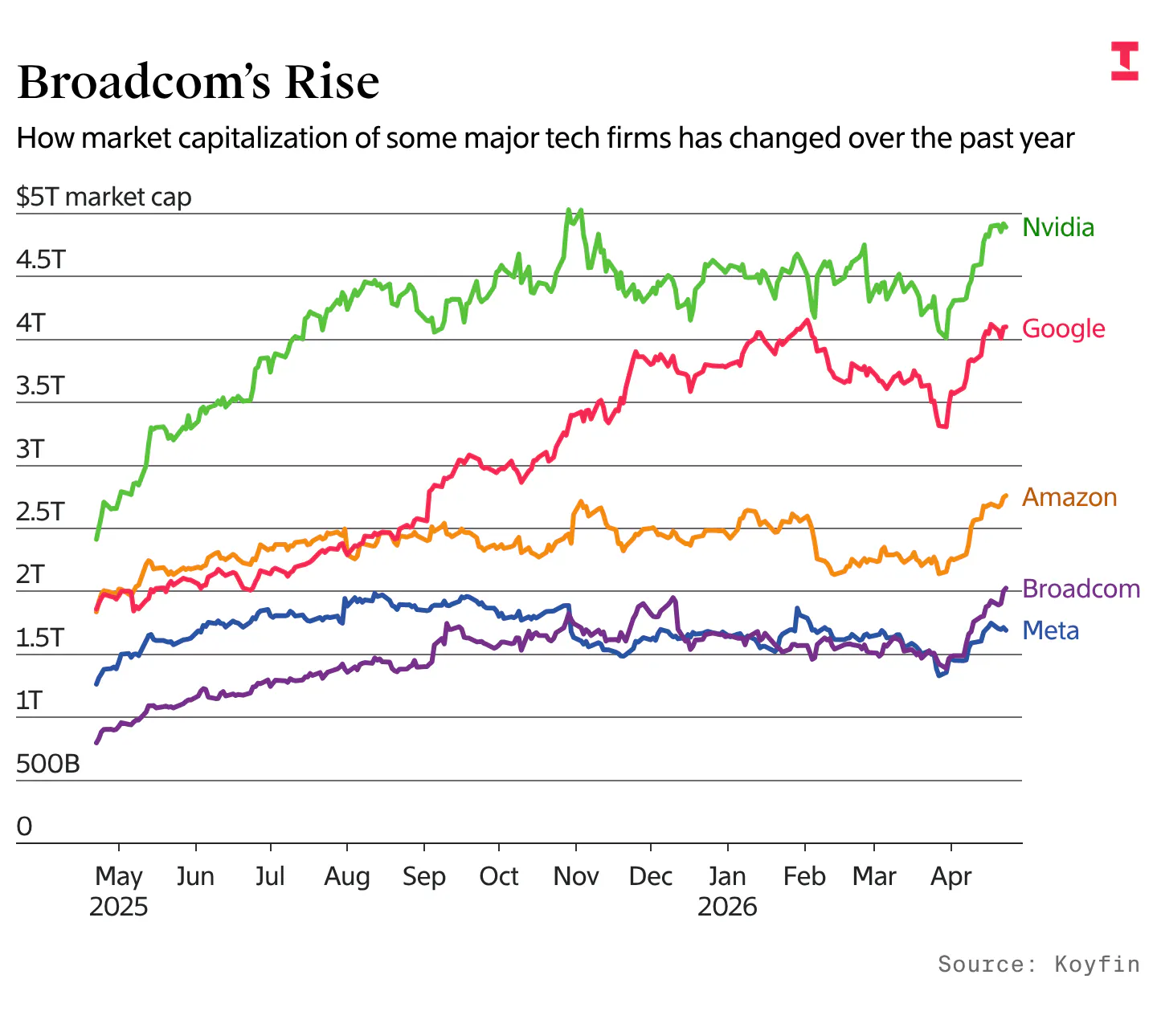
We’re having to rethink our definition of Big Tech. Broadcom on Wednesday closed trading with a market capitalization of $2 trillion, putting it squarely in the top ranks of big tech, although a market selloff on Thursday pushed it just below that level by the close of trading.
Even so, Broadcom in recent weeks has passed Meta Platforms, which is worth about $1.7 trillion, and isn’t that far away from Amazon which in recent weeks has rallied to about $2.7 trillion in value from as low as $2.1 trillion in late March, Koyfin data shows. Broadcom shares are up 21% so far this year, outperforming all other big tech names by a long way, reflecting the rapid growth of its AI chip business. Broadcom’s AI chip customers, incidentally, include other big tech companies, including Google and Meta.
To be sure, Nvidia outranks everyone, more now than ever. In recent days, as its stock price has traded around the $200 level, Nvidia’s market cap has hovered close to $5 trillion. Alphabet, worth about $4.1 trillion, is next.
Grok’s Outage
What’s up with Elon Musk’s Grok? The AI chatbot seemed to be down for an extended period today, at least in New York. (A colleague in Texas got a response.) More amusingly, I was told to “sign up for free to get higher priority access.” This is the core of xAI, let’s not forget, which SpaceX paid $250 billion to buy just a few weeks ago. Will any SpaceX shareholders question what they got for their money?
In Other News
• Tesla is acquiring an unnamed AI hardware company for up to $2 billion, the company disclosed in a securities filing on Thursday.
• Nvidia has not yet sold any H200 chips to China, despite the Trump administration’s approvals months ago for the powerful chips to be exported to the country, Commerce Department Secretary Howard Lutnick said on Wednesday at a Senate hearing, according to Reuters.
• Netflix said its board had authorized a new $25 billion stock buyback program. The new program follows a 13% slide in Netflix’s stock price since its first quarter earnings disappointed investors a week ago.
• OpenAI on Thursday released its latest flagship model, GPT-5.5, according to a blog post. That model, codenamed Spud internally, is better at breaking down complicated requests from customers and showed improvement in coding, financial modeling and scientific research, compared to prior models from the ChatGPT maker.
• Shareholders in Warner Bros. Discovery approved sale of the company to the Ellison family’s Paramount Skydance, the latest step towards completion of the $110 billion purchase.
Today on The Information’s TITV
Check out today's episode of TITV in which we analyze Tesla‘s results, SpaceX’s cursor deal and if a Tesla-SpaceX merger would make sense.
Recommended Newsletter
Start your day with Applied AI, the newsletter from The Information that uncovers how leading businesses are leveraging AI to automate tasks across the board. Subscribe now for free to get it delivered straight to your inbox twice a week.
The Information returns to the New York Stock Exchange on Monday, April 27 to hear from top executives and investors on how the rapid buildout of AI is reshaping tech, finance, and capital markets.
The Information and Aily Labs are convening an intimate group of pharma, CPG, and retail executives in Los Angeles to address the next phase of enterprise intelligence. Request an invite.
Save the date for The Information’s annual AI Agenda Live in San Francisco, where top AI researchers, founders, investors and executives come together for a day of conversations about the breakthroughs and applications shaping the future of AI.
Save the Date: The Information returns to Napa Valley October 27-28 to convene senior women across tech, media, and finance. The event will feature two days of intimate, candid conversations with the leaders navigating today’s global shifts.