|
Dear all,
Please find below your weekly update from the UK Health Security Agency (UKHSA).
If you have any questions please get in touch by emailing externalaffairs@ukhsa.gov.uk
As always, you can also follow UKHSA on X, on Instagram, on BlueSky, and on LinkedIn for all the latest updates. You can also find the latest news from UKHSA on our news page on GOV.UK.
Best wishes,
UKHSA External Affairs Team
New and updated stories
- RSV maternal vaccine cuts baby hospital admissions by up to 85%
- Antibiotics and MenB vaccination to be offered to young people in areas of Dorset
- Abstract submissions close 28 April — don't miss your chance to present at UKHSA Conference 2026
-
Latest measles case data
Ongoing issues
- Measles resources for stakeholders
- Get protected this spring with a COVID-19 vaccination
- Translated versions of the childhood immunisations postcard now available to download
- RSV vaccine: all adults aged 75 and over now eligible
- Tick awareness campaign toolkit 2026
UKHSA communications toolkits
- Information on how to access the range of communication toolkits we produce for stakeholders
UKHSA data, analytics and surveillance:
- Statistics at UKHSA
- UKHSA data dashboard
- Notification of Infectious Diseases report
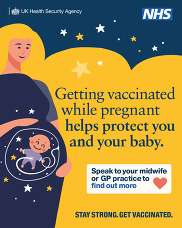
A new UKHSA study, Maternal RSV vaccination and reduced risk of hospitalisation for babies in England 2024/25, clearly shows the maternal respiratory syncytial virus (RSV) vaccination programme is providing over 80% protection for newborn infants, including those born prematurely. The study found vaccination at least 2 weeks before the birth gave 81.3% protection. A narrow range of statistical uncertainty, 78.9% to 83.4%, means there is high confidence in the protective effect of the vaccine.
The study, which was presented on 18 April at the European Society of Clinical Microbiology and Infectious Diseases (ESCMID) global conference, also found that premature babies, who are particularly vulnerable to RSV, can be well protected, provided there is at least 2 weeks between vaccination and birth.
Maternal RSV vaccine uptake in England continues to climb, reaching 55% during the study period and the latest data showing uptake rising to 64.1% for women who gave birth in November 2025.
A reminder that we have materials to help you communicate the benefits of the maternal vaccine programme, including the RSV vaccine, on the Campaign Resource Centre.
|
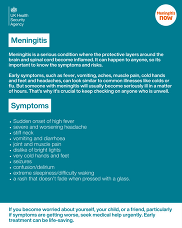
UKHSA is working with Dorset Council, NHS and local partners to support the roll out of antibiotics and vaccination to young people in Weymouth, Dorset after three cases of MenB were confirmed in the area.
We have various resources available including information on the public health measures in Dorset, the signs and symptoms of meningitis, and FAQs for educational and early years settings.
Further information:
If you have any questions please email externalaffairs@ukhsa.gov.uk
|

There's still time left to submit your abstract for this year's UKHSA Conference, taking place on Tuesday 22 and Wednesday 23 September at Manchester Central. The theme is 'Securing health together: Partnership, prevention, preparedness'.
We're inviting submissions of original research, evaluations and quality studies for consideration as oral or ePoster presentations. Exceptional abstracts may also be selected for the main parallel programme, featuring in discussion sessions or masterclasses.
New for 2026, we're also introducing a Featured Presentations Track: a dedicated space in the conference exhibition hall, developed in response to previous feedback, which will run alongside the main programme. This new track means more presenting opportunities than in previous years, whether your work covers emerging findings, innovative approaches, or insights from frontline practice.
We welcome submissions our stakeholders, including partners across academia, industry, local and national government, the NHS, and the wider public health community.
The submission deadline is next week, Tuesday 28 April. Visit the conference website to review topics, themes and submission guidelines, and to submit online.
|
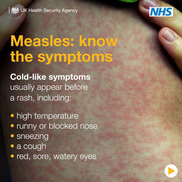
The latest measles case data* shows that activity has increased since January 2026, mostly driven by outbreaks in North London and Birmingham.
Between 1 January 2026 and 13 April 2026, there have been 407 laboratory confirmed measles cases reported in England, an increase of 36 cases since the last report on 10 April 2026. Measles activity has increased since January 2026, mostly driven by an outbreak in North London and Birmingham.
Measles is a nasty illness for any child, but for some it can lead to serious long term complications and tragically death, but is so easily preventable through vaccination.
Having two doses of the measles, mumps, rubella and varicella (MMRV) vaccine gives children the vital protection they need against this highly contagious disease. It also helps protect more vulnerable children around them who are too young or unable to have the vaccine due a weakened immune system.
Older children and adults who missed out on their vaccine when they were younger can catch up at any age with the measles, mumps and rubella (MMR) vaccine.
*Measles case data is being published weekly during this period of increased activity. Thereafter we will return to fortnightly or monthly reporting. Our measles dashboard is also updated weekly.
|
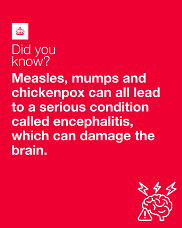
We have a series of resources available to help stakeholders communicate on measles and the vaccines that can prevent it:
- We have a measles communications toolkit on our Google Drive to help support colleagues who are managing outbreaks in their communities. This has been updated this week with further social media assets to help raise awareness of measles, its signs and symptoms, and the MMRV/MMR vaccine. These can be found on p13-14 of the toolkit.
- UKHSA and NHSE stakeholder communications toolkit on the Campaign Resource Centre (CRC): resources to help communicate the MMRV vaccine
|
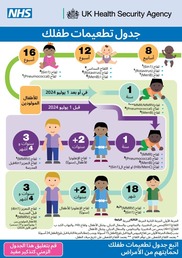
The childhood immunisations postcard has been translated into 31 languages. These are available to download from the Campaign Resource Centre. Physical copies of the postcards will be available to order from the Find public health resources website in due course.
Available languages include Arabic, Bengali, Bulgarian, Chinese (simplified), Chinese (traditional), Dari, Estonian, Farsi, French, Greek, Gujarati, Hindi, Italian, Lithuanian, Pashto, Polish, Portuguese, Punjabi, Romanian, Russian, Urdu and Yiddish.
A reminder other childhood immunisations communications resources including social media assets, posters, digital screens and email signatures can also be downloaded from the Campaign Resource Centre.
|
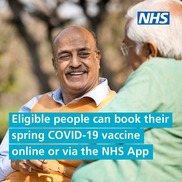
Vaccinations for the COVID-19 spring vaccination programme started this week.
The vaccine is offered to those in the population most vulnerable to serious outcomes from COVID-19 and who are therefore most likely to benefit from vaccination:
- adults aged 75 and over
- residents in care homes for older people
- individuals aged 6 months and over who are immunosuppressed
There are a range of resources to support your communications promoting the spring offer:
The COVID-19 spring vaccination programme will run until 30 June, with the last day to book appointments being 29 June.
More information: nhs.uk/book-covid
|
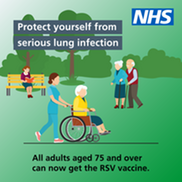
Respiratory syncytial virus (RSV) is a major cause of lung infections like bronchitis and pneumonia.
As of 1 April 2026, the RSV vaccine is available for free on the NHS to all*:
• Adults who are aged 75 or over
• Adults who are living in a care home for older adults
UKHSA and NHS England have a range of resources available to support partners in raising awareness of the expanded vaccine offer. This stakeholder toolkit, posters, digital screens, web banners and social media assets which can all be found on the Campaign Resource Centre. More posters and leaflets can be found on the Find Public Health Resources website.
* The vaccine is also offered on the NHS to pregnant women (28 weeks+ pregnant) and recommended during every pregnancy to help protect newborn babies.
|
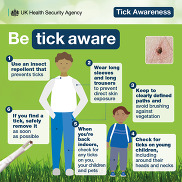
The UK Health Security Agency (UKHSA) has launched its annual tick awareness campaign. The campaign runs throughout the spring and summer months when ticks are most active and more of us spend time outdoors.
The campaign aims to increase awareness of where ticks are found and how to remove them safely and quickly, as some tick bites can result in infections such as Lyme disease.
To support stakeholders promote tick awareness this year, UKHSA has updated their campaign communications toolkit. It contains background information, key messages of the campaign, key behaviours for the public to follow, social media assets, suggested social media copy and links to useful information.
If you have any questions about the campaign or toolkit, please get in touch with externalaffairs@ukhsa.gov.uk.
|
The UKHSA External Affairs Team prepares a range of communications toolkits to support stakeholders to communicate health security messaging to your networks.
Our live toolkits cover a range of issues including outbreak response, vaccination programmes, and resources to help mitigate against the health impacts of adverse weather.
These can all be found on our Google Drive. Our vaccine communications toolkits are also available on the Campaign Resource Centre. If you are experiencing any issues accessing the Drive or the CRC, or have any questions on the toolkits please email externalaffairs@ukhsa.gov.uk.
UKHSA collects and publishes statistics, data and analysis related to planning, preventing and res |