College applications down? Blame it on the rain. A new study found that the weather on the day students tour a college actually affects whether or not they apply to that university. As we’ve charted, when the weather is fine, applications are divine, but when the temperature slumps, applications go in the dumps.
Stocks fell and oil rallied as US-Iran tensions escalated over the weekend. Monday, President Trump said that the Strait of Hormuz will remain closed until a deal with Iran is signed, saying the chances that a ceasefire will be extended are “highly unlikely.” The S&P 500 broke its five-session winning streak and the Nasdaq 100 broke its 13-session winning streak, while the Russell 2000 gained.
Just after the markets closed on Monday, a bombshell from Apple fell, announcing that Tim Cook will be replaced by John Ternus as the company’s CEO on September 1. Cook will step into the role of executive chairman of the board at that time.
|
|
|
The so-called millennial lifestyle subsidy — an era when (then) young people enjoyed cheap products and services thanks to deep-pocketed venture capitalists — came to a close at the start of the decade. Tech-adjacent services like Uber and Lyft, once priced below their true cost, became noticeably more expensive as the companies graduated from chasing customers to chasing profits.
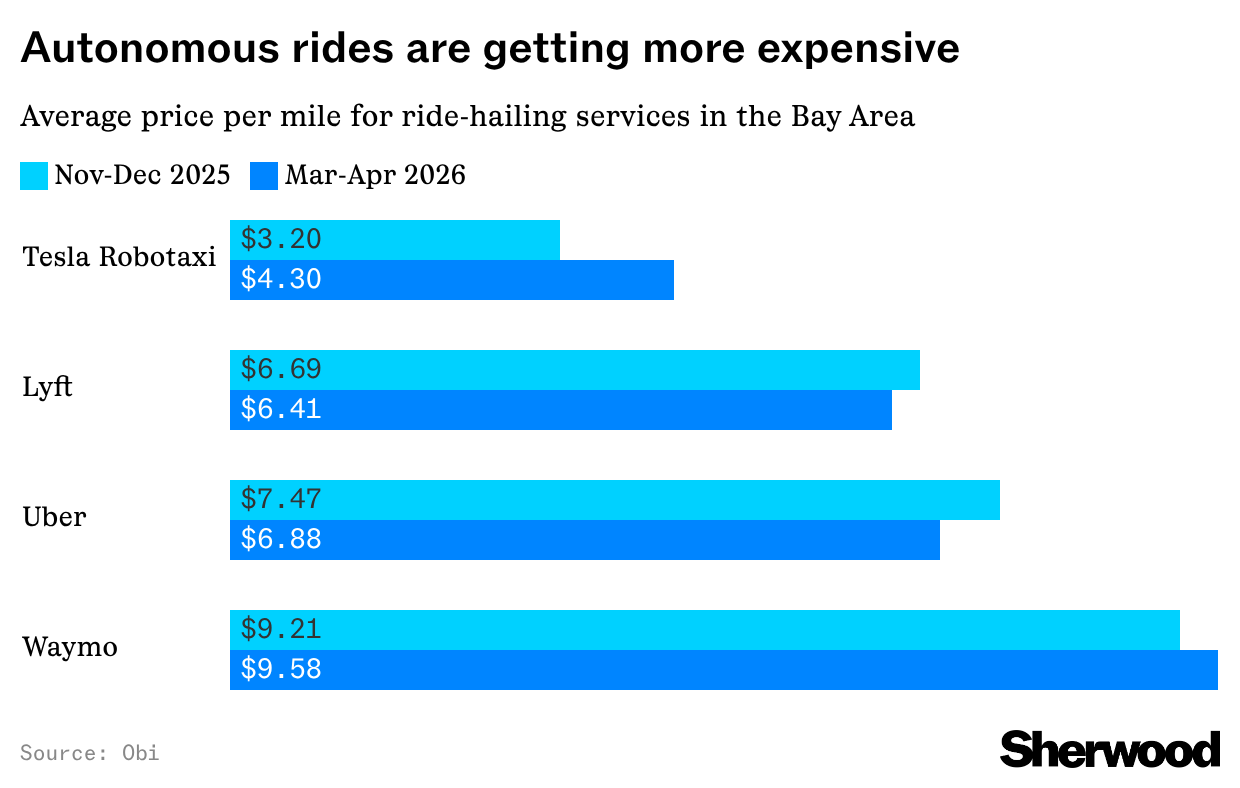
Now, a different version of that subsidy may be emerging — and once again, it revolves around ride-hailing: robotaxis. Autonomous taxi services are popping up in cities across the country. |
-
The situation is most advanced in the Bay Area, where customers can currently choose between Google-owned Waymo, Tesla’s Robotaxi, and Amazon’s Zoox to get to where they’re going.
- And the prices for these services can seem surprisingly cheap. On a recent trip to the Bay Area, Tesla Robotaxi rides were consistently cheaper than comparable trips on Uber.
- Waymos were moderately more expensive, but not notably so when you consider the $75,000 Jaguar I-PACE you’re riding that’s toting around another $120,000 worth of added lidar and other gear.
- For now, Zoox is free.
|
Data from Morgan Stanley Research shows that the cost per mile for Waymo and Tesla Robotaxis is already cheaper than traditional ride-hailing costs. For example, Morgan Stanley Research estimates that Waymos cost about $1.36 per mile to operate versus $0.74 for Tesla, when factoring in depreciation, cleaning, maintenance, charging, mobile operators, insurance, and parking. Meanwhile, new pricing data shared with Sherwood News from ride-share comparison app Obi shows that Waymo is charging about $9.58 per mile while Tesla is charging $4.35. So it seems the companies are charging a premium over their costs.
|
|
|
While the cost of AVs is expected to keep going down, current prices are probably lower than they should be. “From a consumer point of view, it’s definitely the golden era of AV rides, very similar to like 10 years ago with Uber and Lyft,” Harry Campbell, founder of The Driverless Digest, told Sherwood. “We don’t know what the true cost is, but you’re definitely getting a great deal on these rides.”
“I kind of joke with my friends and say, ‘Take these rides while you can.’” (Millennial editor’s note: A “millennial lifestyle subsidy” can really be claimed by anyone of any generational cohort. “Millennial” is more a loss-leading state of mind at this point.) |
|
|
Does the stock market make sense right now? A recent opinion piece for The New York Times argues it does not.
But there is a major difficulty with making the argument that current valuations in public markets reflect a long-lived AI productivity boost: hyperscalers, the companies that are spending the most money to deploy computing power, have seen their valuations go absolutely nowhere for over two years. |
-
All told, the so-called Magnificent 7 cohort has lagged the Nasdaq 100 by about 5% year to date, with the average forward price-to-earnings ratio for Microsoft, Meta, Amazon, and Google hitting its lowest level of the AI boom in March.
- If investors are all in on the long-term earnings power of AI, why are they not willing to pay a higher price for these future earnings streams? Especially if AI is “heads, tech companies win; tails, the government doesn’t let them lose”?
-
Why have the AI winners in 2026 been slightly off the beaten path in a group of tech picks-and-shovels stocks poised to enjoy windfall profits because of supply-demand imbalances?
-
The underbelly of the AI trade throughout 2026 shows the precise opposite of pricing in a prayer. It’s a pricing in instead enjoyed by companies selling umbrellas in a rainstorm, thanks to the weather forecast showing that this downpour isn’t on the verge of ending.
|
This reflects a sense of unease that AI-juiced profits in the near term, as companies experiment with the nascent technology, may not have a high-ROI payoff in the years to come. Based on the available data, it is much easier to make the case that AI has been a net negative rather than a net positive for the S&P 500’s valuations in 2026, based simply on how software companies have seen their multiples crushed amid the potential of AI-induced disruption (or at the very least, a loss of pricing power).
|
|
|
Don’t count out the US consumer. 22V Research economist Peter Williams noted that banks’ card numbers show “possible signs of recent acceleration” in the Q1 reporting period with “little sign of immediate negative impacts for the US consumer or businesses” from the jump in oil prices.
“Wells Fargo noted that historically it takes consumers several months to reduce spending on other categories to adjust for higher oil prices, and they’d expect the same pattern in the second half,” he wrote. “The negative really depends on the extent and duration of the shock. There’s little reason to expect a short-term behavioral shift when balance sheets are strong, and some dissaving is easy enough.” |
|
|
Before Netflix, tech largely scoffed at subscriptions. But Hastings created a subscription model that made Netflix “revered as one of the most innovative companies in Silicon Valley” and turned the company into a stock market behemoth that far outperformed the S&P 500.
|
|
|
|