A short look at the missing layer between learning functional medicine and applying it with confidence.
Hello Friends and Colleagues,
Many programs do a very good job teaching the concepts, tools, and philosophy of functional medicine.
And I
respect that.
Functional medicine has brought tremendous value to healthcare by helping clinicians look beyond symptoms and ask deeper questions about root cause.
But for many clinicians, the greatest struggle is not simply learning what to
do.
It is learning what to do first when a patient has multiple problems happening at the same time.
That is where many clinicians still feel uncertain.
They may understand gut dysfunction, blood sugar imbalance, inflammation, detoxification, hormones, sleep, and stress physiology.
They may know the protocols.
They may understand the lab patterns.
And yet, when a complex chronic patient presents with several issues at once, they still may not feel fully clear on:
what deserves attention first
what may need to
wait
what the patient is actually ready for
and how to build a plan the body can truly tolerate
For example, a patient may present with blood sugar instability, poor sleep, elevated
inflammation, and hormone disruption all at once. The clinician knows all of those matter, but still may not feel fully clear on what deserves attention first.
I recorded a short 2-minute video on this because it gets to the heart of why many clinicians still feel uncertain in complex cases—and what FMU does differently.
At FMU, we teach the foundational knowledge system of functional medicine deeply.
But we also teach what I call the clinical execution system—the missing
layer that helps clinicians know what to do first, what to do next, and what may need to wait.
In plain English, that means we teach clinicians how to think through a case, how to prioritize, how to determine readiness, and how to apply treatment in the right order.
And this is important:
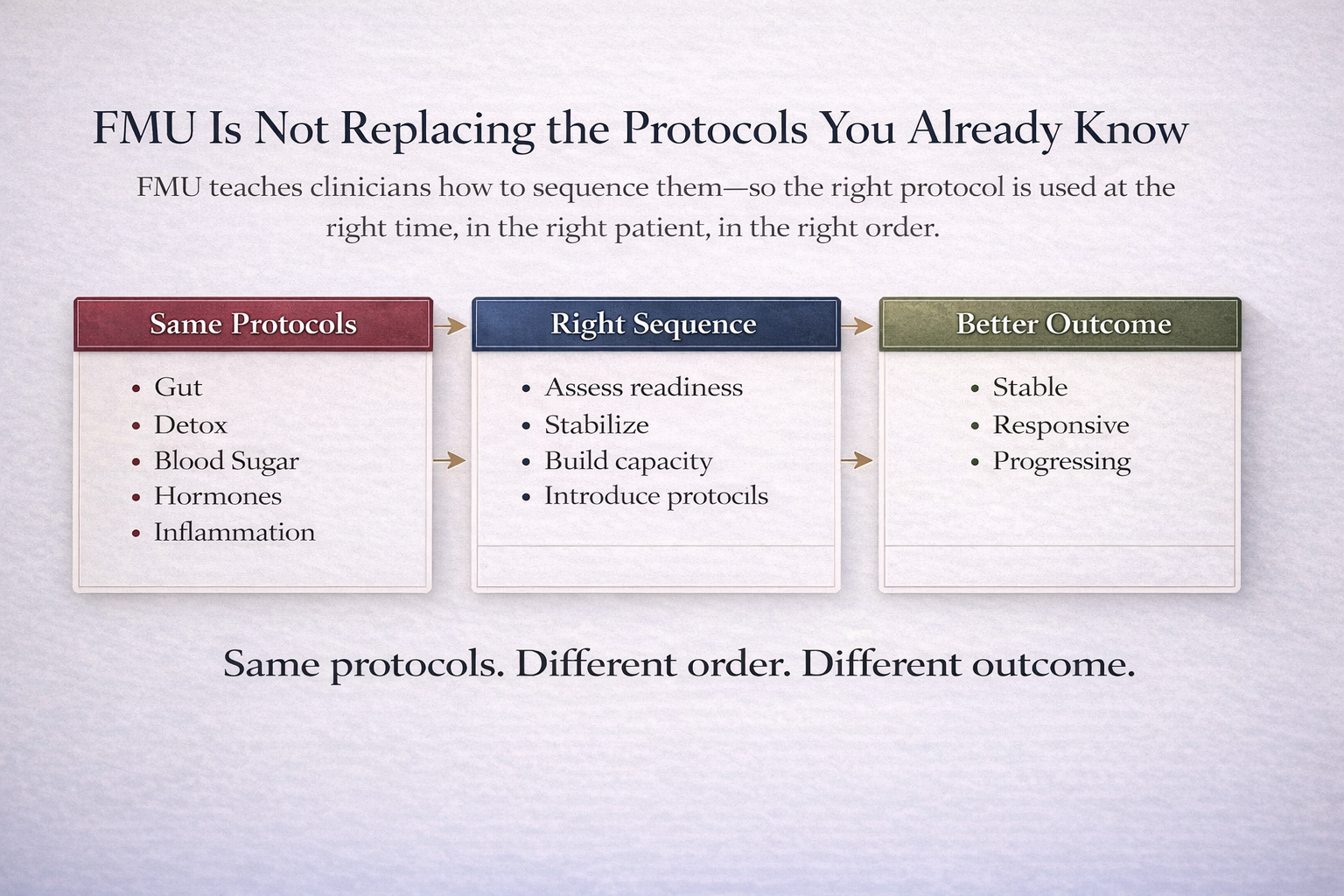
FMU is not replacing the tools and protocols you already know.
What FMU changes is when and how those tools are used.
Because in many cases, the issue is not whether the protocol is
right.
It is whether it is being introduced at the right time.
One FMU clinician shared with me:
“I had
prior functional medicine training, but I still felt uncertain when a patient had multiple issues at once. FMU helped me stop thinking only in terms of what to use and start thinking more clearly about what needed to come first.”
This is especially true for clinicians who have already invested in learning and still feel uncertain in complex cases.
If that sounds familiar, you are not alone.
And as chronic patients become more layered, more reactive, and more difficult to interpret, clinicians need more than information.
They need a way to apply that information with greater order, clarity, and consistency.
That is one of the reasons FMU was built.
Not to replace functional
medicine.
But to help clinicians apply it in order.
I also created a short FMU Clinical Clarification Brief that explains this difference more clearly.
Dr. Ron Grisanti Founder, Functional Medicine University
P.S. Many clinicians already know a great deal about functional
medicine. What they have often not been taught is how to decide what matters first when the case is complex. FMU was built to teach that missing clinical layer.