A 1-minute video on the realization that changed how I approached complex chronic cases.
Hello Friends and Colleagues,
One of the hardest parts of functional medicine is not simply recognizing what is wrong.
It is knowing what deserves attention first.
That may sound like a small distinction, but in a chronic case, it can change everything.
Because when a clinician is not fully clear on what comes first, even a thoughtful plan can become too broad, too layered, or too poorly timed.
The labs may make sense.
The treatment ideas may make sense.
And yet the patient still may not move forward the way you expected.
For example, a middle-aged man presents with abdominal weight gain, elevated blood pressure, fasting glucose drift, poor sleep, afternoon irritability, and low energy.
His labs show insulin resistance, elevated triglycerides, mild liver enzyme elevation, and
inflammatory markers that are beginning to climb.
A very reasonable clinician may feel pulled to address blood sugar, liver function, inflammation, exercise, nutrition, sleep, and stress all at once.
And all of those may matter.
But they may not all matter first.
That is exactly what led me to realize that something important was missing in how many chronic patients were being treated.
I recorded a short 1-minute video on that turning point and what it taught me.
What I came to see is that knowing what is wrong is only part of the equation.
In many chronic cases, the deeper issue is knowing what needs attention first, what can wait, and what the body is truly ready for at that moment.
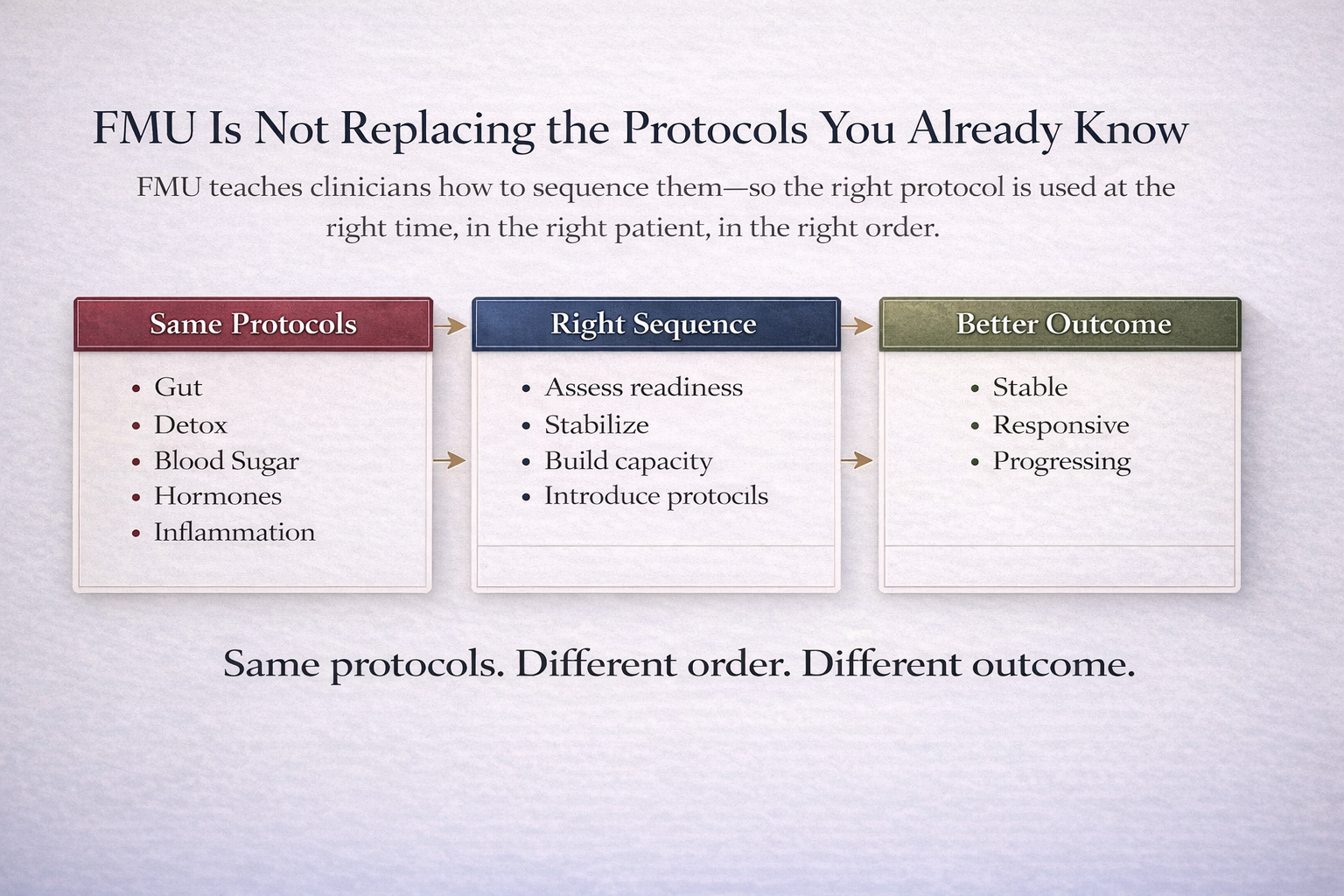
And this is important—FMU is not replacing the protocols you already know.
That is one of the central reasons FMU was built.
Not simply to teach clinicians more functional medicine information.
But to help them know what to do first, what to do next, and what may need to wait.
One FMU clinician shared with me, “I had studied
functional medicine for years, but FMU changed how I think through the opening phase of a case. I stopped trying to address everything at once.”
If you have ever looked at a chronic case and felt pulled in too many directions at once, this is exactly the kind of clinical thinking FMU was built to teach.
And as chronic cases become more layered, more reactive, and more difficult to interpret, this distinction matters more than ever.
I also created a short FMU Clinical Contrast Brief showing how this sequencing-based approach looks in a real cardiometabolic case.
Dr. Ron Grisanti Founder, Functional Medicine University
P.S. Many clinicians are not struggling because they lack
knowledge. They are struggling because they were never clearly taught how to determine what deserves attention first. If that sounds familiar, FMU was built for clinicians who want to practice with more clarity, order, and confidence.