|
This Apple Combo Might Disrupt the Entire Tech Industry—Here’s Why
Apple Shortcuts + Apple Intelligence: Strategic Implications for the Tech Industry and Engineering Organizations
|

| |||||||||||||||


The AI notepad for people in back-to-back meetings (Sponsor)
 |
Most AI note-takers just transcribe what was said and send you a summary after the call.
Granola is an AI notepad. And that difference matters.
You start with a clean, simple notepad. You jot down what matters to you and, in the background, Granola transcribes the meeting.
When the meeting ends, Granola uses your notes to generate clearer summaries, action items, and next steps, all from your point of view.
Then comes the powerful part: you can chat with your notes. Use Recipes (pre-made prompts) to write follow-up emails, pull out decisions, prep for your next meeting, or turn conversations into real work in seconds.
Think of it as a super-smart notes app that actually understands your meetings.
Free 1 month with the code SCOOP
The upgrade to Apple Shortcuts through Apple Intelligence integration shifts how mobile platforms approach automation, AI deployment, and developer economics. This goes far beyond a feature update, marking a strategic repositioning of Apple as a platform company competing directly with cloud giants while maintaining its fortress of privacy and ecosystem control.
On-Device to Private Cloud Compute
Apple’s approach creates a three-tier processing model that solves the complexity problem in AI:
On-Device Processing (~3B Parameter Model) handles the majority of everyday tasks. These include text summarization, proofreading, tone adjustment, and image generation through lightweight diffusion models. The model is quantized aggressively to fit within iPhone memory constraints—using mixed 2-bit and 4-bit precision (averaging 3.7 bits-per-weight) that maintains accuracy equivalent to full-precision models while consuming just 3-4GB of storage. This computation happens entirely offline, delivering sub-100ms latency without any network dependency.
Private Cloud Compute (PCC) handles requests exceeding on-device capabilities. Unlike traditional cloud AI services, PCC employs custom-built Apple silicon servers that replicate the security model of iPhone devices. The architecture is stateless by design: data is encrypted end-to-end from the user’s device to validated PCC nodes, processed, deleted immediately after fulfilling the request, and never retained in any form. No administrator—not even Apple staff—can access user data due to technical enforcement at the hardware level.
The Security Enforcement Model operates at five architectural layers:
The Hardware Foundation uses custom Apple silicon with Secure Enclave processors identical to those in iPhones. Each PCC node is cryptographically inventoried at manufacturing, physically scanned, and re-validated when arriving in the data center with third-party verification.
The Operating System Layer is a hardened subset of iOS/macOS purposefully designed for LLM inference workloads with an intentionally narrow attack surface. It excludes remote shells, SSH access, and general-purpose debugging tools—not as mere restrictions, but as enforceable guarantees. Code cannot be modified at runtime; all executable code must be signed and pre-approved by Apple.
The Request Processing Layer handles encrypted requests using stateless computation principles. User data is used only to fulfill the specific inference request, then deleted through cryptographic key rotation that makes data recovery mathematically impossible even after a reboot.
The Access Control Layer implements “target diffusion”—preventing attackers from routing requests to specific compromised nodes. Requests go through OHTTP relays operated by third parties (hiding IP addresses), and metadata strips personally identifiable information while preserving only routing context.
The Transparency Layer publishes every production PCC software image in a cryptographically tamper-proof log accessible to security researchers. This inverts the traditional cloud service model: instead of providers claiming security without verification, Apple provides verifiable proof.
What This Means for Engineering Organizations
1. The Economics Revolution: Zero-Cost Inference
The most disruptive aspect is the developer economics model:
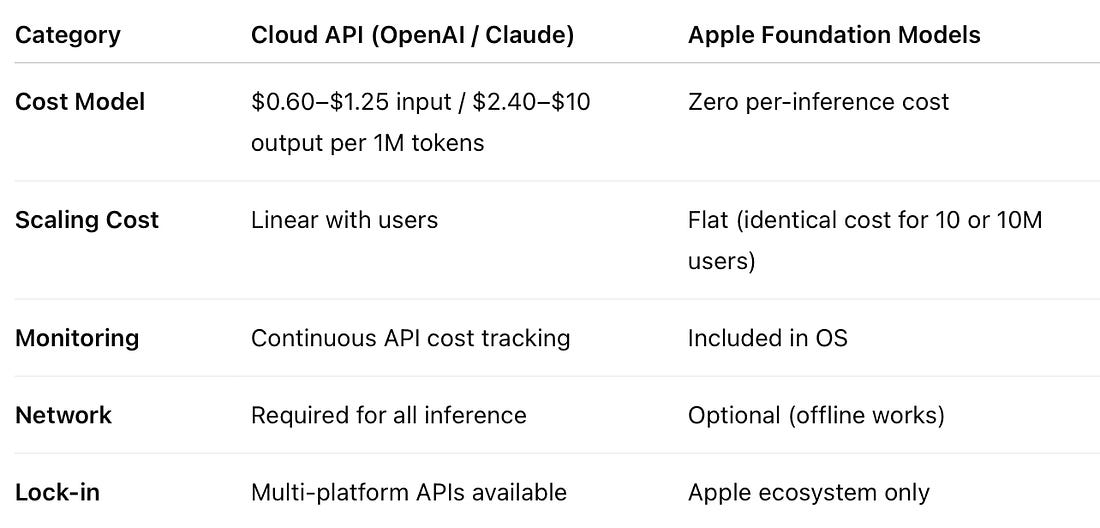 |
This pricing advantage fundamentally changes product roadmap decision-making. A 3-person startup can now build AI-first features that would have required securing $50k+ in annual API budgets with cloud providers. This eliminates the barrier to entry that previously gatekept AI innovation to well-funded teams.
For enterprise teams, the implications are stark: an organization currently paying OpenAI $500k annually for API usage across 10,000 employees can implement equivalent on-device processing at zero marginal cost once devices upgrade to iOS 26+. This creates a competitive incentive to abandon multi-platform strategies and consolidate on Apple devices.
2. The Integration Framework: App Intents as Universal Glue
The fragmented iOS integration landscape (SiriKit, URL schemes, custom shortcuts) has been unified into a single Swift-native framework: App Intents. This matters because:
Reduced Onboarding Friction: Previously, third-party developers had to maintain separate integration paths for Siri, Spotlight, Shortcuts, widgets, and Apple Intelligence. Now, a single intent definition automatically propagates to all surfaces. Interactive snippets (new in iOS 26) allow developers to return SwiftUI views that fire intents from within Spotlight or Control Center—creating contextual workflows without leaving system UI.
Zero-Configuration Availability: App Shortcuts expose the most important intents automatically upon app installation. Users don’t discover these through the Shortcuts gallery; they appear directly in Siri, Spotlight, and the Action button. This shifts the discoverability burden from the app to the OS.