| Oil slick |
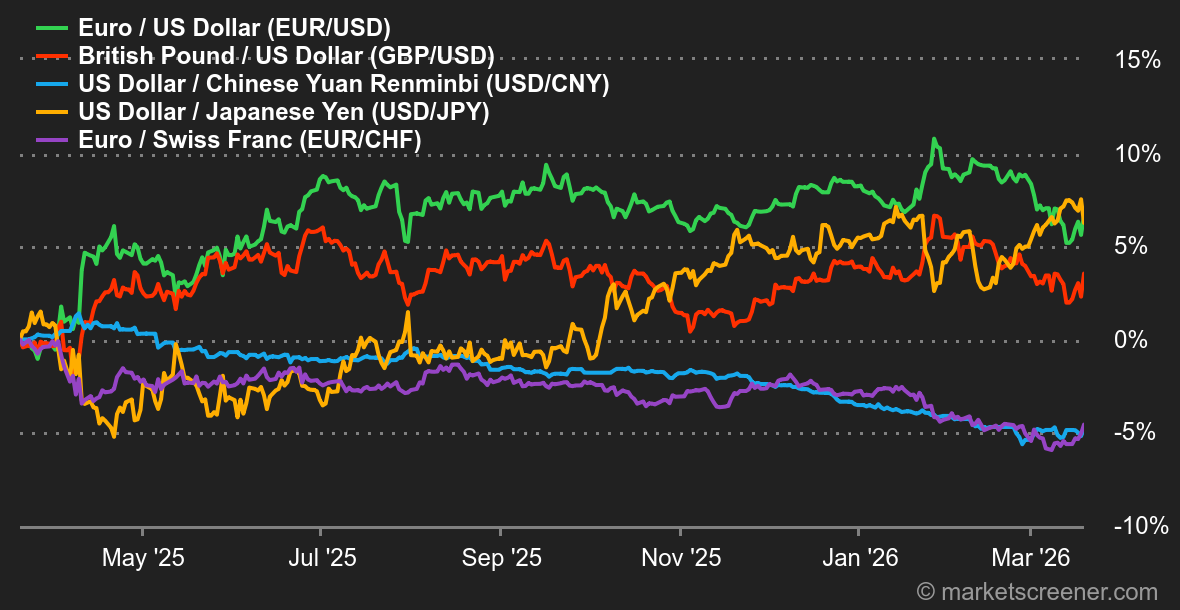
Against the backdrop of the ongoing conflict in the Middle East and the latest surge in commodity prices (oil and gas), financial markets fell again this week. Uncertainty remains very high, especially as this is increasing inflationary pressure and reducing central banks' room for maneuver. The Fed could therefore opt to hold rates steady this year, while the ECB is prepared to consider raising rates, with the prospect of a jump in inflation and a negative impact on growth. While waiting for the next batch of corporate earnings starting in mid-April, markets are very likely to remain highly volatile.
|
|
| This week's gainers and losers |
|
Up:
Trustpilot +34.01%: the online review platform jumped after reporting 5-star results. Its annual profit more than quadrupled, driven by AI-powered search tools that generated a 1,490% increase in clicks to its site and strengthened its role as a key data source for AI models.
Lumentum +13.47%: the company unveiled a groundbreaking optical interconnect solution designed to support AI infrastructure. Morgan Stanley says it should continue to benefit from rising demand.
Ciena +13.79%: the company made waves at OFC 2026 by showcasing innovations that redefine what modern networks can do, further confirming Ciena as a solutions provider for next-generation AI infrastructure.
SanDisk +7.27%: the sector is being driven by rising memory prices, with Western Digital up 8%. Citigroup raised its price target to USD 875 from USD 750 and recommends buying the stock.
Down:
Tencent Music -28.89%: this week was marked by the announcement of a 5% decline in users and rising costs. JP Morgan and Benchmark Company both downgraded their recommendations to neutral.
Super Micro -33.24%: shares fell after U.S. prosecutors charged three people tied to the company, including its co-founder, with helping smuggle U.S. AI technology into China. While Super Micro is not a defendant, the case raises serious risks for its reputation and its relationship with Nvidia.
Wheaton Precious Metals -18.24%: gold miners are being dragged down by gold’s 16.7% drop from its high on January 28. Agnico is down 12% and Coeur Mining 15%. |
| Commodities |
Energy : Another tense week in oil markets, which continue to swing with the escalation of tensions in the Middle East. Israeli forces attacked the South Pars gas field. This site accounts for 70% of Iranian production. In response, Tehran targeted its neighbors’ energy facilities. Iranian strikes severely damaged Qatar’s Ras Laffan complex, the world’s largest liquefied natural gas export facility. Oil facilities in Saudi Arabia, the United Arab Emirates, and Kuwait were also damaged. The Strait of Hormuz, a critical shipping route for the region’s exports, remains paralyzed. Alternative solutions are limited. Iraq has resumed exports of 250,000 barrels per day via a pipeline to Turkey. However, that volume remains marginal compared with the amount of oil blocked in the Gulf. Faced with this maritime bottleneck and to avoid overwhelming their storage capacity, major producer countries such as Saudi Arabia, Iraq, the United Arab Emirates, and Kuwait are currently cutting production by several million barrels per day. In this context, the market is showing a major price gap between the world’s two oil benchmarks. North Sea Brent crude is trading around USD 108 per barrel and even reached USD 118 this week. Brent pricing is heavily influenced by Middle Eastern production and international seaborne trade. It therefore fully reflects the current geopolitical risk. By contrast, WTI remains below the USD 100 mark, closing around USD 96 per barrel. WTI reflects the U.S. domestic market. U.S. production remains stable and is not affected by the Strait of Hormuz logistics bottleneck.
Metals : Metals took a hit this week. For gold, this may seem counterintuitive at first glance, since geopolitical tensions would normally boost safe-haven demand, but that overlooks the fact that soaring energy prices are reviving fears of another acceleration in global inflation. In response, central banks will remain very cautious about easing monetary policy. This macro backdrop is strengthening the U.S. dollar and directly weighing on industrial and precious metal prices. Gold is trading lower at around USD 4,620 per ounce. In London, copper is suffering its biggest weekly loss in nearly a year. The spot LME contract is down roughly 5% on the week, to around USD 12,146 per ton.
Agricultural products : Agricultural commodity prices ended the week on a mixed note in Chicago. Tensions in the Middle East and fluctuations in oil prices are directly influencing the markets. Over the week as a whole, soybeans posted a significant decline, wheat moved lower, and corn was stable. |
| Macroeconomics |
Macro : Investors do not have much to cling to. The parade of central banks is ending without shedding much light, given how great the current uncertainty is. The only certainty is that energy prices are soaring, and European countries are among the hardest hit, as illustrated by the spread between Brent (North Sea) and WTI (Texas). Gold is no longer playing its role as a safe haven because of deleveraging driven on the one hand by higher margin requirements and on the other by the tension seen in global bond markets. As a result, the 10-year yield is still hovering near its 2023 highs at 3.02%, while its U.S. counterpart is trying to break above 4.30%. It will take a rapid ceasefire and the reopening of the Strait of Hormuz to set things right again (lower oil prices and higher-risk assets). Time is now running out, otherwise the economy is headed straight toward a recession.
Crypto : After gaining 10% last week, bitcoin (BTC) is down 3.5% since Monday and is once again trading around USD 70,000. Yet the week had started well, with a 4% increase over the first two days, before a sharp reversal beginning on Wednesday. In other words, BTC has tracked very closely the moves of the main U.S. stock index and true barometer of global finance: the S&P 500. Bitcoin’s performance therefore remains largely dependent on the mood prevailing in traditional markets, and it is clear that since the flare-up in the Middle East at the end of February, the environment has been far from favorable. Volatility was even more pronounced for the market’s second-largest cryptocurrency, ether (ETH). After surging 10% between Monday and Tuesday, it moved back into negative territory this Friday, down 2% at around USD 2,150. Similar moves can be seen across other major cryptocurrencies: Binance Coin (BNB) is down 4.8%, Solana (SOL) 3.4%, and XRP 1%. More broadly, the total cryptocurrency market capitalization has fallen 45% from its October 2025 peak, dropping back to USD 2.4 trillion today. That valuation alone is made up of 58% bitcoin and 11% ether. |
|
Oil remained at the center of the story. Next week, the corporate calendar will be quiet as the market waits for the first Q1 2026 earnings releases. The economic calendar will also be fairly light, although the March Flash PMI indicators will be closely watched because they will bear the scars of the conflict in Iran. In recent weeks, weekends have brought their share of bad surprises. Will the arrival of spring help calm things down? |
|
|
Things to read this week
|
 |
The Million-Dollar Question: What Will Powell Do Now?
It is not just the future of the current Fed Chair that is at stake, but that of the institution itself. Read more
|
 |
Qatar's Gas Shock
In an interview with Reuters, QatarEnergy's chief executive said the company may have to declare force majeure on long-term liquefied natural gas contracts for... Read more
|
 |
TSMC: The Industrial Linchpin of the Digital Economy
Today, TSMC underpins a vast portion of the digital world's architecture. Behind tech's most prominent brands, the Taiwanese company effectively manufactures... Read more
|
|
|