|
 |
I’ll be blunt: These are very challenging times for independent journalism.
First, social media companies like Facebook and X, which had long been a source of exposure and growth for independent outlets, sharply limited outbound traffic to news sites.
Now, Google frequently directs users to AI-generated slop instead of relevant news articles. This has dramatically reduced the number of readers who discover independent media through search.
These companies do not care about journalism. Or whether their users are well-informed. They care about profits.
To survive and thrive in this hostile environment, Popular Information needs your help. Support independent accountability journalism by upgrading to a paid subscription. You can make a real impact for just $6 per month or $50 per year.


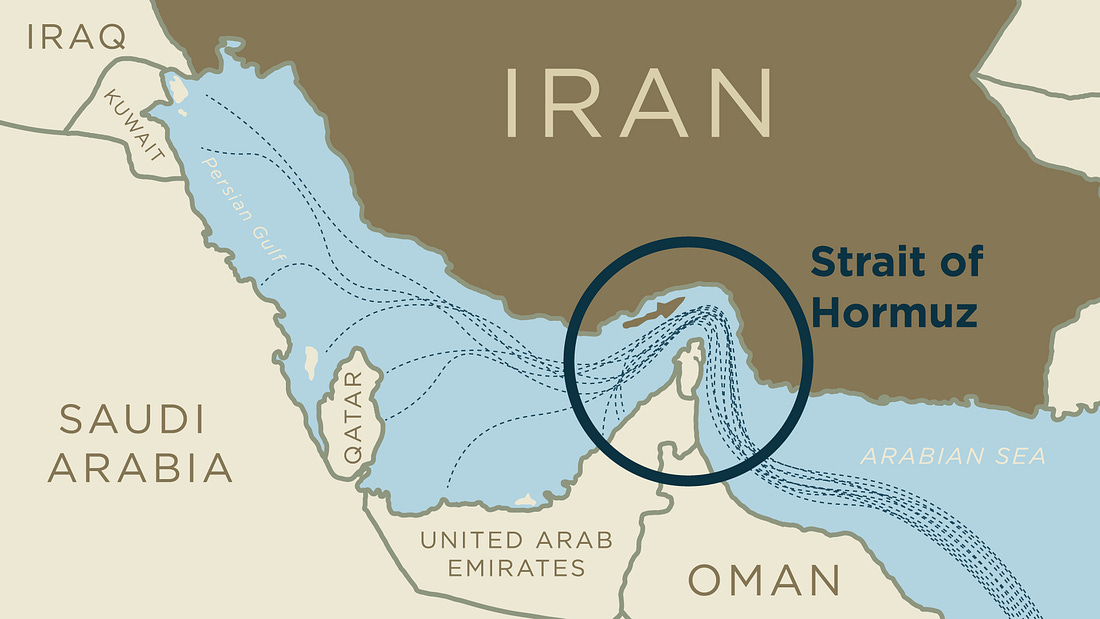 |
Shortly after the start of the war in Iran on February 28, Iran declared that the Strait of Hormuz — which is used to transport about 20% of the world’s oil — was closed. Since then, vessels near the strait have been struck by drones and other projectiles. Only a handful of non-Western tankers have safely made it through the sea passage
As a result, the price of a barrel of oil has skyrocketed from $70 to over $100. Americans are now paying an average of $3.70 for a gallon of gas, an increase of about 80 cents over the last month.
The higher prices are already inflicting pain on Americans struggling to make ends meet, and if oil prices continue to rise, it could tip the economy into a global recession. Oil prices will likely continue to go up as long as the Strait of Hormuz remains closed to most traffic. Thus far, the Trump administration has not identified an effective strategy to reopen it.
The administration “significantly underestimated Iran’s willingness to close the Strait of Hormuz in response to US military strikes while planning the ongoing operation,” according to a March 12 report on CNN. Trump and his advisors, according to CNN, “failed to fully account for the potential consequences of what some officials have described as a worst-case scenario.” Last June, after the U.S. military targeted nuclear sites in Iran, Secretary of State Marco Rubio downplayed concerns that Iran would target the Strait of Hormuz, calling such an action “suicidal.”
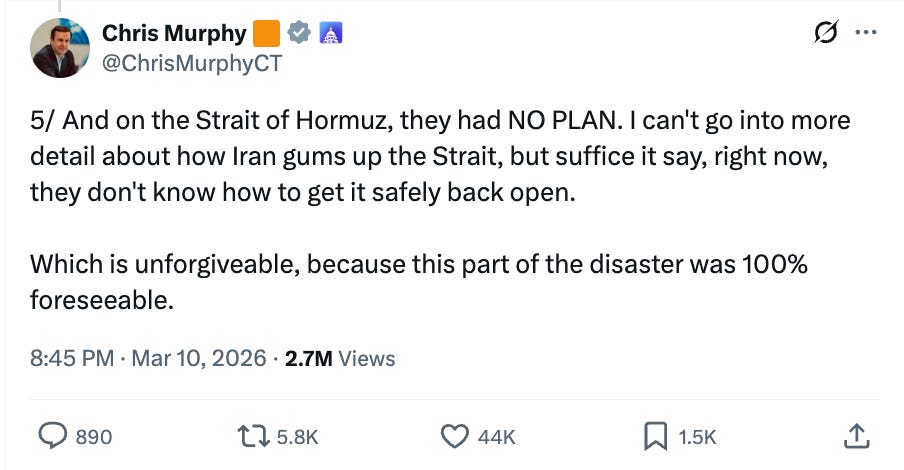
Senator Chris Murphy (D-CT) relayed a similar message on March 10 after receiving a classified briefing. According to Murphy, the administration had “NO PLAN” on the Strait of Hormuz and “don’t know how to get it safely back open.”
 |
White House Press Secretary Karoline Leavitt dismissed the CNN report as “100% FAKE NEWS“ and blasted the network for publishing “garbage.” Secretary of War Pete Hegseth called it a “fundamentally unserious report“ and insisted the administration had “planned” for every possible scenario.
These are strong words, but the administration’s actions tell a different story. In the lead-up to war, the Trump administration made a number of decisions that indicate it was relatively unconcerned that Iran would attempt to shut down the Strait of Hormuz.
Mining for disaster
The Strait of Hormuz remains unsafe, in part, because of Iran’s ability to deploy mines across the narrow passage. In September 2025, however, the Trump administration decommissioned the last of its four mine countermeasure ships, which had been based in Bahrain. These ships were “capable of finding, classifying and destroying moored and bottom mines.”
The ships were to be replaced with three more advanced Littoral Combat Ships. But according to U.S. Navy documents obtained by Hunterbrook, the “next-generation mine-hunting systems suffered from unreliable unmanned vehicles, critical single-point failures, and sonar that couldn’t see.” In a training mission, one of the unmanned vehicles became a “runaway” and could not be recovered by the mothership.
Two of the three replacement ships were recently spotted docked in Malaysia.
Had the Trump administration been competently preparing for Iran to try to close the Strait of Hormuz, it would not have begun operations without an effective anti-mine fleet in the region.
A coalition of the unwilling
In addition to mines, Iran can disrupt travel through the Strait of Hormuz with drones and small vessels. Eager to halt the run-up in oil prices, Trump promised the United States military would “escort” tankers through the strait. “If necessary, the United States Navy will begin escorting tankers through the Strait of Hormuz, as soon as possible,” Trump wrote on Truth Social on March 3.
But escorting a tanker is complex work, and many U.S. Naval assets are occupied fighting the war itself. On March 10, Energy Secretary Chris Wright posted on social media that the “U.S. Navy had successfully escorted an oil tanker through the Strait of Hormuz.” That claim, Wright later admitted, was false. A week later, there are still no documented cases of a tanker traversing the strait with a military escort.
To accelerate this process, Trump has demanded that other nations help escort tankers. “I’m demanding that these countries come in and protect their own territory, because it is their territory,” Trump said.