|
Roundup #79: The revenge of macroeconomics
Ehrlich; AI and knowledge; The Strait of Hormuz; Government debt and inflation; Japanese robots; Democrats and taxes; Smartphones
|

| |||||||||||||||


 |
This roundup is in honor of Chris Sims, the extremely influential macroeconomist, who has just passed away. Item #4 even features some evidence for the Fiscal Theory of the Price Level, which he helped develop.
But first, podcasts. I went on the Members of Technical Staff Podcast with Jayden Clark to talk about the politics of the tech industry, and we ended up talking about a ton of fun stuff:
The Politics of Tech and AI, with Noah Smith Atlas Media Labs |


Anyway, on to the roundup. Before we get to the macro stuff, let’s talk about one of America’s worst public intellectuals…and a little about AI.
1. Paul Ehrlich was bad
Paul Ehrlich, the author of The Population Bomb and a relentless advocate for population control, has died. One general rule of punditry is supposed to be that you don’t speak ill of the dead. But on the other hand, what if the dead had some really, really bad ideas?
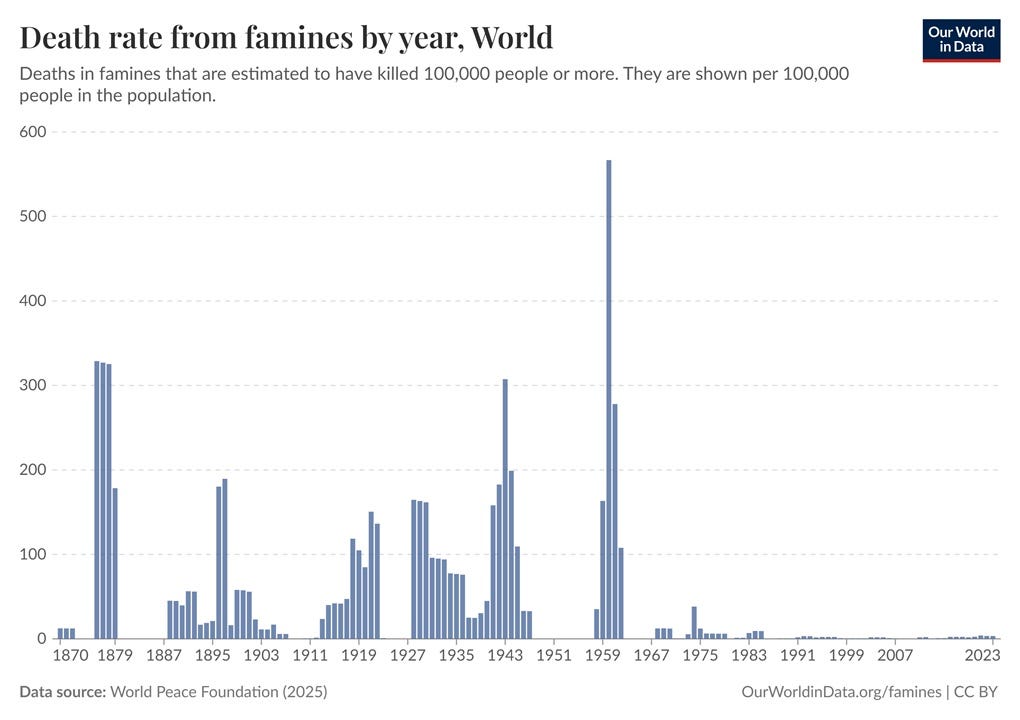
We all know the story of why Ehrlich was wrong. He predicted that the world would run out of food, producing catastrophic famines in the 1970s. Based on those predictions, he called for things like cutting off emergency food aid to India, reasoning that if people were saved from starvation today, it would just mean more people to die of starvation later on. But new farming techniques known as the Green Revolution created enough calories to feed the whole world with plenty to spare. The Population Bomb came out in 1968; by then, famines were essentially already a thing of the past:
 |
And fertility rates fell without the kind of draconian, dystopian population controls that Ehrlich constantly called for. The main country that listened to Ehrlich was China, and their One-Child Policy turned out to be quite unnecessary for reducing fertility rates — as well as being totalitarian, cruel, and dystopian.
What people don’t know about Ehrlich is how relentlessly he kept promoting his ideas and haughtily dismissing his critics, even after it had become clear that he had been completely wrong. A man who had endorsed nightmare policies in service to a broken theory simply never reckoned with this monumental failure, and continued to self-aggrandize and to evangelize for his old mistakes.
And in fact, Ehrlich’s bad ideas have survived and even thrived, in the form of the “degrowth” movement that’s popular in the UK and parts of Europe. Today’s degrowthers call for immiserating the developed-world middle class instead of starving India to death and throwing people in prison for having too many kids, which I suppose is an improvement. Still, the idea is fundamentally based on the same old fallacies that Ehrlich never stopped pushing — that humanity has overstepped its bounds and must be forcibly diminished.
2. A Grossman-Stiglitz Paradox for AI
One of the most interesting results in theoretical economics is the Grossman-Stiglitz Paradox.
Have you ever heard of the Efficient Market Hypothesis — the idea that financial market prices already incorporate all available information about the value of the underlying assets? Well, in 1980, Sanford Grossman and Joseph Stiglitz showed why the EMH can’t be quite right. The idea is pretty simple: It takes effort to find information. Who is going to go out and spend the effort to find out information about what stocks or bonds or houses are really worth, if they can’t make money trading on that information? And if no one spends the effort to find the information, how can it ever be incorporated into the price in the first place? Grossman and Stiglitz concluded that financial markets must be at least somewhat inefficient.
Now, Daron Acemoglu, Dingwen Kong and Asuman Ozdaglar have posited a similar problem for AI. I’m usually not a fan of Acemoglu’s papers on AI, but I think this one gets to an important and fundamental insight.
Acemoglu et al. write that if generative AI put all the information of the world at people’s fingertips, then people will have no incentive to go out and learn new things, which will then prevent them from accidentally finding new knowledge to add to the world’s total knowledge base:
We study how generative AI, and in particular agentic AI, shapes human learning incentives and the long-run evolution of society’s information ecosystem…Learning exhibits economies of scope: costly human effort jointly produces a private signal about their own context and a “thin” public signal that accumulates into the community’s stock of general knowledge,