|
Latest articles
If you’re not a subscriber, here’s what you missed this month.
 |
To receive all the full articles and support ByteByteGo, consider subscribing:



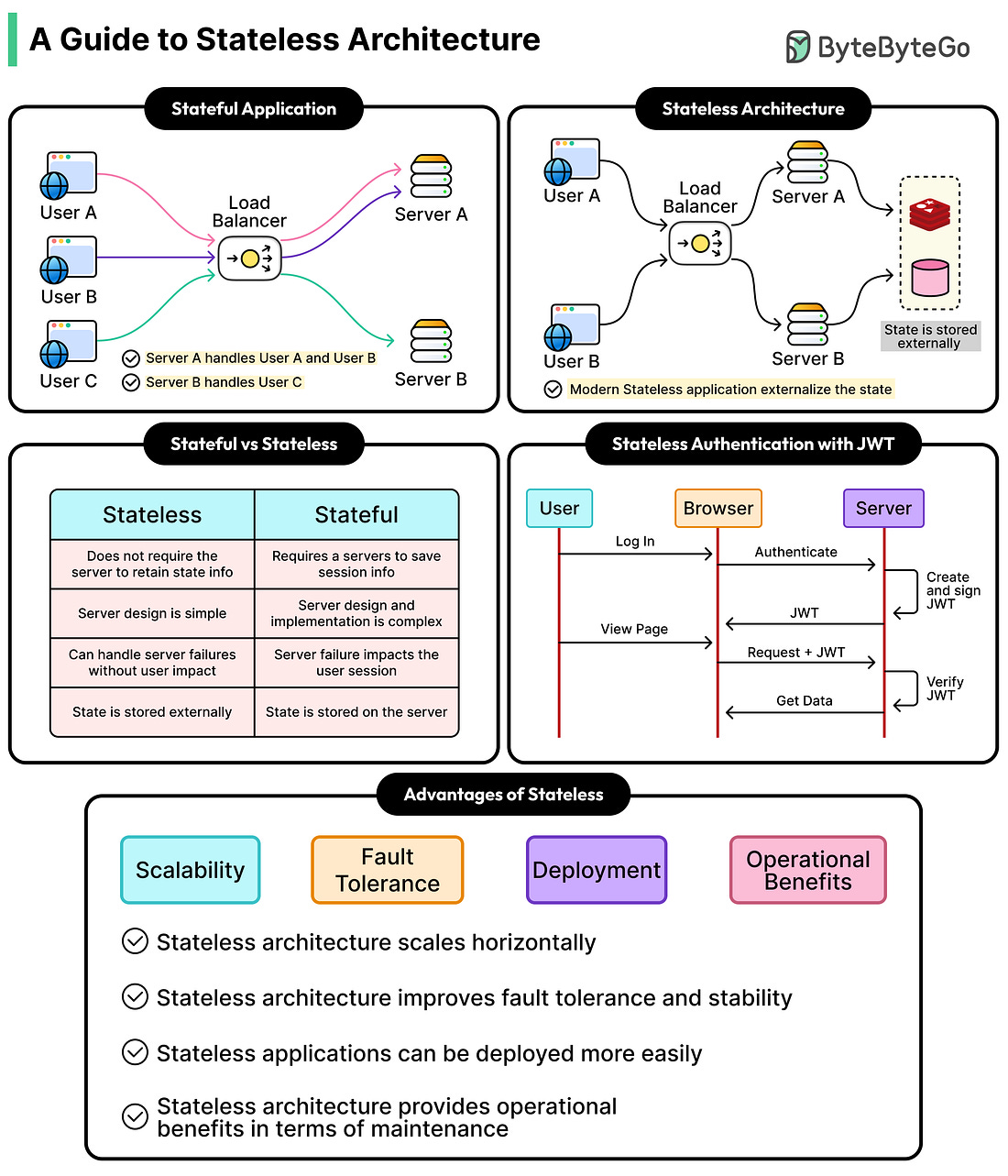
When we hear “stateless architecture”, we often think it means building applications that have no state. That’s the wrong picture, and it can lead to confusion about everything that follows.
Every application has a state, such as user sessions, shopping carts, authentication tokens, and preferences. All of that is state. It’s the application’s memory and the very thing that makes personalized digital experiences possible. Without it, every visit to a website would feel like the first time.
In other words, stateless architecture doesn’t eliminate state but relocates it. Understanding where the state moves, why we move it, and what that move costs us is essential for developers.
In this article, we will understand the nuances of stateless architecture in more detail.
 |
