| | In today’s edition: Trump’s thorny relationship with private markets, and the soaring costs of confl͏ ͏ ͏ ͏ ͏ ͏ |
| |  | Washington, DC |  |
| |
|
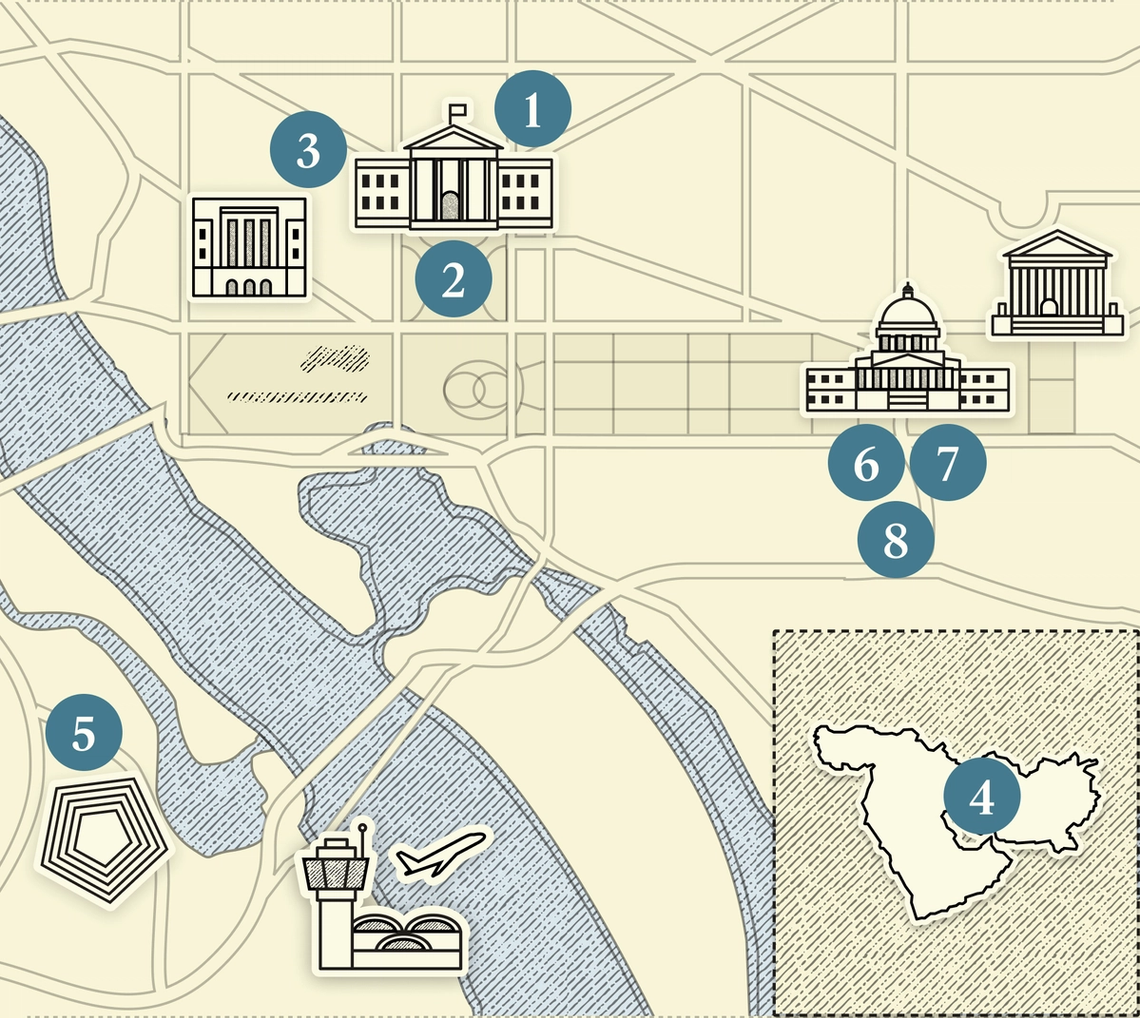 - Trump vs. private markets
- New tariff push
- Gallego on USMCA
- Iran war costs mount
- Pentagon hires bankers
- GOP voting bill strategy
- Dems’ tax debate
- Americans cut back
PDB: Hawley introduces bill to ban abortion drug  Trump hosts Women’s History Month event … Senate votes on housing bill … Oil prices back near $100 a barrel |
|
Private market firms on shakier ground |
 Kevin Lamarque/Reuters Kevin Lamarque/ReutersPrivate market heavyweights helped get President Donald Trump elected. Now they’re hitting the limits of their buying power, Semafor’s Eleanor Mueller reports. Firms like Blackstone and KKR spent the first year of the president’s second term racking up regulatory wins, like the White House ordering agencies to open up retirement plans to private equity and credit. But as Blue Owl’s stumble rattles the industry, the sector’s standing in Washington is also getting shakier. Treasury Secretary Scott Bessent recently indicated a desire to keep certain private assets out of retirement plans, saying last month that officials want to ensure “individual investors will not become the [industry’s] dumping ground.” Meanwhile, the White House is lobbying for legislation that would box institutional investors out of the housing market. “There is a bit of cognitive dissonance that seems to be at play,” one lobbyist said. |
|
Trump presses ahead with new tariffs |
 Piroschka van de Wouw/Reuters Piroschka van de Wouw/ReutersTrump is doubling down on his trade agenda by launching new investigations into other countries’ trading practices after the Supreme Court struck down his tariffs last month. Section 301 of the Trade Act of 1974 requires probes to impose tariffs in response to certain practices — in this instance, so-called excess capacity in manufacturing and forced labor. US Trade Representative Jamieson Greer said Wednesday the former will involve China, the EU, Singapore, Switzerland, Norway, Indonesia, Malaysia, Cambodia, Thailand, Korea, Vietnam, Taiwan, Bangladesh, Mexico, Japan, and India, while the latter will involve about 60 countries. Not on the list: Canada. Greer told reporters he hopes to conclude the investigations before Trump’s Section 122 tariffs, which have a 150-day timeline, lapse later this year. He said the administration was also eyeing trade investigations related to digital service taxes, pharmaceutical pricing, and ocean pollution. — Eleanor Mueller |
|
Call to revisit Canada-Mexico trade pact |
 Sen. Ruben Gallego, D-Ariz., wants the Trump administration to renegotiate parts of the US-Mexico-Canada trade agreement. In a letter shared first with Semafor that will be sent to Trump and Greer today, Gallego argued that the current version of the pact doesn’t do enough to stem underlying causes of illegal migration or prevent China from skirting US trade laws. “I urge you to use this process as an opportunity to renegotiate aspects of the agreement to rebuild the US manufacturing sector, strengthen border communities, and address the underlying causes of illegal migration,” Gallego wrote. The Democratic senator, who voted for the USMCA trade pact in 2019, is calling for better labor standards, enforcement provisions, wage protections, and updates to origin requirements that prevent China from accessing the North American market through Mexico. — Morgan Chalfant and Burgess Everett |
|
Iran war costs at $11 billion and counting |
 A street on fire in Tehran on Sunday. Social media via Reuters. A street on fire in Tehran on Sunday. Social media via Reuters.The price of war with Iran is growing as Trump insists the conflict will end “soon” — while also staying vague on specifics. The first week reportedly cost north of $11 billion. Trump maintains it will be a worthwhile short-term expense, but his administration announced plans to tap the Strategic Petroleum Reserve to address rising oil prices as the Strait of Hormuz remains effectively closed. Two tankers were set ablaze in Iraqi waters Thursday, while a container ship was struck near the UAE and Iran warned the world to prepare for oil prices to reach $200 per barrel. Key ally Israel is taking a harder stance on timelines, raising questions about when — and how — the US will extract itself, with its defense minister saying there would be no “time limit.” Tehran says the US must agree that neither it nor Israel will attack before there can be a ceasefire, Bloomberg reported. — Shelby Talcott |
|
Pentagon taps bankers for economic defense |
 Kevin Lamarque/Reuters Kevin Lamarque/ReutersThe Pentagon is building a new team of investment bankers steeped in private equity to invest $200 billion over three years in defense deals, aiming to counter China’s rise, Semafor’s Liz Hoffman scoops. The Defense Department is targeting bankers at firms including Goldman Sachs and Morgan Stanley; a headhunter brief pitches a chance to deploy “more capital than most investors deploy in their entire careers.” Trump has long strived to direct a massive sovereign wealth fund akin to Gulf and Asian countries, using private capital to wield political power. The administration has hundreds of billions of dollars to invest in critical industries, but there’s been a bottleneck in finding deals, Liz writes. The headhunter brief also promises recruits will receive “unmatched access to top-level government officials and privileged information flow — whatever you need, you can get.” |
|
Inside the Senate’s voter ID bill plan |
 Annabelle Gordon/Reuters Annabelle Gordon/ReutersSenate Republicans are leaning toward bringing their voting bill requiring ID and proof of citizenship to the Senate floor by taking up the House-passed SAVE America Act — without a talking filibuster. Because it’s a “message” from the House, that would require only 50 votes to get on the floor, and 60 to eventually end debate. That’s the most popular option to get the bill on the floor among Republicans who oppose using the talking filibuster, like Sen. John Curtis, R-Utah. “My preference is to bring up the House version and then let us offer amendments to that,” Curtis told Semafor. Another option would be to set up an initial 60-vote vote on the bill to open debate, but that would lead to a quick failure. Senate Majority Leader John Thune’s been quizzing his members on which strategy to pursue, Republicans said. — Burgess Everett |
|
Inside the Democrats’ brewing tax debate |
 Nathan Howard/Reuters Nathan Howard/ReutersEvery Democrat agrees that the next election will hinge on which party is better at lowering the cost of living, but they’re starting to disagree about how to make their case, Semafor’s David Weigel reports. Sen. Cory Booker, D-N.J., is pushing a new tax cut that would double the standard deduction and push millions of people off the income tax rolls, while Sen. Chris Van Hollen, D-Md., is preparing to unveil an even larger income tax cut. “Overwhelmingly, the response has been positive,” Van Hollen said. While neither man is guaranteed to run in 2028, their tax plans have sparked the first real debate about what Democrats should stand for when they next face voters, beyond “affordability.” Critics of both proposals argue that the party’s mission depends on doing good things with public funds — not just pitching taxes as a pox on people. |
|
Americans cut back to afford health care |
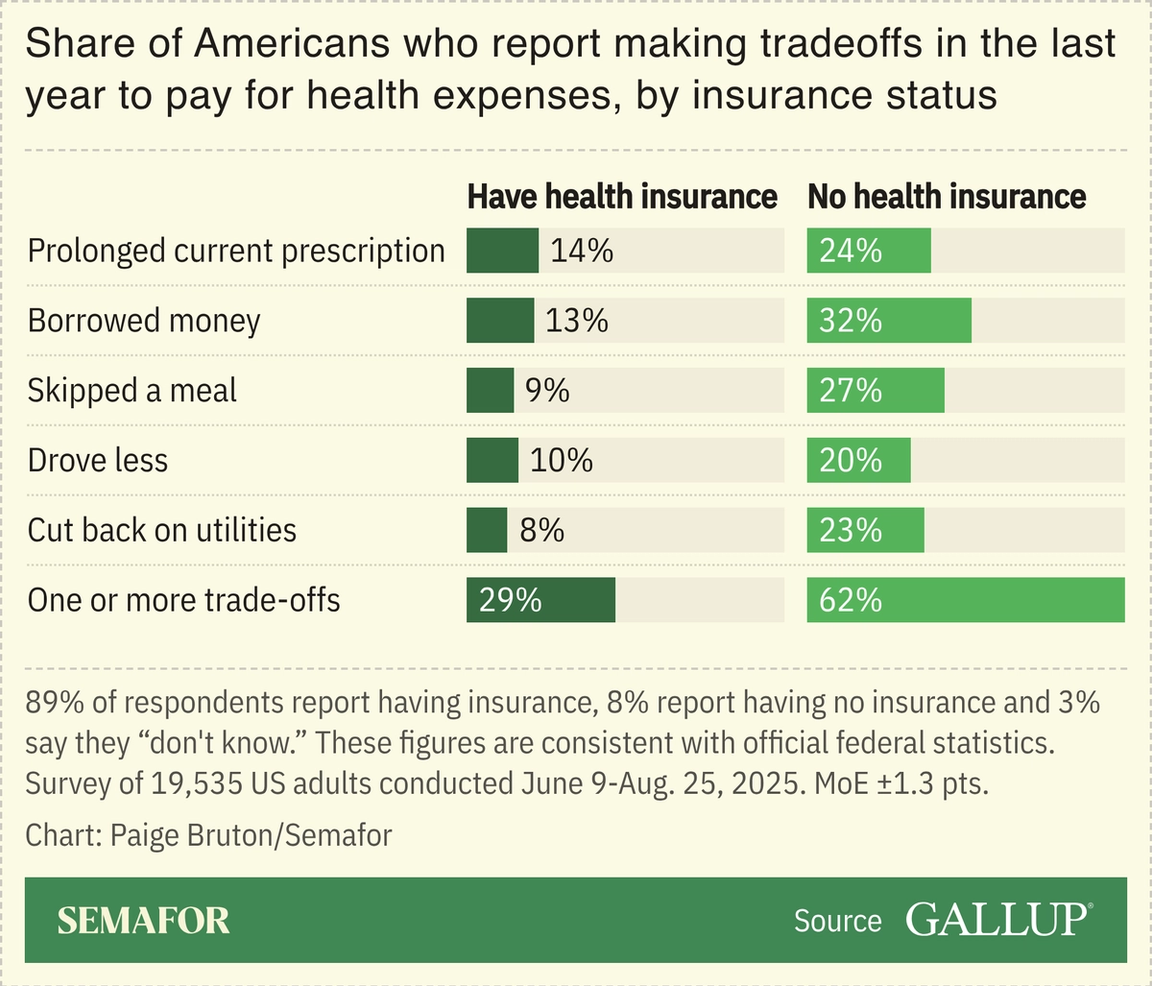 A sizable slice of Americans are cutting back on other expenses in order to afford rising health care costs, the latest sign the issue will be a salient one in November’s midterm elections. One-third of US adults said they have made at least one tradeoff in their daily life — by stretching out their prescriptions; borrowing money; skipping meals; driving fewer miles to save gas money; or cutting back on utilities — to pay for health expenses, according to newly released polling from Gallup and West Health conducted last year, before the enhanced Obamacare subsidies expired. A separate survey conducted later in 2025 found that nearly one in 10 Americans have postponed their retirement due to health care costs. Democrats are hoping to make the expired subsidies an issue in the midterms, after bipartisan talks to revive them faltered. |
|
Blindspot: Polls and dollars |
 Stories that are being largely ignored by either left-leaning or right-leaning outlets, curated with help from our partners at Ground News. What the Left isn’t reading: President Trump still beats out former Vice President Kamala Harris and California Gov. Gavin Newsom in overall popularity, according to a new NBC poll. What the Right isn’t reading: Sens. Elizabeth Warren, D-Mass., and Richard Blumenthal, D-Conn., are probing what happened to millions of dollars pledged to Trump’s presidential library after the fund was dissolved. |
|
 On Thursday, March 19, Dr. Vivek Murthy, 19th and 21st Surgeon General of the United States, will join Semafor for The State of Happiness in 2026: Wellbeing in the Digital Age. The 2026 World Happiness Report, powered by new global data from Gallup, reveals striking generational shifts in wellbeing. From rising loneliness to changing patterns of social connection, the findings challenge assumptions about technology, social media, and happiness. In partnership with Gallup, Semafor will bring together leaders across research, policy, media, and technology to explore what the evidence means — and how institutions and communities can foster deeper connection in a rapidly evolving digital world. Join us for a forward-looking conversation on resilience, belonging, and the future of human connection. March 19 | Washington, DC | RSVP |
|
|


