|



It’s not just about getting the prompt right. (Sponsored)
 |
When trying to spin up AI agents, companies often get stuck in the prompting weeds and end up with agents that don’t deliver dependable results. This ebook from You.com goes beyond the prompt, revealing five stages for building a successful AI agent and why most organizations haven’t gotten there yet.
In this guide, you’ll learn:
Why prompts alone aren’t enough and how context and metadata unlock reliable agent automation
Four essential ways to calculate ROI, plus when and how to use each metric
If you’re ready to go beyond the prompt, this is the ebook for you.
For years, Airbnb supported credit and debit cards as the primary way guests could pay for accommodations.
However, today Airbnb operates in over 220 countries worldwide, and while cards work well in many regions, just relying on this payment approach excludes millions of potential users. In countries where credit card penetration is low or where people strongly prefer local payment methods, Airbnb was losing bookings and limiting its growth potential.
To solve this problem, the Airbnb Engineering Team launched the “Pay as a Local” initiative. The goal was to integrate 20+ locally preferred payment methods across multiple markets in just 14 months.
In this article, we will look at the technical architecture and engineering decisions that made this expansion possible.
Disclaimer: This post is based on publicly shared details from the Airbnb Engineering Team. Please comment if you notice any inaccuracies.
Understanding Local Payment Methods
Local Payment Methods, or LPMs, extend beyond traditional payment cards. They include digital wallets like Naver Pay in South Korea and M-Pesa in Kenya, online bank transfers used across Europe, instant payment systems like PIX in Brazil and UPI in India, and regional payment schemes like EFTPOS and Cartes Bancaires.
Supporting LPMs provides several advantages.
First, offering familiar payment options increases conversion rates at checkout.
Second, it unlocks markets where credit card usage is minimal or nonexistent.
Third, it improves accessibility for guests who lack credit cards or traditional banking access.
The Airbnb team identified over 300 unique payment methods worldwide through initial research. For the first phase, they used a qualification framework to narrow this list. They evaluated the top 75 travel markets, selected the top one or two payment methods per market, excluded methods without clear travel use cases, and arrived at a shortlist of just over 20 LPMs suited for integration.
Modernizing the Payment Platform
Before building support for LPMs, Airbnb needed to modernize its payment infrastructure.
The original system was monolithic, meaning all payment logic existed in one large codebase. This architecture created several problems:
Adding new features took considerable time, and time to market for new capabilities was measured in months.
Different teams couldn’t work independently.
The system was difficult to scale.
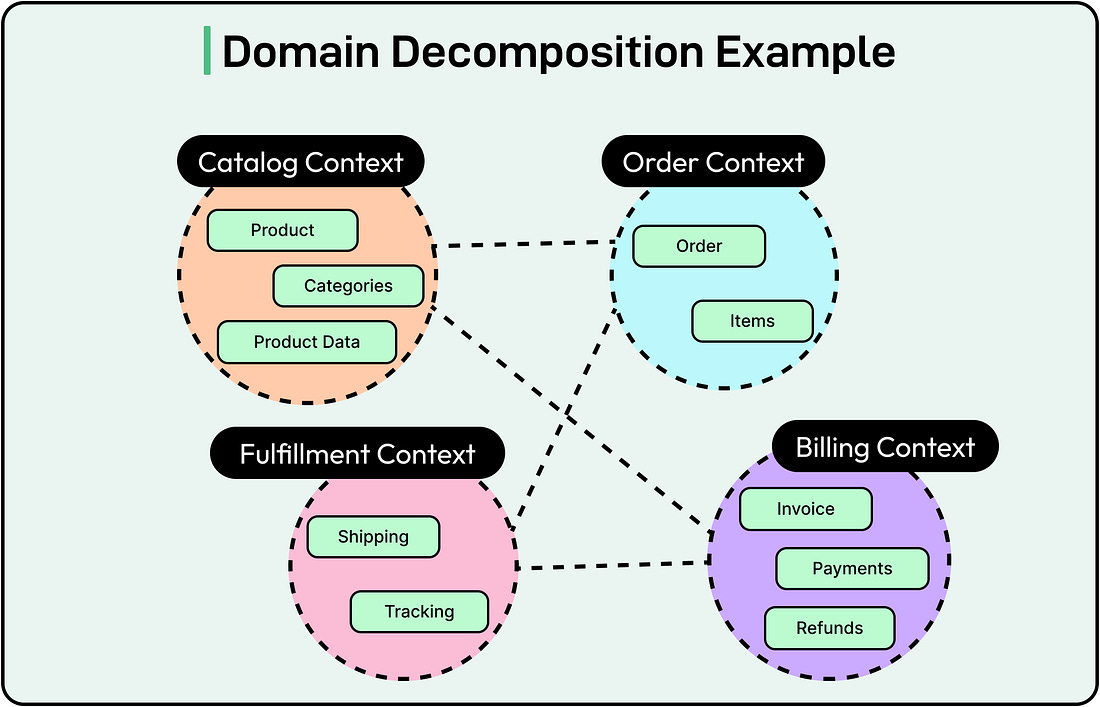
Airbnb implemented a multi-year replatforming initiative called Payments LTA, where LTA stands for Long-Term Architecture. The team shifted from a monolithic system to a capability-oriented services system structured by domains. This approach uses domain-driven decomposition, where the system is broken into smaller services based on business capabilities.
See the diagram below that shows a sample domain-driven approach:
 |
After the entire exercise, the core payment domain at Airbnb consisted of multiple subdomains:
The Pay-in subdomain handles guest payments.
The Payout subdomain manages host payments.
Transaction Fulfillment oversees the complete transaction lifecycle.
The Processing subdomain integrates with third-party payment service providers.
Wallet and Instruments for stored payment methods.
Ledger for recording transactions.
Incentives and Stored Value for credits and coupons.
Issuing for creating payment instruments.
Settlement and Reconciliation for ensuring accurate money flows.
This modernization approach reduced time to market for new features, increased code reusability and extensibility, and empowered greater team autonomy by allowing teams to work on specific domains independently.