|
Sam Drysdale
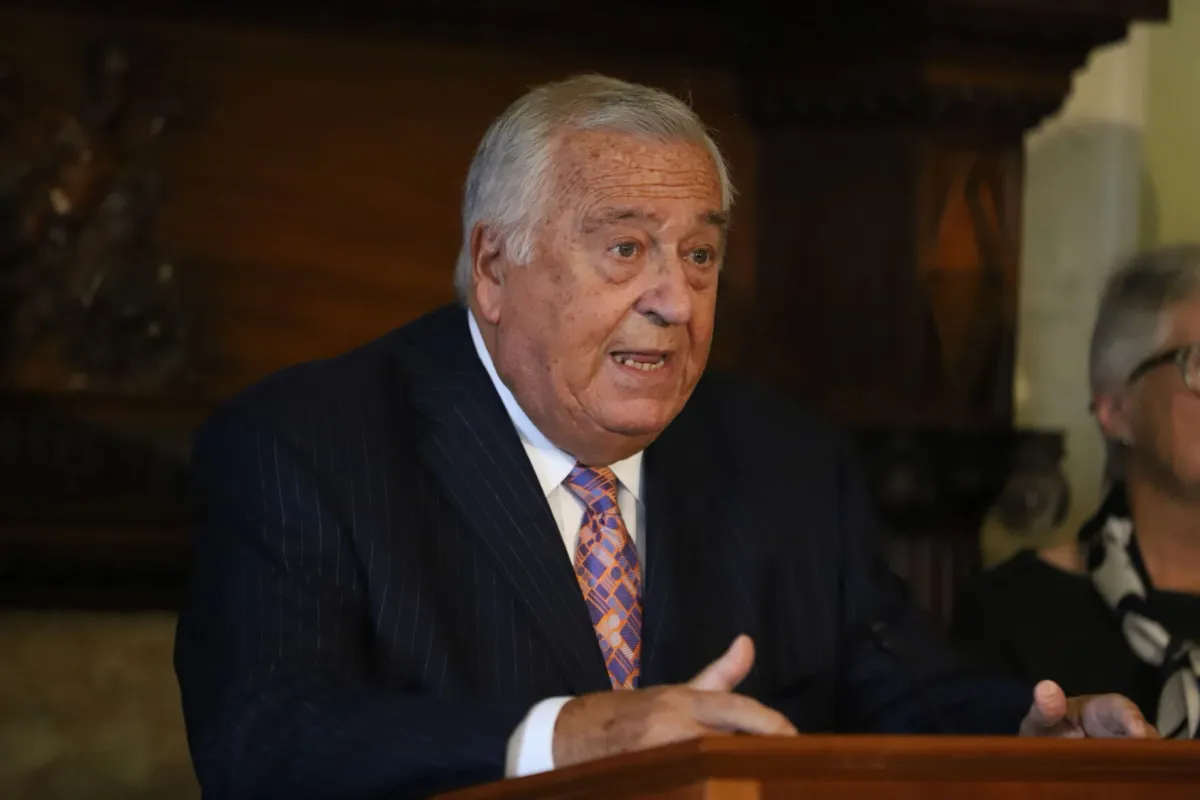
State House News Service With a vote on an immigrant protection bill looming, House Speaker Ron Mariano is blasting ICE as "far from" transparent, Gov. Maura Healey is demanding federal data on arrests, and federal officials say the governor is overlooking federal immigration laws. Healey asked the U.S. Department of Homeland Security on Friday to provide information within a week on every immigration arrest in Massachusetts since January 2025, arguing agency data shows many detainees lack criminal records. The push comes as lawmakers mull proposals from the Black and Latino Caucus, including the so-called PROTECT Act, which would bar civil immigration arrests in sensitive locations such as courthouses without a warrant, and a separate broader immigrant protection bill backed by Healey. "What we're doing is trying to guarantee that if you're in our state, you are going to get the same rights as everyone else in our state," Mariano said on WCVB's On the Record on Sunday. "There's no reason why you should be denied if you got here and you're not a criminal. Let me preface this: you're not here on a criminal charge. You deserve to be treated just like everyone else." As representatives weigh legislative options, Mariano has repeatedly pointed out that their powers are limited — and that they cannot reform immigration policy, as that authority lies with the federal government. The House is trying to "find out where the lines are," Mariano said, later emphasizing a focus on ensuring that whatever legislation they pass will hold up in court. "You want to go in there on solid footing, and we wanted to talk to the folks who are on the front lines," he said, referring to House efforts to communicate with local law enforcement officials about the situation. Healey is taking the case of immigrants straight to Washington. Her letter to the Department of Homeland Security and Acting U.S. Immigration and Customs Enforcement Director Todd Lyons demanded "complete and accurate information on every person arrested in Massachusetts since January 2025, including the identity of each individual, the legal basis for each arrest, case status, detention location, court jurisdiction, and upcoming hearing dates." Her office said the governor is challenging ICE's claims "that it is targeting the 'worst of the worst,'" by citing data that the majority of people arrested in Massachusetts have no criminal history. "Many of those taken into custody are long-standing members of our communities—parents, caregivers, and workers whose sudden detention leaves their families in crisis," Healey wrote. "This has had far-reaching consequences for their children, families, our communities, and the state of Massachusetts." In a response posted to X on Friday, Lyons and U.S. Attorney Leah Foley called out Healey. "Isn't it rich that the very governor who refuses to share information with federal law enforcement is now demanding information on ICE arrests? She forgets that being in the country illegally is, in fact, illegal," they wrote. "The truth is every single alien arrested during Operations Patriot and Patriot 2.0 was in violation of U.S. immigration law," they wrote. "The majority of those had committed serious crimes in the United States or in their native countries. Most were released due to local and state jurisdictions refusing to cooperate with ICE. Why does Governor Healey wish to impede ICE from removing criminal illegal aliens from the Bay State?" Lyons and Foley wrote that two ICE sweeps through the state resulted in more than 2,860 immigrant arrests. Healey's office also outlined the arrest data, though they additionally claim about half of those arrested had no criminal background. "According to ICE's own public statements, a May 2025 surge operation known as 'Operation Patriot' resulted in 1,461 arrests in Massachusetts, yet 46 percent of those detained had no criminal charges or convictions. A second surge operation in September 2025, 'Operation Patriot 2.0,' resulted in 1,406 arrests, with approximately 57 percent of those detained having no criminal background. ICE has released limited public information about only a small fraction of those individuals," says a release from the administration. Healey also pointed to her own immigration legislation — she signed an executive order in January to ban new 287(g) immigration enforcement agreements "unless there is a public safety need." The Department of Correction is currently partnered with federal immigration enforcement through the agreements. Her order would also to prohibit ICE from making civil arrests in non-public areas of state facilities, and to ban the use of state property for immigration enforcement staging. She also filed legislation that her office says is designed to keep ICE out of courthouses, schools, child care programs, hospitals and churches; make it unlawful for another state to deploy its National Guard in Massachusetts without the governor's permission; and allow parents to pre-arrange guardianship for their children in case they are detained or deported. The so-called PROTECT Act (H 5158), which the House has pointed to as a model, adds restrictions to local police cooperation with federal immigration enforcement, and with only a few exceptions bans new 287(g) agreements, as well as significantly expands protections from immigration arrests at courthouses. "We found a number of different issues that directly impact the refugees that are being hassled," Mariano said. He said "since we can't have any control over the immigration policy — it's a federal issue" that they brought together law enforcement entities last week in a forum to discuss the PROTECT Act, what the state is within its rights to do and "how we can have an impact on the process without overstepping a boundary and infringing upon the federal rights that these folks have to run their programs." He spoke about protecting people's First and Second Amendment rights, as well as their right to counsel and phone calls while in detention. "They can't just put you on a bus and send you to New Hampshire or wherever else they're sending you," he said. "We'll take all those egregious circumstances that they've used to beat up people and strong-arm people, and back them off, so that if you are in Massachusetts, you know that you will get the same rights as anyone else." A partial federal government shutdown has been ongoing since Feb. 14, as Democrats in Congress withhold votes to fund the Department of Homeland Security until certain demands on immigration reform are met. The New Democrat Coalition, the largest Democratic Caucus in the House, is demanding reforms such as ending arrests without judicial warrants and, outside of exigent circumstances, arrests at sensitive locations such as churches, shelters, schools and courthouses. They're also asking for federal agents to remove masks and provide identification, ensure minimum standards of care at detention facilities, and ensure independent investigations into all DHS-related shootings. Some of the demands mirror measures in the state bill, but Mariano spokesperson Ana Vivas said the House is not necessarily waiting for the DHS funding and Congressional immigration debate to be resolved to move forward, as the speaker continues to point out the state's limited power legislating the issue.
|