| | In this edition: Lessons from the Texas primaries, Trump’s rocky Iran polls, and a Charlie Kirk bann͏ ͏ ͏ ͏ ͏ ͏ |
| |  EL PASO EL PASO | CHARLESTON |  WASHINGTON, D.C. WASHINGTON, D.C. |
 | Americana |  |
| |
|
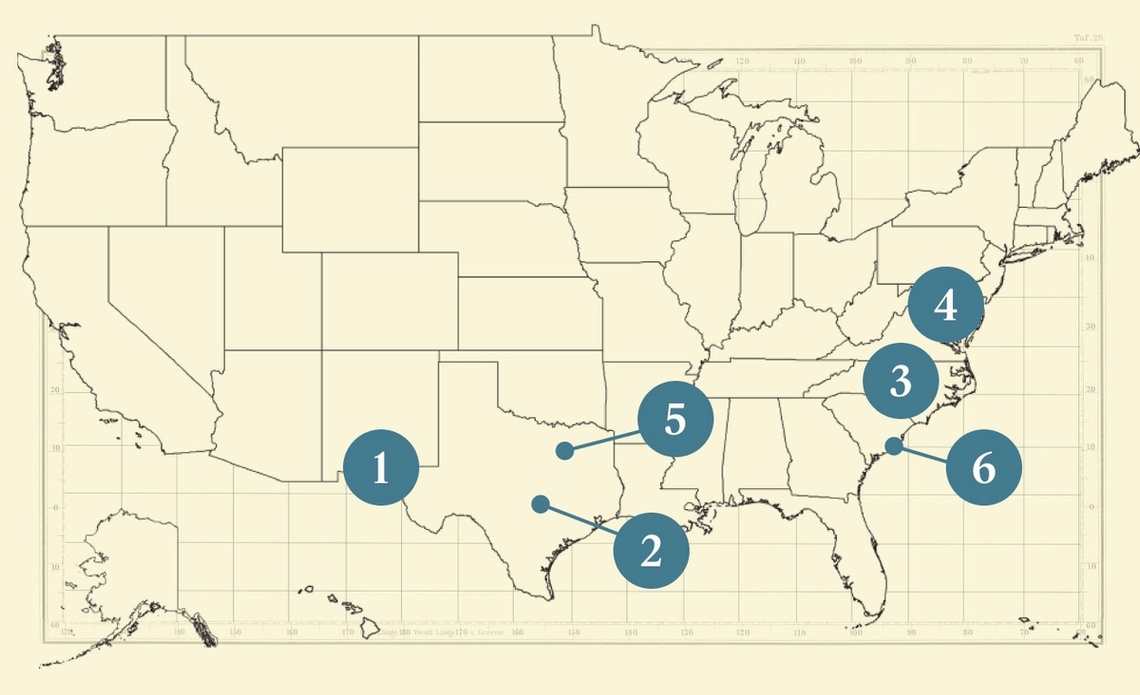 - What Texas’ primaries told us
- Texas personality crisis
- The Foushee-Allam endgame
- Trump’s rocky Iran polls
- Texas’ ad landscape
- Third Way’s way
|
|
Biggest takeaways from Texas’ primaries |
 Joel Angel Juarez/Reuters Joel Angel Juarez/ReutersTexas voters forced Sen. John Cornyn into a May runoff last night, and nominated state Rep. James Talarico to face the eventual nominee. That was the result Republicans had hoped to avoid, after breaking spending records to weaken state Attorney General Ken Paxton, convincing President Trump not to make an endorsement — polling suggested that it would have locked up the race for Paxton — and nudging Rep. Jasmine Crockett into the Democratic primary. Cornyn fared better than some other conservatives who had crossed Trump in the past or been targeted by America First campaigners. Rep. Dan Crenshaw became the first member of Congress this year to lose a re-nomination fight, a landslide loss to state legislator Steve Toth, who got help from Tucker Carlson (a friendly interview last year) and Sen. Ted Cruz (an endorsement that ran on TV at the end of early voting). Cornyn led Paxton in the vote count as of Wednesday morning, but Rep. Tony Gonzales trailed in his rematch against 2nd Amendment influencer Brandon Herrera. Delays at polling places in Dallas and El Paso slowed the overall count, but for the first time in more than two decades, more Texans pulled a Democratic ballot than a Republican ballot. Republicans got the candidates their national party wanted in two south Texas seats re-drawn to take advantage of Latino voters’ shift right, which accelerated in 2024. GOP turnout was high, but in some Rio Grande Valley precincts, Democratic primary candidates got more votes than Kamala Harris did when she faced Trump. |
|
Talarico-Crockett on the ground |
 Kaylee Greenlee/Reuters Kaylee Greenlee/ReutersROCKWALL, Texas — Rep. Jasmine Crockett spent the final day of early voting on a trek from east Texas to her Dallas home base, stopping at polling places, meeting huge crowds of people backing her Senate campaign. Sometimes, she had enough time for a stump speech about turnout: “We are not deep-red, we are voter-suppressed.” She told supporters to “get in your group chats” and line up for selfies. Texas Democrats rejected Crockett on Tuesday, nominating state Rep. James Talarico to compete for a Senate seat their party hasn’t won since the 1960s. In any recent year, Crockett’s vote total would have been enough to win it. But turnout exploded for Democrats — Texas voters can pull a ballot in either party’s primary — to the benefit of Talarico, a 36-year-old former seminarian whose fame from viral floor debates, podcasts and TV interviews helped him raise $21 million. Crockett raised less, but built a fanbase of her own. Both candidates conquered the attention economy. Talarico saw that as a necessity. “A handful of billionaires have redesigned our politics for their own profit,” Talarico said at a rally in Dallas last week. “It’s us versus them, trolling, owning, name calling, winning at all costs. It’s professional wrestling. We all keep watching, we all keep scrolling, we all keep fighting, and they keep getting richer.” Read our reporting, before the polls closed, about the Senate race. → |
|
|
An incumbent holds on in N.C. |
 Rep. Valerie Foushee. Andrew Harnik/Getty Images Rep. Valerie Foushee. Andrew Harnik/Getty ImagesNorth Carolina Rep. Valerie Foushee narrowly won her re-match with Durham county commissioner Nida Allam, holding off a challenger who ran aginst against AI data centers and called Israel’s actions in Gaza “genocide.” That was before the US-Israel war in Iran, which both candidates opposed — but Allam was more ready to talk about. Last Sunday, Allam sat in her children’s play room to record the first political ad condemning the war. It also condemned Foushee for taking money from “the same AI corporation that powered Trump’s attacks.” Before the ad went live, Allam told Semafor that “the road to another endless war runs right through [Foushee’s] office.” Foushee had benefited greatly from pro-Israel PAC spending in 2022; last year, she said she’d reject it, and Allam confidently campaigned with Bernie Sanders as the more credible anti-war, Israel-critical candidate. She fell short, but Foushee’s climb-down from her old support for Israel encouraged Allam’s allies, who have many more targets in the six-month primary season. “AIPAC was already becoming the NRA of this cycle, and their proud support of illegal regime change in Iran makes it even clearer,” said David Hogg, the founder of the Leaders We Deserve PAC, which went in early for Allam. |
|
Public support missing for Trump’s Iran war |
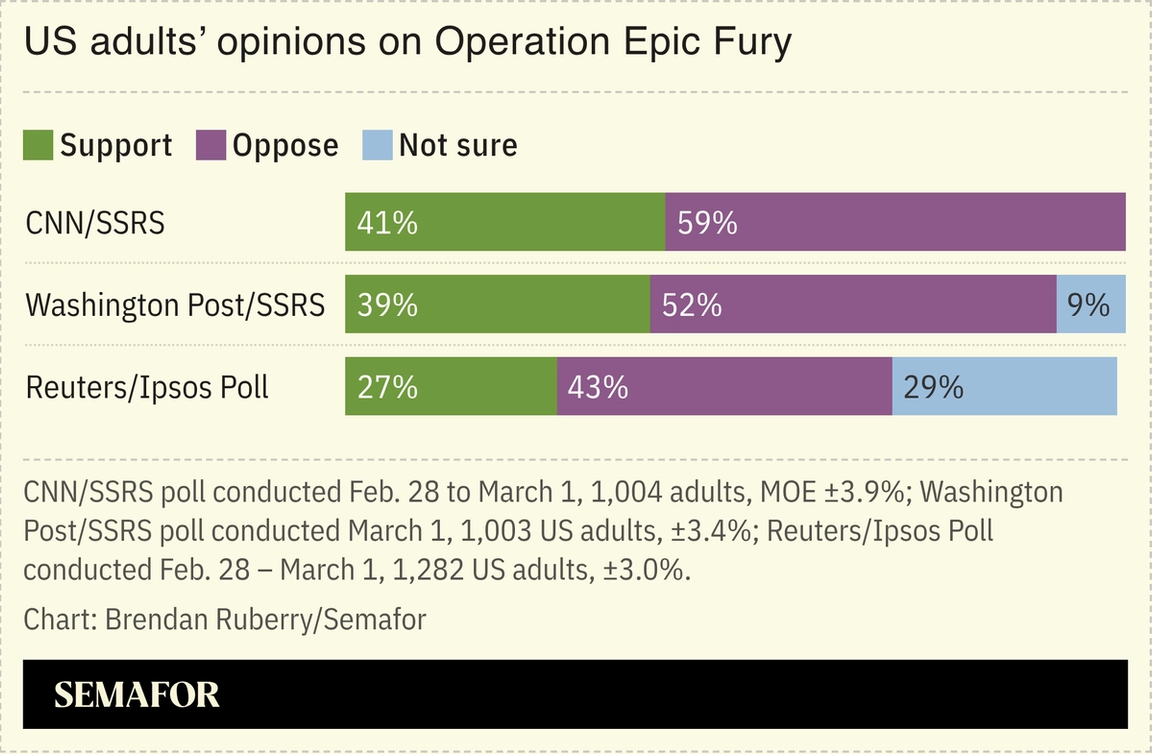 Six years ago, when President Trump ordered airstrikes in Iraq that killed one of Iran’s top military commanders, a slight majority of Americans supported it. That majority hasn’t materialized for any of the foreign military interventions of Trump’s second term. CNN’s polling found slightly more support for last year’s Trump strikes on Iranian nuclear facilities than for the first strikes of this war, and Reuters found slightly more support for the January military operation that removed Venezuelan President Nicolás Maduro. All of the support is propped up by Republicans; 77% of them approve of the strikes in CNN’s poll, 37% of them approving “strongly.” Most of the president’s base is still with him, but these early polls show how cool Americans are to any foreign intervention of choice. |
|
The future of the Texas ad wars |
 Greg Abbott/YouTube Greg Abbott/YouTubeThe Texas ad wars didn’t end last night. John Cornyn and Ken Paxton will fight out their race for another 10 weeks. But we learned plenty from what aired this winter. Texans for Greg Abbott, the governor’s reelection campaign, had no serious primary challenge and spent six figures to run “Defeat the New Radical Left,” an ad that attacks Crockett as an accomplice of “socialists” in Washington that was designed to boost her support in her primary. (Crockett insisted the spending was evidence that Republicans didn’t want to run against her.) Republicans in competitive races were more likely to invoke the president, whether or not he endorsed them. Trump was neutral in the GOP’s state attorney general primary, but state Rep. Mayes Middleton built his campaign around rival Rep. Chip Roy’s criticism of the 2020 election challenge and his libertarian views. “President Trump Doesn’t Trust Chip Roy” packaged all of that together, even arguing that Roy’s constitutional concerns about legislation on gender-affirming care amounted to him supporting “child transgender surgeries.” |
|
 Business — and the way companies operate — is transforming in ways both subtle and seismic. The forces moving Wall Street and global enterprise are accelerating, powered by AI breakthroughs, shifting capital flows, and evolving ideas about risk. In every sector, technology, regulation, and government are rewriting the balance of power and possibility. To help decode the fast-changing forces reshaping business and markets, Semafor is launching Compound Interest from Semafor Business — a podcast featuring in-depth conversations with the leaders building the next chapter of the global economy. Led by Semafor Business journalists Liz Hoffman and Rohan Goswami, Compound Interest will pull back the curtain, and talk directly to the operators, experts, and innovators behind some of the world’s most consequential companies. On this week’s inaugural episode, Uber CEO Dara Khosrowshahi explains how the company is evolving from ride‑hailing app to an AI‑era operating system for moving people and stuff around cities. |
|
One major Dem group’s plan for 2028 |
 David Weigel/X David Weigel/XCHARLESTON, S.C. — Don’t be led around by “the groups.” Don’t worry about what people say on X or Bluesky. And please, please, please: Don’t be boring. On Sunday and Monday, the centrist Democratic think tank Third Way gathered allies, reporters, and potential 2028 campaign staff for “Winning the Middle,” an effort to organize their faction of the party and avoid the leftward march they blame for Donald Trump’s comeback. Joe Biden had left the city 24 hours earlier, after a celebration of the 2020 primary win that sent him to the White House. That win, said Third Way’s leaders, was undone by Biden’s decision to bring Bernie Sanders’ allies into the party’s platform and transition committees. “Democrats’ post-Obama drift left must be reversed,” said Third Way president Jonathan Cowan at the start of the conference. Biden and the liberals of his era had not effectively resisted ideas like “defund the police, a Green New Deal that would ban fossil fuels by 2030, open borders, modern monetary theory that says deficits or inflation are good, a $44 trillion government takeover of health care, land acknowledgements, identity politics, cancel culture and more.” Conference attendees got new polling on their voters’ media preferences (YouTube, not Bluesky), advice from pragmatic liberals who’d battled the left (San Francisco District Attorney Brooke Rollins), and face time with the South Carolina Democrats who helped Biden win in 2020. Third Way’s Jim Kessler described the candidate key voters wanted: A “crusading reformer” who would fight Trump, while disagreeing enough with leftists that moderates knew they could trust him. |
|
 - 13 days until primaries in Illinois
- 62 days until primaries in Indiana and Ohio
- 244 days until the midterm elections
- 887 days until the Democratic National Convention
|
|
|


