| | In today’s edition: Washington offers tanker escorts, UAE stock markets take a tumble, and Iran targ͏ ͏ ͏ ͏ ͏ ͏ |
| |  Tehran Tehran |  Washington DC Washington DC | Abu Dhabi |
 | Gulf |  |
| |
|
 - US opening up Hormuz
- UAE stocks plunge
- IRGC spies in the Gulf
- Data centers vulnerable
- Trump’s economic challenge
 Some airlines are continuing to fly. |
|
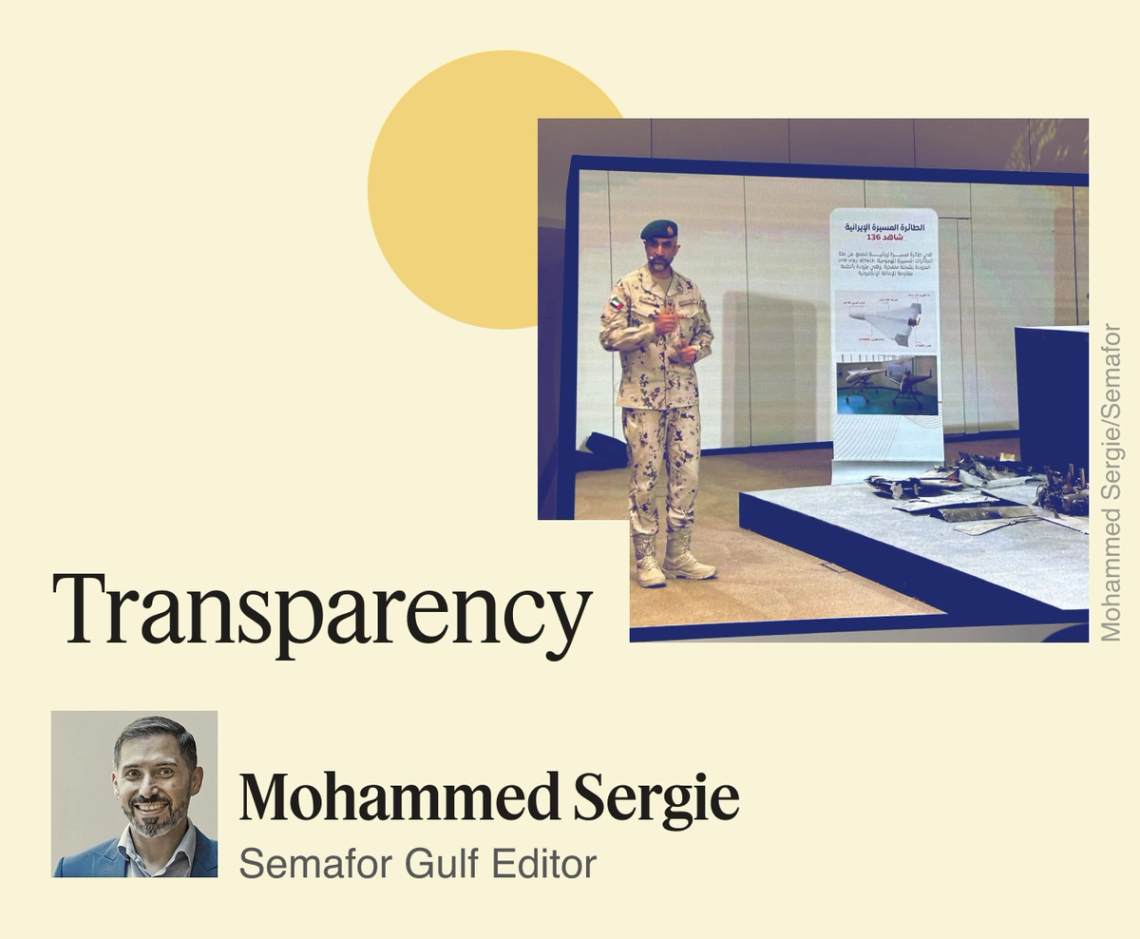 The UAE government is being uncharacteristically open about the war it has found itself in. At a briefing in Abu Dhabi yesterday, generals and ministers outlined how the country is responding to the onslaught of more than 1,000 Iranian missiles and drones. While they didn’t take questions, some military officers lingered afterward, discussing the capabilities of the intercepted ballistic missiles and drones whose carcasses were on display. In a region where governments reveal as little as possible even in peacetime, the level of disclosure so far has been striking. Narrative control is a driver: The UAE is packed with influencers who have bigger audiences than official channels — and dwarf that of your humble writer — and misinformation can spread faster than any statement on a government newswire. But in the fog of war the stakes go beyond fake news. The UAE’s reputation as a haven in a volatile neighborhood has helped tourism flourish, contributing around 13% of GDP. Luxury real estate, family offices, AI data centers, and all the non-oil portions of the economy depend on effective government and security. Air defenses have so far intercepted the vast majority of threats. If the UAE, and the wider Gulf, are able to hold — and if the war ultimately curbs Iran’s ability to launch missiles at its neighbors, as the latest US objective states — the entire region may emerge stronger. |
|
Trump offers Hormuz insurance |
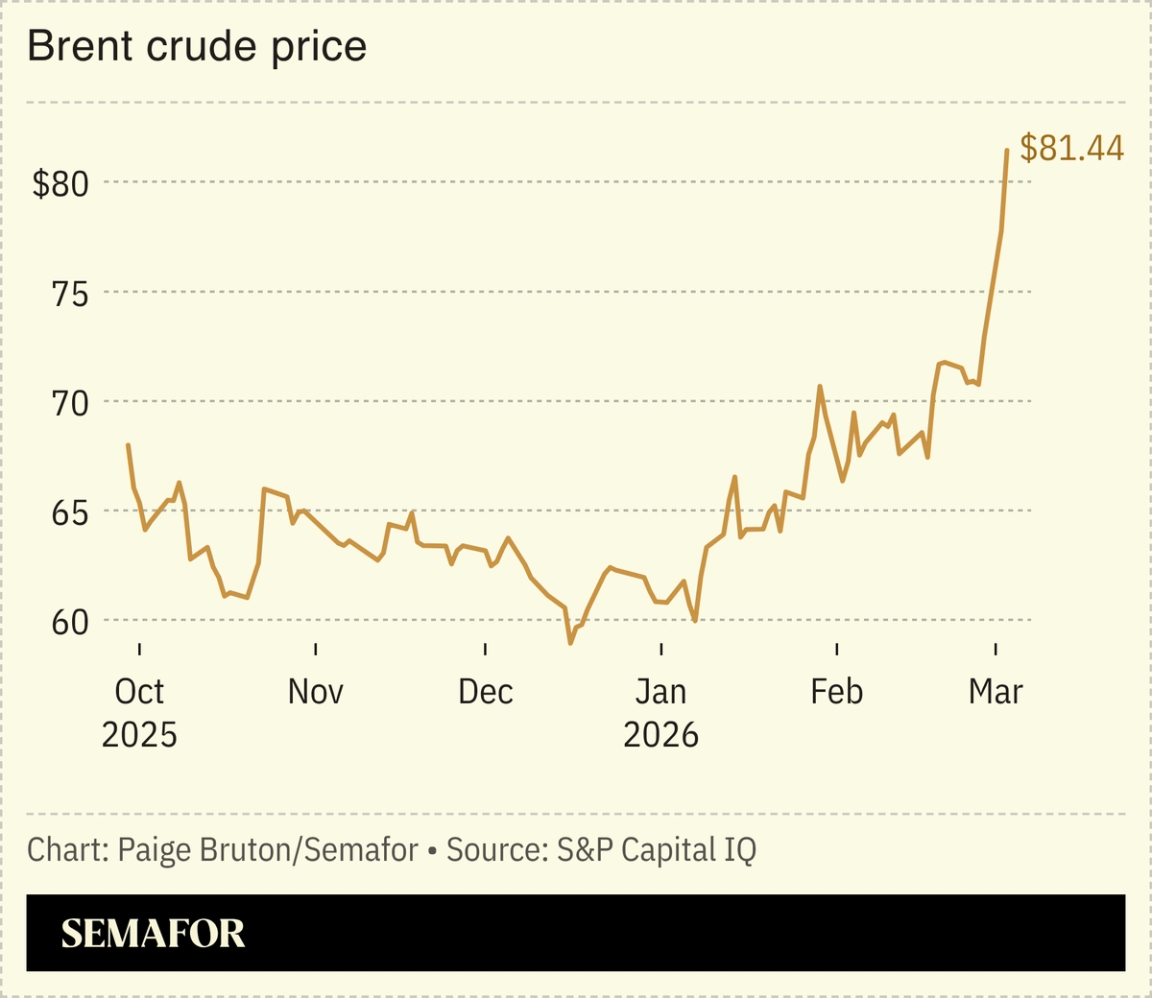 Oil markets took some comfort from US President Donald Trump’s pledge to protect and insure tankers traveling through the Strait of Hormuz, which handles around a fifth of global seaborne oil supplies. Crude oil had briefly risen to more than $85 a barrel on investor concerns about a potential energy crisis caused by Iran’s threat to block the passage of ships, but prices have eased from that high. The shipping industry said Trump’s assurances were only a partial solution, given the risk to other infrastructure. Around 10 vessels have been targeted in the Gulf or in waters near Oman since the war started, while Saudi Aramco’s Ras Tanura refinery also came under a fresh attack on Wednesday, although there was no damage. QatarEnergy has declared force majeure on LNG shipments, having said earlier in the week it had halted production amid the Iranian strikes. Aramco is now reviewing alternatives to shipping oil through the Gulf, including using its east-west pipeline to export crude via the Red Sea, and using Egypt’s Sumed pipeline to the Mediterranean, according to people familiar with the matter. It needs new export routes to avoid having to curtail production as storage facilities in the country quickly fill up, Antoine Halff, founder of analytics company Kayrros, wrote on LinkedIn. Iraq has already had to start shutting production at its biggest fields because of the closure of the Strait of Hormuz and a lack of storage facilities. — Matthew Martin |
|
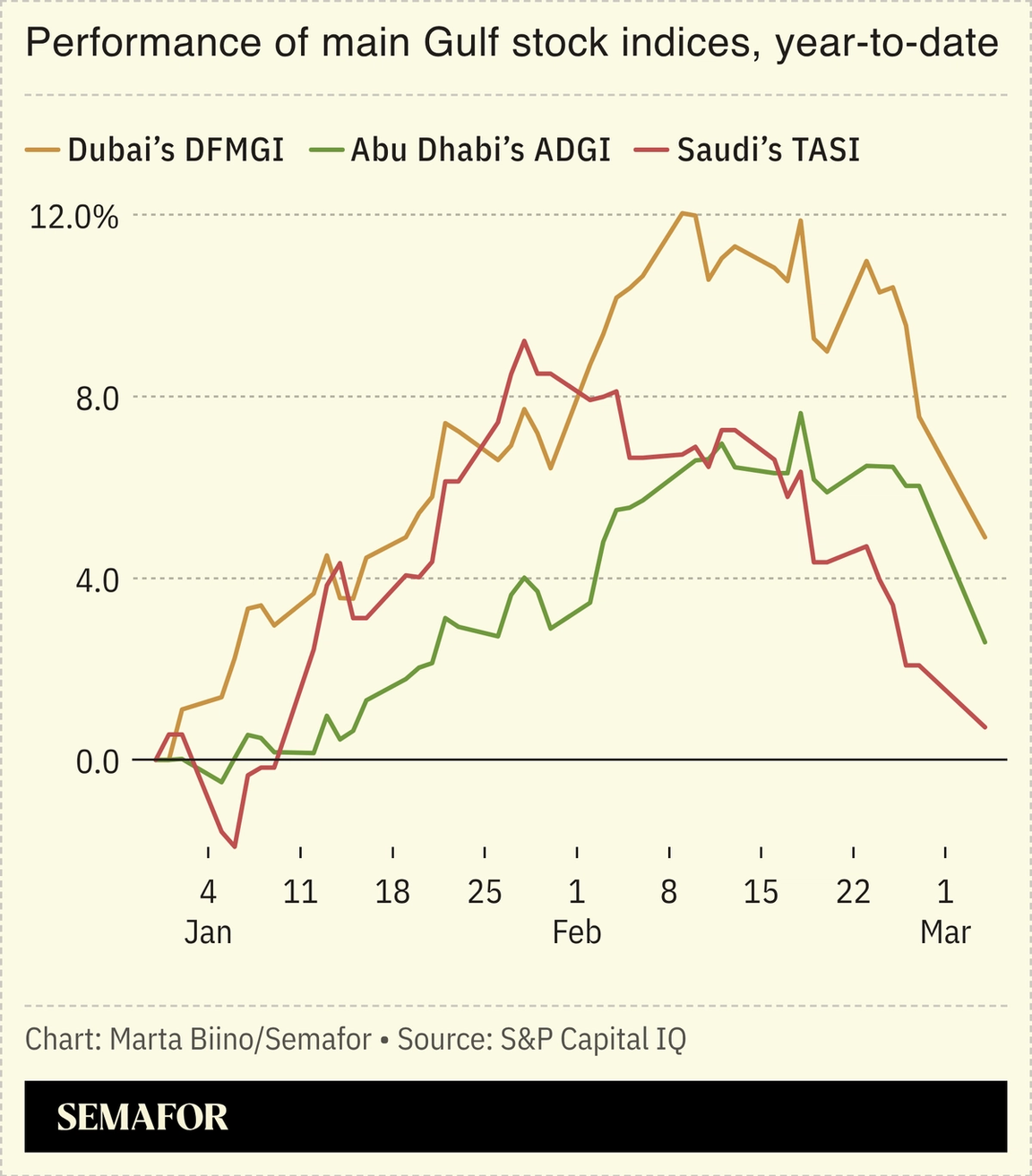 UAE stocks plunged on the first day of trading since the country was targeted by Iranian strikes. The main indices for the Abu Dhabi and Dubai bourses ended Wednesday down 1.9% and 4.7% respectively, with utility companies, banks, and property firms leading the declines. Emirati regulators had closed the country’s stock markets for two days as its main business hubs were attacked by Iranian missiles and drones, upsetting the cities’ long-developed reputations as stable trading centers insulated from regional volatility. Citigroup said in a note that the conflict could have a “profound and potentially long-lasting impact” on the region. Before the war, Dubai’s stock market had risen to the highest level since 2006, as the emirate’s economy and real estate market benefited from an ability to attract everyone from the super-rich to blue-collar workers. Elsewhere in the Gulf, markets that stayed open have recovered some earlier losses. Saudi Arabia’s main index was up 1.7%, regaining most of the ground lost since the war began. Brookfield added its name to the list of big investors saying the conflict hadn’t impacted its appetite for investing in the region. — Matthew Martin |
|
Iran strikes US military assets |
 Smoke rises in the Fujairah oil industry zone following a fire caused by debris after interception of a drone by air defenses. Amr Alfiky/Reuters. Smoke rises in the Fujairah oil industry zone following a fire caused by debris after interception of a drone by air defenses. Amr Alfiky/Reuters.Iran’s attacks in the Gulf appear to be focusing on US military and intelligence assets. Communication and radar systems on at least seven US military sites have been hit, according to a New York Times analysis of satellite images. Some of the equipment helps track incoming missiles and coordinate operations. A drone strike on the US Embassy compound in Riyadh yesterday targeted the CIA station there, The Washington Post reported. The strikes suggest Iran has gathered intelligence on high-value targets in Gulf countries, potentially with assets on the ground. Qatar has arrested 10 people linked to Iran’s Revolutionary Guard Corps, accusing them of spying on military sites and planning sabotage. |
|
Data centers caught in Iran crossfire |
 A view of construction progress at the Stargate UAE data center in Abu Dhabi. Courtesy Emirates News Agency-WAM. A view of construction progress at the Stargate UAE data center in Abu Dhabi. Courtesy Emirates News Agency-WAM.Iranian drones have hit multiple Amazon data centers in Bahrain and the UAE, raising concerns about the security of similar facilities across the region, Semafor’s Rachyl Jones reports. The Gulf has sunk billions of dollars into building AI infrastructure in the hope of becoming a global hub for the technology. But data centers are often soft targets that can easily be damaged by missiles and drones. “The physical risks have increased substantially,” said Murat Kantarcioglu, a computer scientist at Virginia Tech who specializes in data security. Protection comes at a premium, though: Building data centers in nuclear-hardened bunkers costs more than $2,000 per square foot in the US, according to Larry Hall, who owns Kansas-based Survival Condo. At $200 million for the average sized facility (before energy, cooling, and server costs), that’s twice the cost of building above ground — and in the Middle East, it can be even more expensive depending on the terrain, he said. |
|
View: Trump’s race against time |
  Jonathan Ernst/Reuters Jonathan Ernst/ReutersUS President Donald Trump’s offensive against Iran may be constrained more by economics than any battlefield reality, geopolitics analyst Alaa Shahine Salha wrote in a Semafor column. Washington’s offer to insure and escort vessels travelling through the Strait of Hormuz points to an acknowledgment that sustained restrictions to energy flows could lead to higher inflation at home, and borrowing costs remaining high as a result, hitting his strategy. “My base case has been that Trump would soon take his wins and look for an off-ramp to end the most intense phase of the operation,” he wrote. “Now, it seems he is trying to buy more time. He needs the oil market to cooperate.” |
|
 Business — and the way companies operate — is transforming in ways both subtle and seismic. The forces moving Wall Street and global enterprise are accelerating, powered by AI breakthroughs, shifting capital flows, and evolving ideas about risk. In every sector, technology, regulation, and government are rewriting the balance of power and possibility. To help decode the fast-changing forces reshaping business and markets, Semafor is launching Compound Interest from Semafor Business — a podcast featuring in-depth conversations with the leaders building the next chapter of the global economy. Led by Liz Hoffman and Rohan Goswami, Compound Interest will pull back the curtain, and talk directly to the operators, experts, and innovators behind some of the world’s most consequential companies. On this week’s inaugural episode, Uber CEO Dara Khosrowshahi explains how the company is evolving from ride‑hailing app to an AI‑era operating system for moving people and stuff around cities. |
|
 - NYT: Iran can’t match Israeli or US firepower, so it is seeking to enlarge the battlefield and drive up the cost of war for Washington, in terms of casualties and economics.
- CNN: The US is seeking to foment rebellion inside Iran by arming Kurdish groups; even if they don’t succeed, it could stretch Iranian military resources more thinly.
- NYT: The late Supreme Leader Ayatollah Ali Khamenei’s son Mojtaba Khamenei is the front-runner to be the new Iranian head of state; a decision is expected soon from Tehran.
- Fox Business: Former Qatari Prime Minister Sheikh Hamad Bin Jassim Al-Thani (HBJ) said he was taken by surprise by Iran’s attacks on its Gulf neighbors and relations with Tehran will not return to their previous position, even when the war stops.
- Axios: The UAE is weighing up possible military action against Iran, after fending off more than 1,000 Iranian missiles and drones since the war started; other Gulf states could follow.
- The Economist: Iranian strikes have “shaken Dubai’s halo of safety” and “the stuff of small print has become reality” as companies in the UAE start looking for political risk insurance for the first time.
- AGBI: Hotels in the UAE could see revenues halve in the first quarter of the year, with some executives blaming ” anxiety and knee-jerk reactions” rather than a lack of safety.
- Faisal Abbas: The Arab News editor-in-chief said some reports have indicated that the attack on Saudi Arabia’s Ras Tanura refinery came from Iraq rather than Iran. If true, that will require urgent talks with Baghdad.
- Middle East Eye: Yemen’s Houthi rebels have stayed out of the war so far but could intervene to support their patron Iran if they think the Tehran regime is facing an existential threat.
|
|
|


