|
|
|
|
Good morning. Today, we’re breaking down the central ways oil makes the world work – and why rising prices driven by war in the Middle East would spread far beyond paying more at the pump. |
|
|
|
|
|
|
|
|
|
|
|
|
|
|
|
|
Retail: Roots Corp. could be up for sale as the iconic Canadian clothing and accessories brand launches a strategic review of the company. |
|
|
|
|
Trade: Churchill port signs development and trade partnership with massive Belgian terminal. |
|
|
|
|
Procurement: Canadian submarine contract speed is setting new standard, companies say. |
|
|
|
|
|
|
|
|
|
|
|
|
|
|
|
|
|
|
|
|
|
Water is poured into bottles made from a byproduct of polymer resin at a manufacturing plant in Dhaula Kuan, India. Anushree Fadnavis/Reuters
|
|
|
|
|
|
|
|
|
|
|
How oil fills up the economy |
|
|
|
|
Worries about the inflationary impact of higher oil prices are growing as the Middle East conflict continues to threaten the flow of crude. Prices of international benchmark Brent crested US$80 yesterday, and many analysts said US$100 is likely if the war lasts the month suggested by U.S. President Donald Trump. |
|
|
|
|
|
|
|
|
That would seem to be a best-case scenario, as uncertainty remains over Iran’s leadership after the killing of Ayatollah Ali Khamenei and many of his top lieutenants; over the severity and duration of the war, as more missile and drone attacks were carried out; and over the supply of oil, as the vital Strait of Hormuz remains effectively blocked – and as Iraq, OPEC’s second-largest producer, began to make deep reductions. |
|
|
|
|
It’s important to say, we think, that uncertainty also includes the possibility that something bad won’t happen. |
|
|
|
|
Trump might find it harder to back down on war in the Middle East than he did over his threats to annex Greenland, but similar market dynamics are coming into view: U.S. Treasury yields spiked yesterday, making it more expensive for consumers to borrow for things like homes and cars. That’s inflationary, and that would be poor timing for the President with the midterms ahead. |
|
|
|
|
Perhaps that’s one reason the market was muted on Monday, lost its resolve yesterday morning, then regained its composure before the close. And maybe, if investors are smart, they’ve read David Berman’s latest column. |
|
|
|
|
The wider concern, for many market watchers, remains the effect of rising oil prices. |
|
|
|
|
Economists have warned that sustained high prices for oil and gas could fan inflation,
making it less likely that central banks in the U.S., Canada, Britain and the European Union will trim interest rates. Economists at Deutsche Bank said yesterday that “should energy prices stick at current levels, we would expect [Bank of England] rate cuts to slow.” |
|
|
|
|
Canada is a net exporter of oil. But because oil is priced globally, consumers here are not immune to rising prices at the pump. And because crude is used to make and move so many things in the world, costlier oil can translate to costlier everything. |
|
|
|
|
|
|
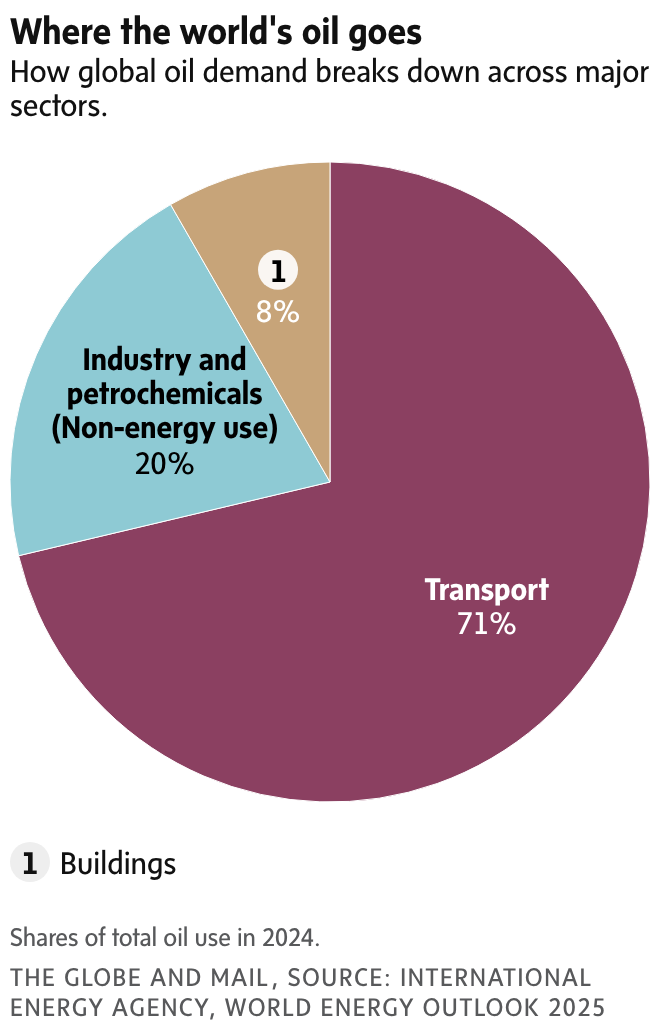
Transportation is by far the largest market for oil, which is the main ingredient in fuels like gas and diesel. But demand is growing in the petrochemicals category, which includes rubber, chemicals and synthetic fibres like polyester and nylon. |
|
|
|
|
Most notably, it includes plastics – a material used in packaging, bottles, consumer goods, electronics, your toothbrush, the expensive headphones my dog chewed to death, roofing materials and more. Plastics account for the highest growth area in this category, owing in part to rising incomes in developing regions and an increase in packaging for all those Amazon orders. |
|
|
|
|
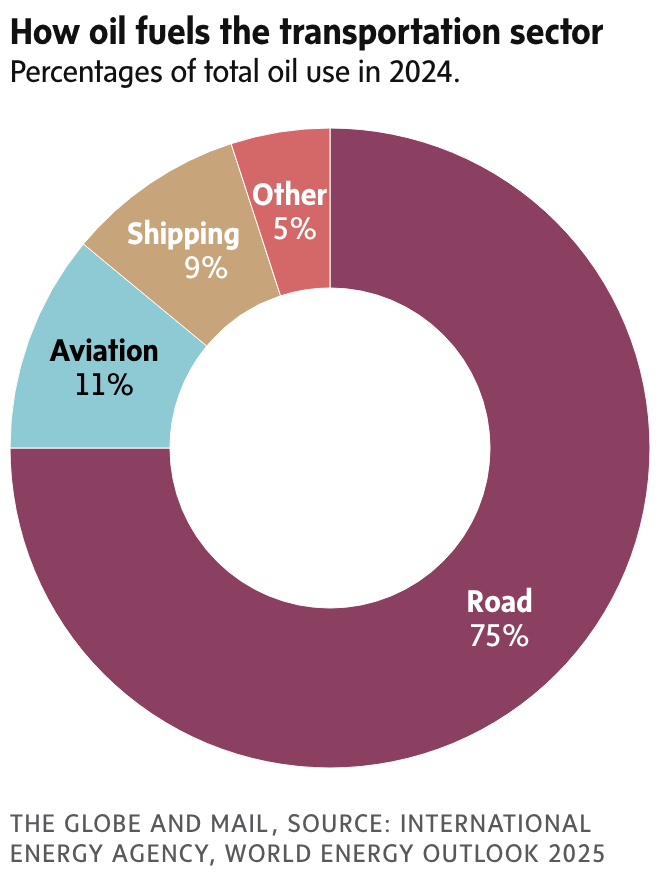
- That’s the widest view of how an oil gets used. Drilling even deeper into transport, we’re still looking at big slices of the economy. Here, “road travel” — the millions of passenger cars, trucks and freight vehicles keeping us trapped in traffic — accounts for the majority of oil use. (Traffic is other people rudely slowing us down. We’re innocent.)
|
|
|
|
|
|
|
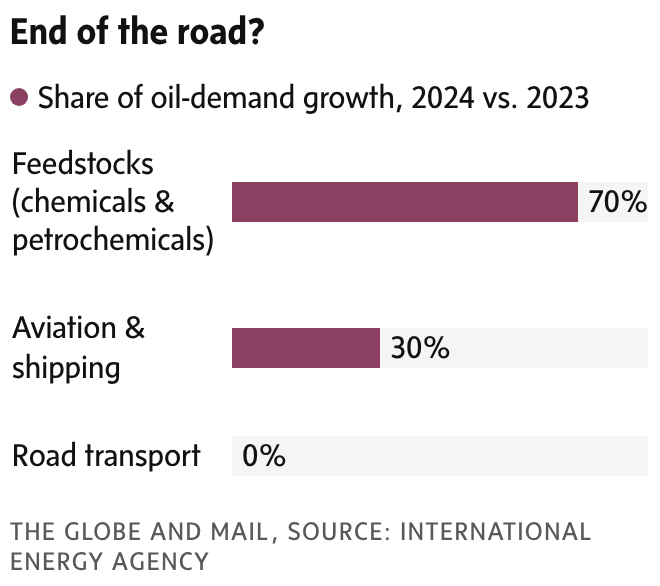
But in recent years, as electric vehicles have hit the market and countries move to cut emissions, oil-demand growth driven by road travel has already stalled out, according to the International Energy Agency: |
|
|
|
|
|
|
Trump said on Truth Social he has ordered the U.S. government to provide, “at a very reasonable price,” political risk insurance and guarantees for the financial security of “ALL Maritime Trade, especially Energy,” travelling through the Persian Gulf. |
|
|
|
|
If necessary, he said on his social-media platform, the U.S. Navy will begin escorting tankers through the Strait of Hormuz. |
|
|
|
|
Perhaps worries over the war will settle after an initial jump. “While concerning,” Bank of Montreal chief economist Douglas Porter told me yesterday, “it is possible that this will end up having only moderate impacts on the North American economy. |
|
|
|
|
“The key variable is oil prices.” |
|
|