| | The Iran conflict is creating a windfall for US natural gas exporters.͏ ͏ ͏ ͏ ͏ ͏ |
| |  | Energy |  |
| |
|
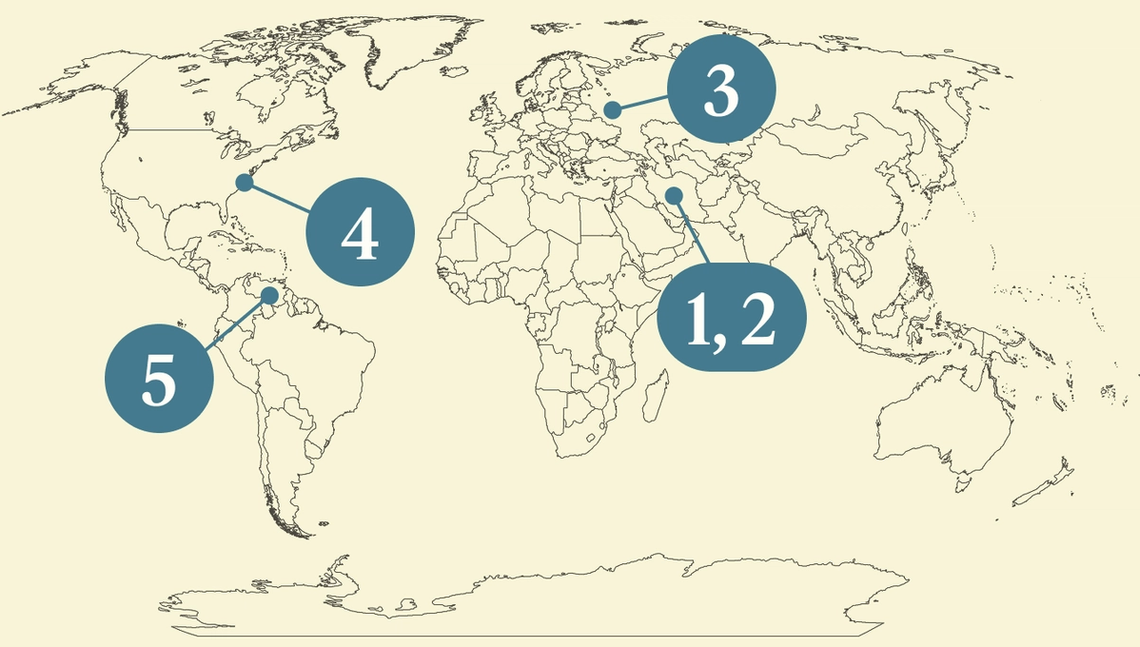 - Windfall for US LNG
- Insurance rates jump
- Good news for Putin
- US renewables record
- Investor headwinds in Caracas
 It’s a great time to be an energy trader. |
|
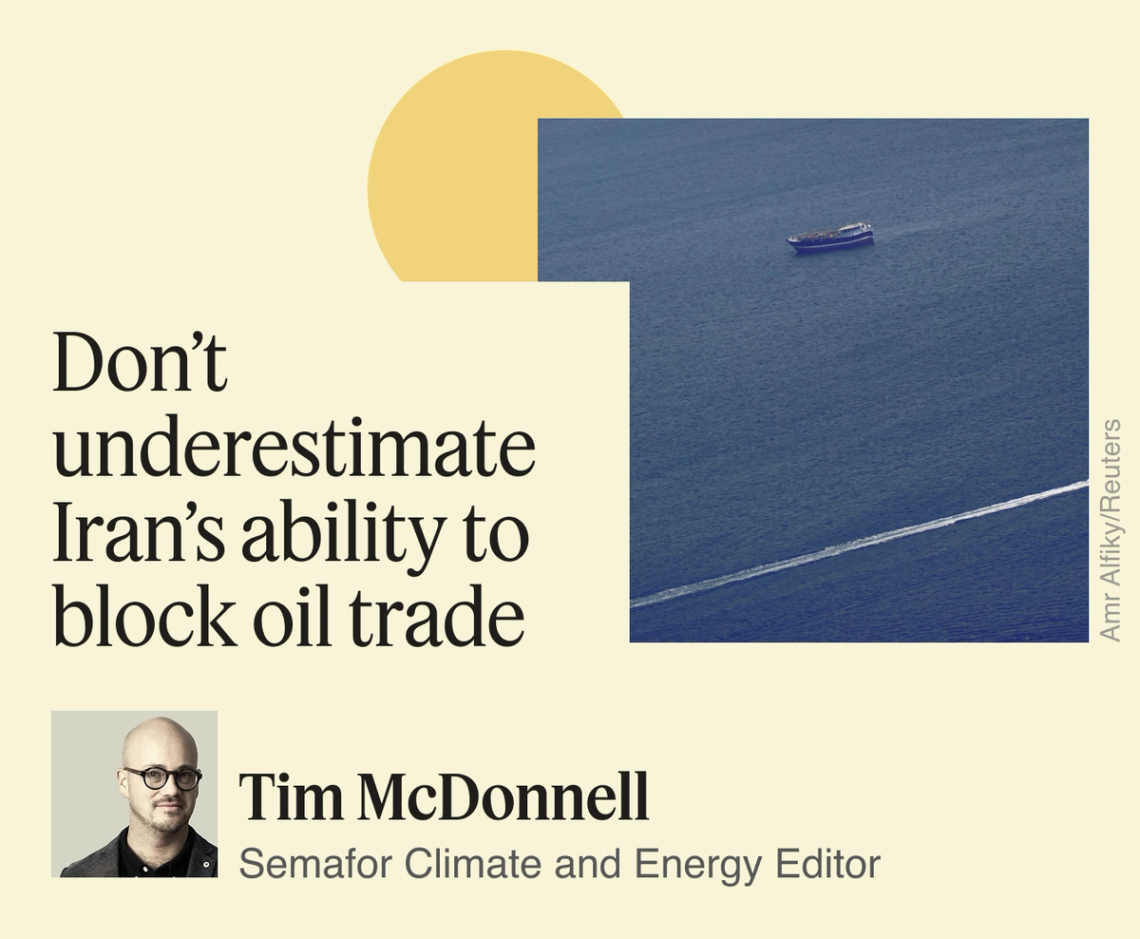 The biggest question in global energy markets this week is how willing and able Iran will be to enforce the closure of the Strait of Hormuz, and defense experts are warning not to underestimate the country’s capabilities. On Monday, a senior Revolutionary Guards official told state media that the strait, which carries about 20% of global oil and LNG traffic, is “closed” and that Iranian forces “will set those ships ablaze” if they try to pass. Time is a critical factor: If Hormuz traffic is disrupted for a week or so, market prices should settle down quickly, and at around $80 per barrel, prices are still much lower, inflation-adjusted, than they were during most of the war in Iraq. But a closure much longer than that could trigger the biggest energy bottleneck in decades, with dire consequences for consumers. Iran has a few options for enforcing this closure, defense experts told me. They could confront tankers directly with their own warships, but that would increase their vessels’ vulnerability to engagement with US forces, which, President Donald Trump said on Sunday, have already sunk nine Iranian warships. The second option is to use land-launched missiles and drones to target passing ships. As of Tuesday morning, at least seven tankers, including one of Iran’s own, have been damaged in this way. Attacking those missile launchers is a high priority for the US and Israel; according to Israeli media, half have already been destroyed. The third option is to lay sea mines in the Strait, which would make the situation “much more complicated,” Jonathan Panikoff, a former senior US intelligence official and director of the Atlantic Council’s Scowcroft Middle East Security Initiative, said. In the past, Iran has even used civilian vessels to lay mines, Mark Montgomery, a retired US Navy rear admiral and senior fellow at the Foundation for Defense of Democracies, told me. Sinking a few warships won’t solve the problem, he said: “We really need to destroy all Iranian Navy storage, logistics, and command facilities, so there’s a lot of work to be done.” In the meantime, US Secretary of State Marco Rubio said the administration will announce on Tuesday measures to blunt the impact of price spikes on American consumers — but reportedly will not consider selling oil from the Strategic Petroleum Reserve. |
|
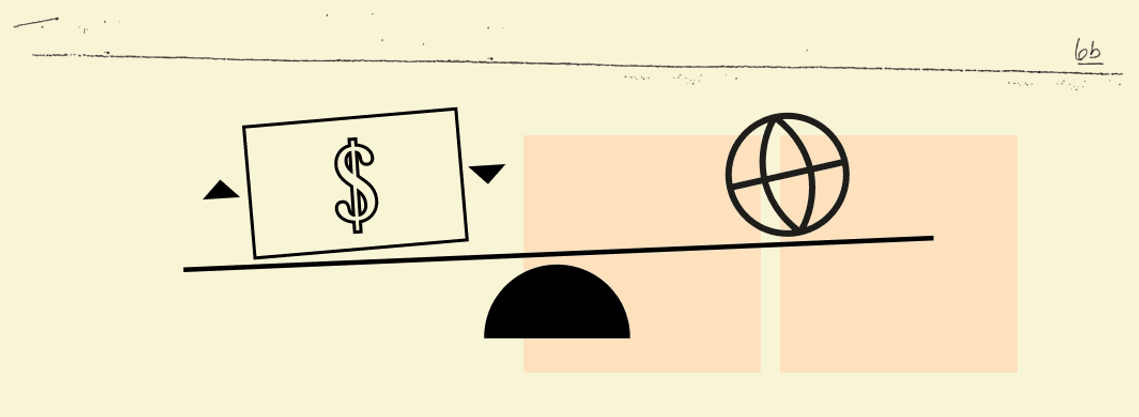
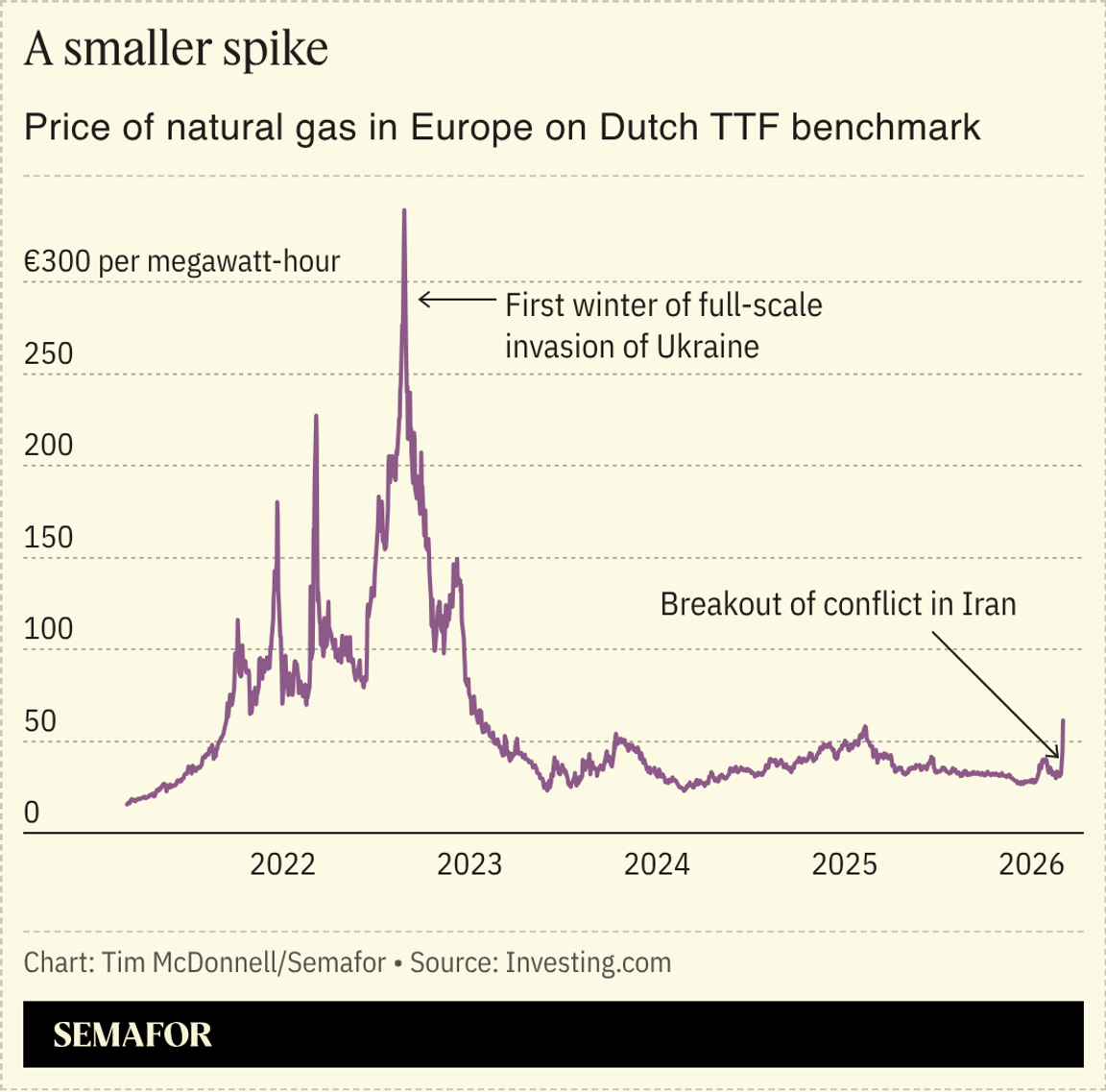 The Iran conflict is creating a windfall for US natural gas exporters. Gas prices in Europe jumped more than 20% on Tuesday after Qatar said it had suspended operations at the Ras Laffan LNG export facility, the world’s largest, following drone attacks. That’s the biggest spike in European energy prices since the 2022 Russian invasion of Ukraine. And as in that case, this latest disruption will pit European and Asian LNG buyers against each other, to the benefit of US exporters. Mike Sobel, CEO of LNG exporter Venture Global, told shareholders on Monday the company “stands ready to help keep the markets stabilized.” The company’s share price closed up nearly 20% on Monday; rival Cheniere Energy also saw a sizable jump. The gas market doesn’t have the same degree of supply flexibility as oil; there are few strategic reserves and little spare production or export capacity to fire up on short notice. Even the US can’t completely fill the gap left open by Qatar. For now, the price jump is far smaller than what Europe experienced in 2022. But if prices remain elevated, Goldman Sachs analysts warned, many lower-income countries could be forced to switch their power plants back to coal. |
|
 Stringer/Reuters Stringer/ReutersInsurance prices for oil tankers passing through the Strait of Hormuz could more than double, a leading broker told Semafor. Before conflict broke out over the weekend, insurance rates for most oil tankers in the region were around 0.25% of the value of the ship, said Marcus Baker, global head of marine and cargo for the brokerage and risk advisory firm Marsh. Now that Iranian forces have threatened to attack any ship entering the Strait, and followed through in several cases, many insurers are cancelling pre-existing war risk policies and looking to renegotiate at higher prices. Although some insurers quickly angled for sky-high rates that Baker described as “nonsense,” the market hasn’t yet coalesced around a standard rate. But Baker said he expects that within the next day or so, rates will shake out at a level at least double what they were prior to the weekend. Still, he pointed out, that’s far lower than the eye-watering 5% rate that ships faced navigating the Black Sea at the beginning of the Ukraine invasion. Rates are likely to remain highly volatile until there’s a clearer indication of what the US Navy is willing and able to do, including potentially escorting convoys of tankers through the Strait. Even then, Baker said, some shipping companies and captains may decide that, insured or not, they simply don’t want to take the risk. |
|
 Manon Cruz/File Photo/Reuters Manon Cruz/File Photo/ReutersThe upswing in global oil prices could drain political momentum for enforcing stronger sanctions against Russia. Russia’s oil and gas revenue is down by 27% compared to pre-2022 levels, thanks to US and European sanctions and overall low oil prices. But the Kremlin could be a key winner, at least temporarily, from turmoil in the Middle East, Luke Wickenden, sanctions analyst at the Center for Research on Energy and Clean Air, told Semafor. If major disruptions to physical oil supply materialize over the coming days, it will erode the leverage that countries such as China and India have used to extract steep discounts from Russia, Wickenden said. Western governments may also be less inclined to enforce existing sanctions or apply new ones in a highly-constrained energy market — although Belgium seized a Russian shadow fleet tanker as recently as Saturday, and the new sanctions bill in the US Senate was already bogged down before the Iran situation began. In the meantime, Senate Democrats are still pushing for a separate bill to target Russia’s shadow fleet. “We would hope that Western sanctions policy remains anchored in Russia’s geopolitical aggression rather than short-term oil price movements,” Svitlana Romanko, director of the Ukrainian advocacy group Razom We Stand, told Semafor. |
|
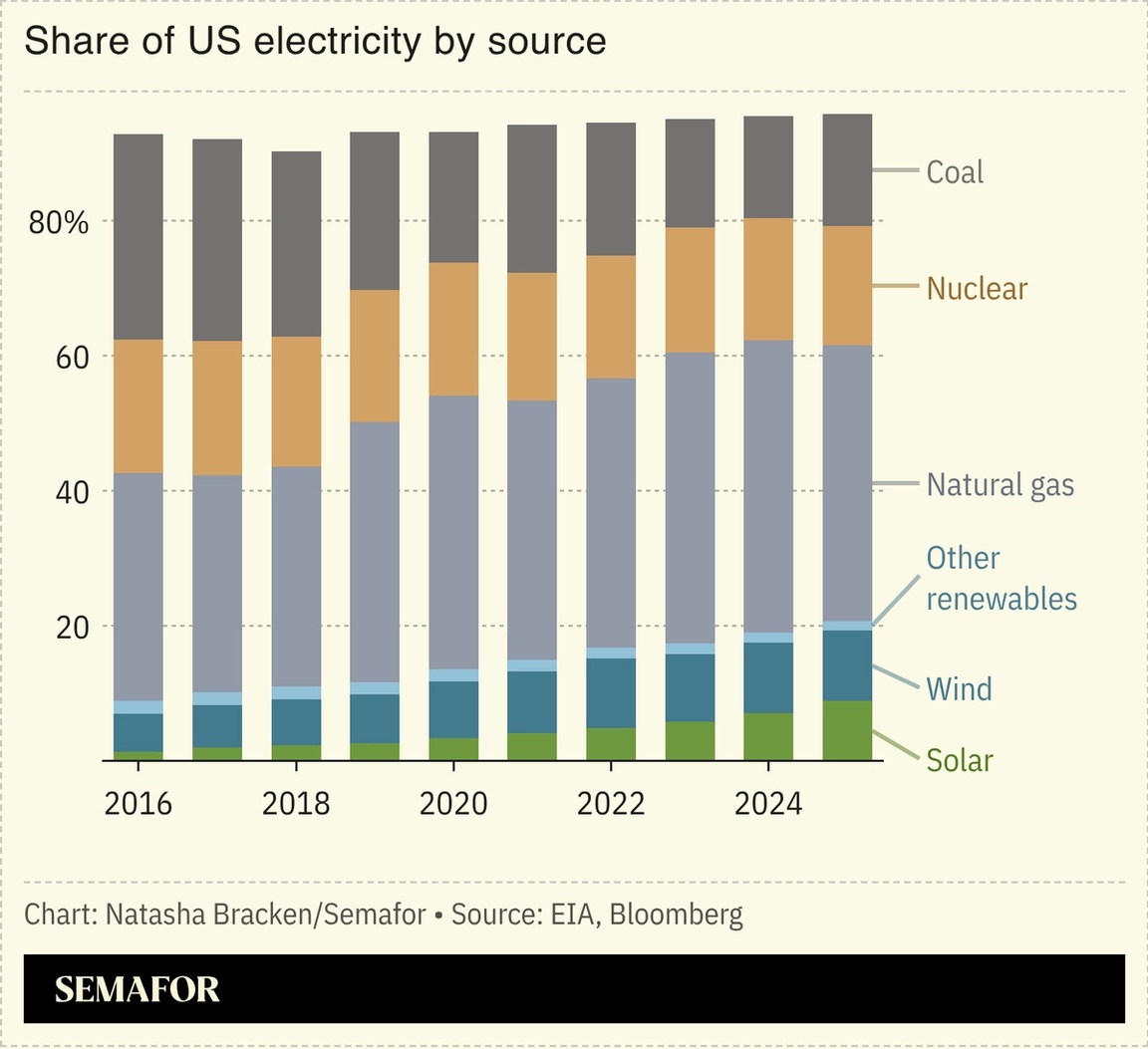 Green energy generation in the US hit record highs last year, despite repeated efforts by the Trump administration to sideline it. More than a quarter of US electricity came from renewable sources in 2025, up from 10% the prior year, the EIA found. Solar and wind, both of which lost their federal tax credits last year and have been frequent targets of US President Donald Trump’s broadsides, remained the fastest-growing electricity source in the country. Although a surge in energy demand has driven up power generated from fossil fuels, renewables are accelerating beyond those gains, mostly for economic reasons. The cost of photovoltaic panels, wind turbines, and grid-scale batteries has fallen low enough that building new renewable capacity remains cheaper than most alternatives, with or without government subsidies. Investors have evidently caught on: Nearly 80% of the power plant capacity planned over the next decade is tied to renewable sources. —Natasha Bracken |
|
 The Gulf has transformed from a bustling economic hub to the front line of a major war. Iran’s retaliatory strikes have hit bases and airports across the region. The Gulf’s cities have gone quiet, their airports grounded and streets empty as residents take shelter. The US-Israel assault that killed Iran’s supreme leader has unleashed a new and unpredictable phase of conflict. For the Gulf, the illusion of distance from regional turmoil has been put on hold. Energy markets are bracing for volatility, diplomacy is strained, and the region’s stability is under pressure. Semafor Gulf is here to help you make sense of it. Four times a week, editor Mohammed Sergie and our team across Abu Dhabi, Dubai, and Riyadh will connect you with what’s happening on the ground, and how it affects business, energy, and diplomacy — bringing clarity to the most consequential story in the world. |
|
Investor headwinds in Caracas |
 Venezuela’s interim President Rodriguez and US Energy Secretary Wright tour oil facilities. Miraflores Palace/Handout via Reuters Venezuela’s interim President Rodriguez and US Energy Secretary Wright tour oil facilities. Miraflores Palace/Handout via ReutersUS and Gulf investors are eyeing Venezuelan oil deals after Caracas amended its hydrocarbons law, but deeper reforms and higher crude prices will be needed to unlock the country’s massive reserves, Amena Bakr, head of Middle East Energy & OPEC+ research at global commodities data firm Kpler, wrote in a Semafor column after visiting the Latin American nation. Venezuela aims to almost triple its oil output to 3 million barrels a day within five years, but the country’s oil is often relatively expensive to extract. “What surprised me most was hearing industry executives suggest production costs could be squeezed down to $15-$20 per barrel on average, and even below $10 per barrel in some projects,” Bakr wrote. “Independent consultants put the cost at $50-$60 per barrel, making much of the extra output uneconomical.” |
|
 New Energy- Oil lobbyists have recently argued to Trump administration officials that the president’s attacks on offshore wind farms in the US could undermine congressional initiatives aimed at accelerating permits for energy projects.
- China saw a slight decline in emissions from energy and industry last year after a solar boom helped meet a large part of its growing energy demand.
 Tingshu Wang/Reuters Tingshu Wang/ReutersFossil Fuels- BP is expanding shale drilling in a bid to repair its balance sheet and reverse a drop in production, profits, and shareholder value after the company pivoted to greener options.
- Cheniere, a major natural gas exporter, received a $370 million windfall from the Trump administration, which approved the company’s use of an “alternative fuels” tax incentive for running some of the world’s most carbon-intensive ships.
Finance- Major commodity traders are using profits made during the volatile markets of the Covid pandemic and Russia’s invasion of Ukraine to cement their market dominance.
Politics & Policy |
|
|


