|
|
|
|
Good morning. The attack on Iran is once again highlighting the unpredictable governing style of Donald Trump. A year ago this week, the U.S. President’s first tariffs on Canadian imports took effect. With the global trade war continuing, this new conflict is adding to economic risks. |
|
|
|
|
|
|
|
|
|
|
|
|
|
|
|
Men watch from a hillside as a plume of smoke rises after an explosion on March 2, in Tehran. Majid Saeedi/Getty Images
|
|
|
|
|
|
|
|
|
|
|
The latest on the Middle East |
|
|
|
|
Markets: A sense of unease is hanging over global markets, as rising gold and oil prices and a move into the U.S. dollar point to anxiety simmering beneath the muted reaction to the attacks in the Middle East. |
|
|
|
|
- The response to the U.S.-Israeli attack on Iran pointed to expectations that the crisis will be short-lived, even as U.S. President Donald Trump said it will last at least a month and perhaps “far longer.” Iran’s retaliatory attacks on other key energy-producing countries stoked fears that a protracted battle could force costly supply-chain disruptions.
-
The S&P 500, Nasdaq and S&P/TSX Composite shook off early morning jitters to end the day higher. Some analysts said the muted reaction suggests investors had largely anticipated a conflict over the past few weeks. Others worried about complacency.
|
|
|
|
|
|
|
|
|
|
|
- A period of four or five weeks would see prices of crude, which were trading around US$70 yesterday, land “well into triple digits,” said Hakan Kaya, senior portfolio manager at investment management company Neuberger Berman.
- Alberta Premier Danielle Smith said the conflict underscores the need for a new pipeline connecting the province’s oil reserves to the West Coast.
|
|
|
|
|
Inflation: Oil’s surge has markets bracing for higher inflation, prompting a selloff in U.S. Treasuries and Canadian bonds. |
|
|
|
|
- With prices falling and yields rising – especially in shorter-term bonds – traders are effectively betting that the Fed and the Bank of Canada will hold rates higher for longer, and even see a small risk of rates rising.
|
|
|
|
|
Travel: Air Canada has suspended flights to and from Tel Aviv and Dubai until March 23. |
|
|
|
|
|
|
|
|
- Stocks of companies in the travel sector were among the losers as key Middle Eastern hubs were closed and thousands of flights cancelled.
- Evacuation flights from the UAE began as governments seek to extract stranded citizens from the Middle East.
|
|
|
|
|
Gambling: Bets on the potential death of Iran’s Supreme Leader, Ayatollah Ali Khamenei, have cast fresh scrutiny on prediction markets such as Polymarket and Kalshi, and sparked threats from U.S. lawmakers to outlaw the controversial wagers. |
|
|
|
|
|
|
|
|
|
|
|
|
|
|
|
From factory jobs and consumer prices, to supply chains and trade flows, we take a visual look at how the global economy has changed in the past year. Photo illustration by The Globe and Mail/iStockPhoto / Getty Images
|
|
|
|
|
|
|
|
|
|
|
A year of Trump’s tariffs, in charts |
|
|
|
|
Hi, I’m Matt Lundy, economics editor at The Globe and Mail. |
|
|
|
|
Colleague Jason Kirby and I recently teamed up to look at how the global economy has changed over the past year, pegged to the first of U.S. President Donald Trump’s tariffs that hit Canada and others. Because the trade file can be so chaotic, we wanted to cut through the noise and visualize how commercial ties are being redrawn on the fly. |
|
|
|
|
Expect more turbulence over the rest of 2026. Not only is Trump trying to rebuild his tariff wall, but his overseas interventions have raised a fresh set of macroeconomic risks, most recently in the Middle East. In times of crisis, I find it beneficial to track down statistics – then scrutinize them. |
|
|
|
|
Here are some of the tariff-related charts that I found helpful in making sense of the past year. |
|
|
|
|
|
|
|
|
|
|
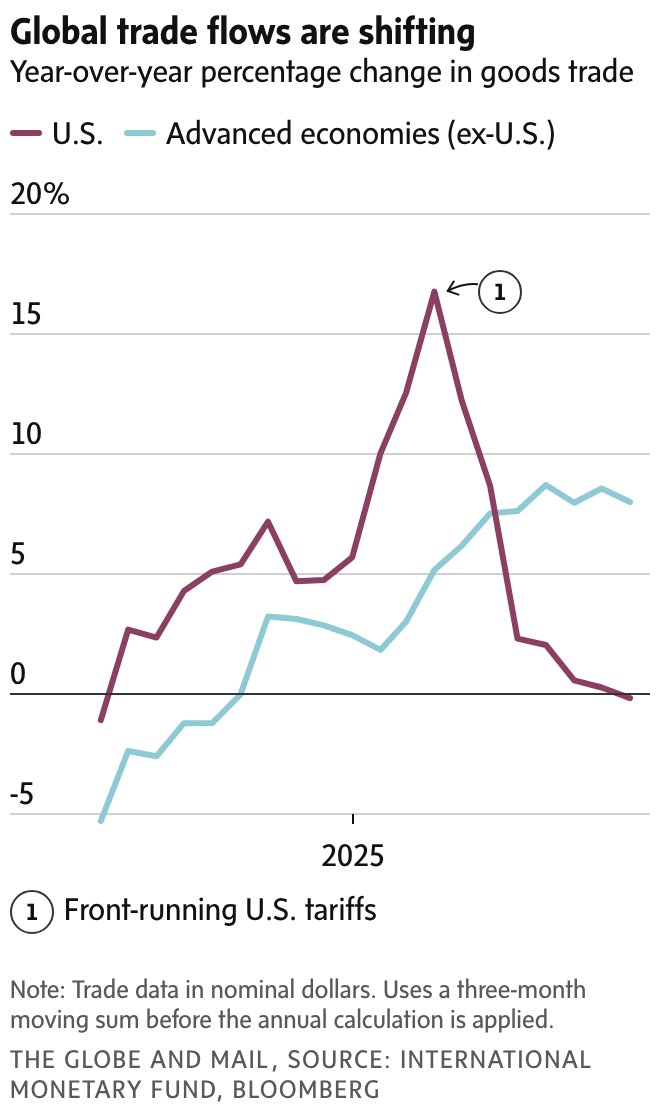
U.S. importers rushed to get goods in the country last year, before various tariffs took effect. Since then, U.S. trade has really slowed down. But trade among other countries is going strong, benefiting the likes of China and emerging Asian markets. While the U.S. has been keen to implement tariffs, other countries have largely avoided protectionism, or even sought to liberalize trade. Just take a look at Canada and India, which this week said they were starting talks on a comprehensive trade deal. |
|
|
|
|
|
|
|
|
|
|
|
|
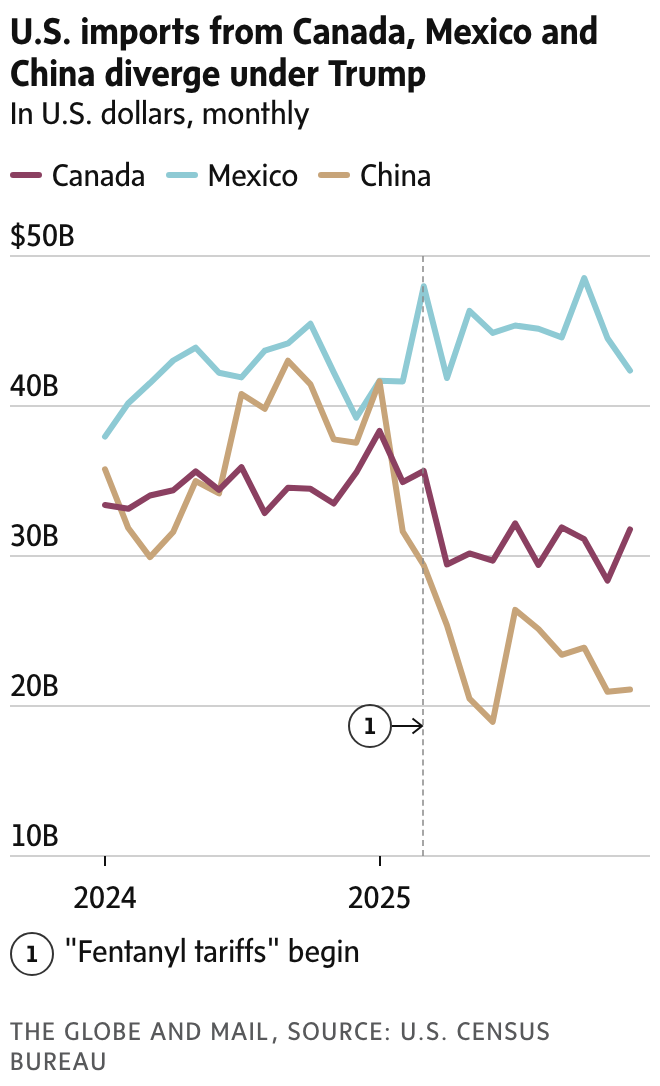
Because its economic fortunes are so tied to the United States, Canada has suffered a great deal during the trade war, even if most goods can continue entering the U.S. tariff-free. Sectoral tariffs on autos, steel, aluminum and other industries have delivered a blow to key segments of the Canadian economy. On the other hand, Mexico has emerged as a relative winner, owing to a huge increase in exports of computing equipment. |
|
|
|
|