|
|
|
|
Good morning. In focus today, we’re tracking how the U.S.-Israeli strikes on Iran are playing out across global markets. Plus, Prime Minister Mark Carney makes headway with India, announcing earlier today a deal to supply the fast-growing country with uranium. |
|
|
|
|
|
|
|
|
|
|
|
|
|
|
|
|
Live now: Tensions are flaring in the Middle East after air strikes kill Iranian Supreme Leader Ayatollah Ali Khamenei. |
|
|
|
|
Trade: Conservative Leader Pierre Poilievre said he’s open to meeting with U.S. leaders if it will help Canada’s efforts to end the continuing trade dispute. |
|
|
|
|
|
|
|
|
|
|
|
|
|
|
|
|
|
|
|
|
|
Thousands gathered yesterday for a pro-government demonstration in Tehran after Iranian state media confirmed the death of Ayatollah Ali Khamenei. Majid Saeedi/Getty Images
|
|
|
|
|
|
|
|
|
|
|
Stepping back on a seismic moment |
|
|
|
|
Oil will be at the centre of market attention this week, but the repercussions of the air strikes and Iranian retaliation are likely to ripple across currencies, equities,
safe‑haven assets such as gold and a wide range of commodities. |
|
|
|
|
1. Zooming out: The U.S. and Israeli attack on Iran is poised to intensify volatility across global markets – already unsettled by the Trump administration’s new tariff threats – and to fuel renewed concerns about broader inflationary pressures. |
|
|
|
|
|
|
|
|
The potential for a prolonged conflict that could envelop the Middle East carries significant risks for oil prices, which had already moved higher this year in anticipation of a strike on Iran. Oil futures rose last night, reflecting bets that a drawn-out conflict could disrupt flows through key shipping routes and keep global supply tighter for longer. |
|
|
|
|
The Organization of the Petroleum Exporting Countries and its allies announced yesterday that it would boost daily output in an attempt to calm energy markets, and U.S. President Donald Trump said he was in talks with Iranian leaders to de-escalate. |
|
|
|
|
But market watchers were doubtful that oil’s short-term trajectory, at least, could be contained. The key question hinges on how long they’ll stay elevated. Rising oil prices lift the costs of transportation, manufacturing, agriculture and shipping. Climbing crude pushes up the cost of making and moving things, and the difference is ultimately passed along to consumers. In the U.S., where energy markets are already under pressure from tech companies’ insatiable appetite for electricity, inflation is likely bound to heat up this year, John Rapley writes. |
|
|
|
|
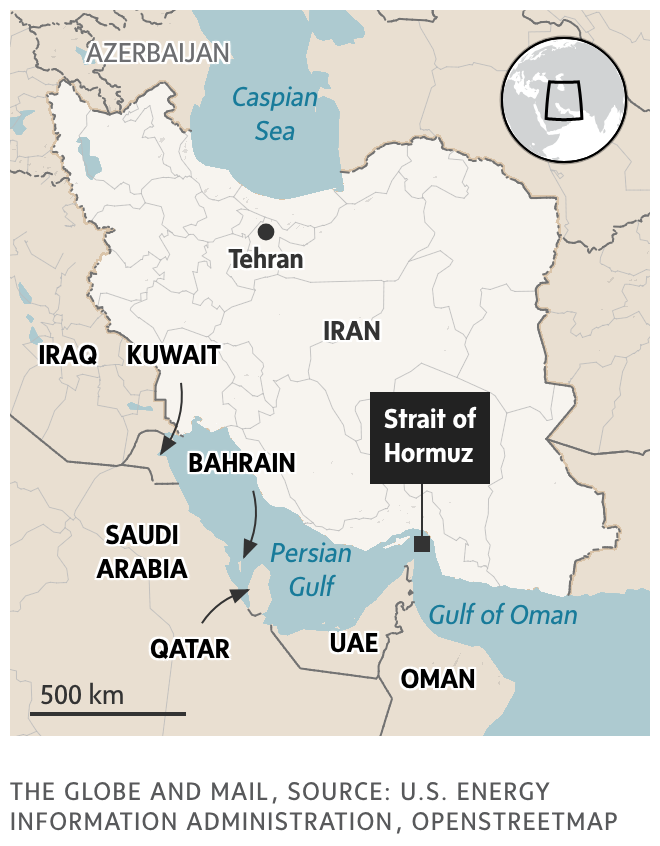
2. Zooming in: The scale of the fallout will largely rest on what happens on the strip of water between Oman and Iran. The Strait of Hormuz, which carries roughly a fifth of the world’s petroleum, is the single most important chokepoint in global energy trade. |
|
|
|
|
At present, shipping across the strait is at a near-standstill after insurers warned of cancelling policies and raising premiums. In retaliation for the U.S. attacks, Tehran could close the strait outright. “How this ends is extremely uncertain at this point but in the meantime oil markets will have to face their worst fears,” Amarpreet Singh, a Barclays analyst,
wrote in a client note yesterday. |
|
|
|
|
A prolonged shutdown of the corridor, which connects the Persian Gulf with the Gulf of Oman and the Arabian Sea, could drive Brent crude futures – the most widely used global benchmark – north of US$100 a barrel from a close of about US$72 on Friday, a shock economists say could pose a significant risk for countries already struggling to find steady footing. |
|
|
|
|
|
|
|
|
|
|
|
|
If the conflict proves short‑lived – and if tankers can move freely through the Strait of Hormuz – crude prices would still rise, but far less sharply, and with a much more limited impact on the broader economy. Still, it might make sense to fill up if you haven’t already. |
|
|
|
|
(And if you’re planning a trip to the Middle East, Toronto Pearson International Airport authorities are recommending that passengers check with their airlines before heading to the airport.) |
|
|
|
|
For a growing number of Canadian companies investing in the Persian Gulf, meanwhile, the missile attacks are upending what had been a safe bet around a spike in economic development. |
|
|
|
|
3. Knocking on India’s door: Prime Minister Mark Carney announced a $2.6-billion deal earlier today to supply Canadian uranium to India. After meeting with Indian Prime Minister Narendra Modi, the two leaders also launched talks on a comprehensive trade deal. |
|
|
|
|
The uranium deal was one of 10 commercial agreements touted during the trip and valued at a combined $5.5-billion. Unlike the uranium contract, many had been made public months ago. |
|
|
|
|
Speaking to a crowd of about 100 business investors and executives in India’s financial capital of Mumbai this weekend, the Prime Minister said he aims to wrap up the wider trade agreement with India by the end of the year, Steven Chase reported from the financial centre. |
|
|
|
|
The four-day visit to the subcontinent marks the end of a “challenging period” in Canada-India relations and the beginning of a new, “more ambitious |