|




👋 Howdy Partner,
Today I’m sharing a guest post from my friend Dividendology.
He thinks a lot like I do, and he writes a great Newsletter, X account, and Youtube channel.
He wrote a great article about 5 high yield asset classes that I’m excited to share with you.
Enjoy the article below from Dividendology:
-TJ

Most people approach high yield investing the same way they play the old game minesweeper.
They start going around randomly clicking on squares, and maybe make a few lucky guesses-
But they are basically guaranteed to hit a mine eventually, ending their game.
 |
Of course, if you know what to look for, you can strategically avoid the mines, and win the game.
This is a perfect metaphor for high yield investing.
🏆 Building a High Yield Portfolio
There are two major advantages to high yield investing most don’t take the time to acknowledge:
📝 Limited analyst coverage & market inefficiencies
Unlike the mega-cap S&P 500 names that have Wall Street analysts dissecting every detail, many high-yield alternatives trade with less attention. This lack of coverage often results in pricing inefficiencies and misvaluations, both on the upside and downside.🔍 Greater opportunity for diligent investors
For those willing to roll up their sleeves and learn the nuances of high yield asset classes (things like AFFO for REITs, NAV growth for BDCs, or option coverage ratios for Covered Call ETFs), there are chances to capture both yield and capital appreciation where the broader market overlooks it.
This is the beauty of high yield investing.
While there are certainly a multitude of risky investments out there, there are also some massive overlooked opportunities.
For example, a little over a year ago, I built an example high yield portfolio. (You can see and read about that portfolio here)
Our example high yield portfolio had the goal of providing a reliable yield of close to 8%, without seeing erosion of our net asset value.
At the time we analyzed our portfolio, the returns had been amazing.
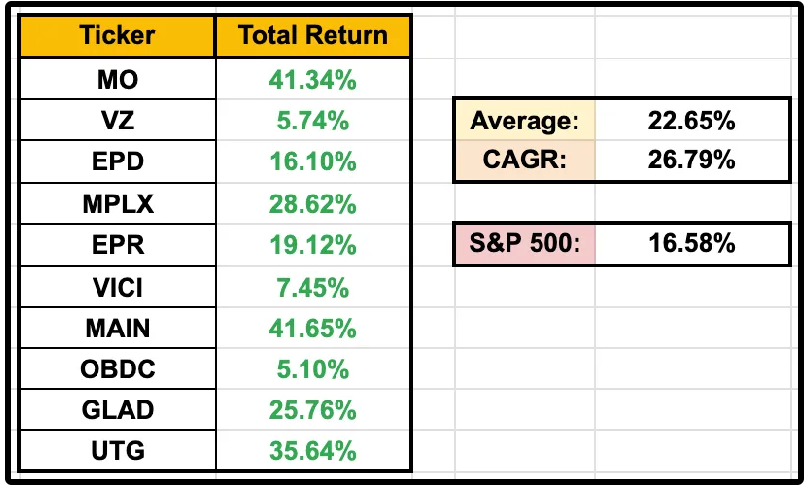 |
This portfolio actually outperformed the market!
But the performance doesn’t tell the whole story.
I ran a backtest on it for deeper insights.
 |
Not only did this portfolio outperform by a wide margin, but it:
Had lower volatility (standard deviation)
Had a lower maximum drawdown
Had a stronger Sharpe Ratio
The Sharpe Ratio is an important one.
The Sharpe Ratio is a way of measuring how much return you’re getting for every unit of risk you take.
Basically, this portfolio took on less risk than the S&P 500, while still experiencing better returns.
🎯 The Truth
High Yield Investing does NOT always equal high risk.
In reality, a stock or fund’s dividend yield tells us nothing about the sustainability of the dividend.
It’s always about the fundamentals.