|
|
|
|
|
|
|
|
|
|
The Morning Download: Demand for AI Remains Strong
|
|
By Steven Rosenbush | WSJ Leadership Institute
|
|
|
|
|
|
|
|

|
|
Nvidia CEO Jensen Huang. Steve Marcus/Reuters
|
|
|
|
|
|
Good morning. AI’s impact on the economy is probably going to turn more on the ways in which specific companies are able to execute and less on broad thematic shifts. Will AI draw all of the value out of software or data or professional services or other broad sectors of the economy? The answer will come down to the judgement of particular companies, their leadership and capacity to manage change.
The results from Nvidia, Salesforce and Snowflake reflect businesses that are far more stable than the financial markets where they trade. You can forgive those markets a certain amount of volatility given the uncertainty that AI introduces into the system, but hopefully a solid quarter will help restore a bit of equilibrium. There may be plenty of
good reasons for investors to remain cautious about bidding AI shares ever higher, but the business fundamentals of the companies at the heart of the sector are, broadly speaking, solid.
Nvidia’s ability to grow so quickly at this stage of its development, and expand its margins at the same time, suggests that demand is strong and very real. “Revenue of $68.1 billion was up 73% from the same period last year and represented the company’s best growth rate in four quarters,” Dan Gallagher notes in the Journal.
Nvidia's growth is driven by a handful of large customers, but their customer base in turn is vast and diverse and representative of the entire economy.
The fact that Nvidia shares didn’t soar like a rocket on the news doesn’t raise concerns about an AI bubble, it helps dispel them. Bubbles happen when prices soar unreasonably high. As of yesterday, Nvidia’s trailing 12-month PE ratio was 48 times, which is elevated above the broad market but nowhere close to setting a record for speculative excess in the tech sector.
See below for insights into what tech leaders should take away from a pivotal earnings season for AI, software and data.
|
|
|
|
|
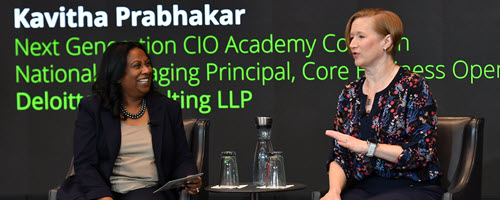
Content from our sponsor: Deloitte
|
|
|
From Cornfield to C-Suite: Cargill CIDO on Leading Tech With Passion and Purpose
|
|
Jennifer Hartsock, chief information and digital officer at Cargill, shares the importance of technology leaders being business leaders first—and how passion can fuel meaningful impact. Read More
|
|
|
|
|
|
|
|
|
|
|
|
|
|
Nvidia beats back bubble fears. Nvidia reported a 94% surge in quarterly profit to $43 billion on record revenue of $68.1 billion, beating Wall Street estimates.
Data center hardware made up 91% of sales, driven by demand from major AI and cloud firms. Gross margins rose to 75%. Nvidia said it expected $78 billion in revenue in the current quarter, significantly higher than the $72.9 billion predicted by analysts.
Speaking Wednesday, Nvidia Chief Executive Jensen Huang made it clear that the competitive advantage goes to those that can translate compute into business value.
“In this new world of AI, compute equals revenues," Huang said. "I am certain at this point that we’ve reached the inflection point” where agentic AI is upending how business is done worldwide and selling AI tools is starting to generate real profits.
|
|
|
“SaaS-pocalypse” poster-child Salesforce sees stable growth. CEO Marc Benioff told investors Wednesday he wasn’t fazed by the recent selloff across software companies, driven by concerns that AI companies would replace software services. The company said it closed 29,000 Agentforce deals in the quarter, up 50% from the third quarter. The AI product debuted in fall 2024. Profit rose to $1.87 billion from $1.82 billion a year earlier. Current-quarter revenue is projected at $11.03 billion to $11.08 billion, above analysts’ $11.0 billion estimate.
|
|
|
The AI metric to watch pointed higher: Barron’s says Salesforce’s AI agents gained traction. “Agentforce annual recurring revenue reached $800 million in the fourth quarter, up 169% year-over-year. Last quarter, the company reported that its Agentforce platform had $540 million in annual recurring revenue, a 330% increase from the prior year.”
|
|
|
|
|
“If there is a SaaS-pocalypse, it may be eaten by the SaaS-quatch because there are a lot of companies using a lot of SaaS because it just got better with agents-as-a-service.”
|
|
— Salesforce CEO Marc Benioff
|
|
|
|
|
|
|
|
|
Snowflake revenue rises as AI adoption accelerates. The Cloud storage company narrowed its fourth-quarter loss and grew revenue to $1.28 billion, topping expectations, as AI initiatives powered workloads. The company in December signed a $200 million deal with Anthropic to boost deployment of AI agents on its platform.
|
|
|
C3.ai announces staff cuts. The software company will cut about 26% of its roughly 1,200 employees and reduce nonemployee costs by 30% to boost efficiency under new CEO Stephen Ehikian. The company, which makes data analysis software, also lowered full-year revenue guidance, Bloomberg reports.
|
|
|
|
The Latest From CIO Journal
|
|
|
|

|
|
The word ‘pilot’ was used in about 18% fewer earnings calls in the fourth quarter, according to AlphaSense. Manaure Quintero/Agence France-Presse/Getty Images
|
|
|
|
|
|
Business leaders want to ground the AI pilot. In today’s turbulent, AI-anxious market, executives are signaling commitment in subtle but telling ways, starting with vocabulary. One word they’re ditching: “pilot.”
|
|
|
|
|
“We are not a pilot company... What we’re doing truly is driving value.”
|
|
— AT&T Chief Data and AI Officer Andy Markus
|
|
|
|
|
|
|
That infamous 2025 MIT study, which found that 95% of enterprise AI pilots fail to produce a measurable financial impact, may also be to blame. Whatever the case, executives tell WSJ Leadership Institute's Isabelle Bousquette that 'piloting a project' hardly conveys the seriousness of their efforts. In short, it's not cool anymore.
“Pilots are a really safe way to say that you’re doing something with AI without actually having to change anything or take any risk,” Greg Meyers, chief digital and technology officer at Bristol-Myers Squibb, tells Isabelle.
Meyers calls his AI testing “proof of concept,” a phrase also used in the pharmaceutical development side of the business.
Worldwide, the word “pilot” in reference to AI was used in about 18% fewer earnings calls in the fourth quarter of 2025, compared with the third quarter, according to data from AlphaSense.
|
|
|
|
|
|
|
|

|
|
IBM, Cisco Systems, SAP, Stellantis and ASML Holding are among the companies said to be leveraging Mistral AI’s models. Dado Ruvic/Reuters
|
|
|
|
|
|
French AI startup beefs up client list. Mistral AI struck an agreement with Accenture that will make the technology consulting group its latest high-profile client, the Journal reports. They didn’t disclose financial details for the multi-year agreement. IBM, Cisco Systems, SAP and Dutch chip-equipment giant ASML are among the high-profile companies using Mistral AI’s models.
|
|
|
Visa squeeze is chilling U.S. tech talent. Trump administration policies, including a $100,000 fee for new H-1B applicants, are deterring top engineers and scientists from coming to the U.S. Visa delays are pushing some groups to consider establishing talent hubs outside of the U.S., immigration consultants tell the FT. More than half of multinationals surveyed by Envoy Global said they lost foreign employees in the past year due to visa delays or denials.
|
|
|
Hacker turns Claude on Mexico’s networks. In a stark example of how even advanced AI safeguards can be bypassed, an unknown hacker “jailbroke” Anthropic’s Claude to identify vulnerabilities in Mexico’s government networks and generate exploit scripts, Bloomberg reports. Research published Wednesday by Gambit Security said the attacker ultimately exfiltrated 150 gigabytes of data.
|
|
|
Lawmakers seek answers from Big Tech on DHS data requests. Democrats on the House Committee on Homeland Security are pressing tech firms to disclose how much user data they shared with the Department of Homeland Security after the New York Times reported that the agency used administrative subpoenas to unmask ICE critics. Companies contacted include Google, Meta and others. Lawmakers are considering legislation to curb the practice.
|
|
|
|
Everything Else You Need to Know
|
|
|
The Department of Justice last month released millions of documents, but withheld many others, including FBI notes from several interviews that a woman gave to agents in 2019 where she made allegations against Jeffrey Epstein and Donald Trump, shortly after Epstein was arrested. (WSJ)
More citizens are replanting overseas, drawn by a quality of life made easily affordable by the U.S.’s enviable salaries. (WSJ)
Since the U.S. Supreme Court struck down many of Trump’s tariffs last Friday, dozens of companies have rushed to court to try to get their money back, joining hundreds of others who filed suits in anticipation of the court’s ruling. (WSJ)
The Trump administration is pausing nearly $260 million in Medicaid funding to Minnesota, calling it a way to push the state to better account for how government funds are being distributed. (WSJ)
|
|
|
|
The WSJ Technology Council
|
|
|
|


