|
 |
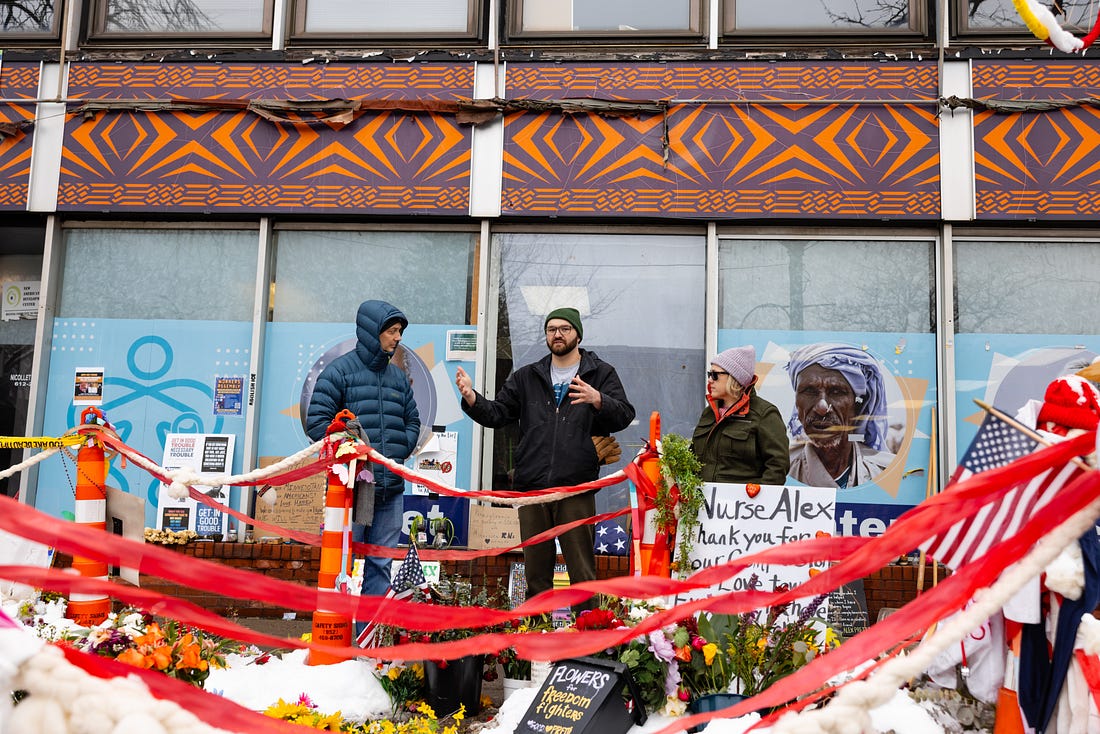
Fam, I have been on the ground in Minneapolis since Wednesday and let me tell you: It’s worse than you think.
I’ll explain why in a minute. But first I want to say that what I saw from the people of Minnesota left me speechless. The ways in which they have mobilized are awe-inspiring. We met Zena Stenvik, the superintendent of the Columbia Heights Public Schools from which Liam Ramos was abducted, and she and her colleagues are basically on a war footing. Teachers, bus drivers, custodians, parents—retired principals—all mobilized to defend against the government agents who would harm the children under their care.
And I heard dozens of stories like hers.
This is the power of community.
Minneapolis has fought back because it has powerful community institutions. Elks Lodges, Rotary Clubs, PTA groups, churches, neighborhood associations. When you have communities, you can leverage them into power.
The rest of America is going to have to learn this lesson, fast.
I came away from Minneapolis convinced of two things:
We are in much more danger than we realize.
The most important thing we can do is bind together.
I believe—with both my head and my heart—that the value The Bulwark provides as a media company is real, but that if we’re going to have any impact on events it will be because of the community we’re building for this moment.
We need you because we need each other. Right now.
And if you can’t afford a membership, that’s okay. No real community can be pay-to-play. Just hit reply to this email and we’ll work something out. Everyone who wants to be part of this node of the resistance can be.
Special Saturday Triad: What I Saw at the Battle of Minneapolis
The national media has moved on. Minnesota is still under siege.
|
| |||||||||||||||


 |
1. War
I understand that spending three days on the ground in Minneapolis is not real perspective. But it brought home something that may not be obvious from afar: Minnesota, especially the Twin Cities, has been—and still is—under a paramilitary occupation in which the federal government is at war with the population.
“War” is the operative word here.
One of the hallmarks of war is that combatants engage in a continual cycle of tactical adaptation and counteradaptation. Example: Russia invades Ukraine with tanks. Ukrainians deploy Javelin anti-tank missiles. Russians construct anti-missile cages around tank turrets, to detonate missiles before they can burrow into the armor. Ukraine responds by designing suicide drones that hunt Russian armor and attack not just weak points around turrets, but exhaust grates and other spots where there is an opening. Russia responds by building anti-drone drones, designed to hunt the hunters.
And so on. This cycle is as old as war itself.
New tactics succeed for a time; then the enemy adapts and your doctrine must shift to counter their adaptation.
It is useful to think about the Trump regime’s attack on American cities through this lens.
When the regime’s troops occupied Chicago, the city’s residents developed a number of tactics to harry them. They protested. They recorded. They used whistles to signal swarms of observers whenever DHS agents were spotted.
These measures succeeded. DHS left Chicago. The city was too big and the government didn’t have the manpower to counter the civilian population.
So the regime altered its tactics. It set its sights on a smaller city—Minneapolis–Saint Paul. It surged what it hoped would be an overwhelming force of more than 3,000 agents. And having seen what the whistles in Chicago did to alert the populace, it shifted from stakeouts to lightning raids, staging fast abductions to extract victims before citizens could respond.
This shift in tactics succeeded for DHS initially. But the people of Minnesota adapted, too.
They began using hyperlocal Signal chats to organize not just by the neighborhood but by the block. Simultaneously, they set up observation stations near the Whipple Federal Building, which DHS uses as headquarters, to observe DHS vehicles. As a vehicle left the building, observers would follow it. If they saw DHS agents deploy from the vehicle, they would tag the license plate and feed it into a distributed system used to keep track of known DHS vehicles. This way, local observers who spotted a suspicious vehicle in their neighborhood could check the plates against the database. This early warning system cut citizen response times to minutes (or less).
Various local civic groups—churches, PTAs, Rotary Clubs—morphed into a decentralized network of resisters, with hundreds upon hundreds of nodes. Some of them protested. Some observed. Many more worked to provide for the people the government was hunting. We’ll talk more about this last group in a moment.
The observers proved to be a problem for DHS, as its agents were caught on camera, over and over, striking, gassing, abusing, and murdering civilians. So the government adapted again.
DHS agents began recording the observers and scanning their faces. They then used government databases to identify them. Sometimes they showed up at their homes to threaten them.
In recent days DHS has continued to evolve its doctrine. They have attempted to stage their vehicles away from the Whipple HQ to avoid having them identified. They have employed a sort of camouflage, putting “Fuck ICE” or gay pride stickers on their vehicles. They have taken to using known DHS vehicles as “bait”—sending them out hoping to lead observers on a meaningless drive while new, untagged DHS vehicles slip away to carry out raids.
Move, countermove.
2. The Next Battle
DHS has adopted other tactics. I met two observers who recounted how they had been following a DHS vehicle only to have it lead them to their own house, where it parked and waited—a warning that the government agents knew