|




 |
If you’re already using Claude Code, or thinking about it, you’ve probably felt overwhelmed trying to figure out which components, folders, and files you’re actually supposed to create.
Claude Code is impressive. That’s undeniable. However, if we don’t understand how to organize its internal architecture, we won’t get the results we expect.
It’s not Claude Code’s fault.
Many of us try to solve everything through prompts alone. That approach is not entirely wrong, but it becomes far more effective when it’s supported by a clear structure.
So what should your first project include?
You need to think about the following:
A clearly defined role
Written rules
Explicit boundaries
The environment is intentionally designed
At this point, you already understand the central idea. This is the foundation that will support every project you decide to build on your own.
When I first started, I spent hours going through documentation and watching countless tutorials. The reality is that it can be frustrating not to fully understand how projects are structured.
When working with Claude Code, clarity around structure makes all the difference.
That’s why, by the end of this article, you’ll have:
Clarity on which files to create first
A simple but scalable structure (highly underrated)
An understanding of how to think like Claude Code—not just how to use it
This will become your starting point for any project, from the most basic to the most advanced.
I’m creating a series of guides on Claude, Claude Cowork and Claude Code.
Before you build anything, learn these 3 foundational concepts
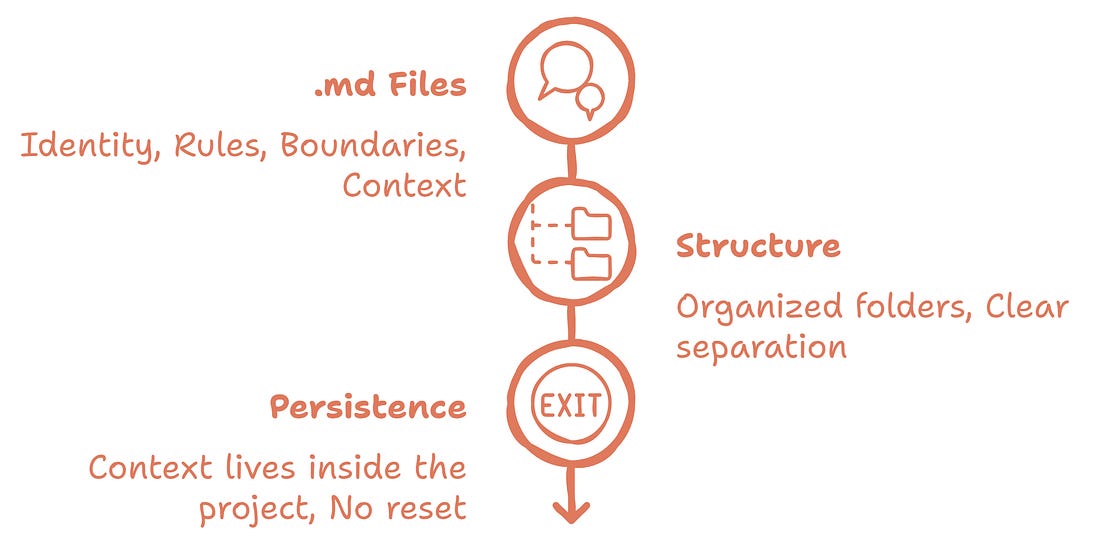 |
.md Files (Markdown)
An .md file is simply a plain text file with a lightweight structure for organizing information.
It is not complex code.
It is not something highly technical.
It is a clean and structured way to write instructions, rules, and context.
An .md file exists so that Claude understands the environment.
And that is the key difference. In a traditional chat, every conversation starts from scratch. In Claude Code, .md files allow context to live inside the project.
Project Structure
Claude Code does not operate on a single file. It reads the entire project.
That project may include different types of files, but the most important elements typically live inside .md files.
How you organize those files into folders is not just a technical detail. It is a way of giving structure to the system.
When you separate rules, context, and content, you are creating clarity.
It is not about having many files. It is about ensuring that each file has a clearly defined purpose.
Context Persistence
In a traditional chat, each conversation begins almost from zero. In Claude Code, however, context remains within the project.
This means the role, rules, and objectives do not need to be repeated in every interaction.
In other words, the system already knows where it is and what it is building.
And when that happens, the experience stops being improvisation and starts becoming architecture.
Consider becoming a paid subscriber, so you get full access to our next Claude guides 👇