|
You are no longer the smartest type of thing on Earth
The coming of AI means that humanity's destiny is (mostly) out of our hands.
|

| |||||||||||||||


 |
“He comes like a day that has passed, and night enters our future with him.” — Charlo
Yesterday my pet rabbit bit my finger. It was an accident; he was trying to bite a towel to move it out of his way, and I accidentally stuck my hand in his mouth. He is a gentle beast, and would never bite a human intentionally. Anyway, the bite punctured and lacerated my left index finger near the front knuckle. I washed it out, put some ointment and a band-aid on it, and that was that.
It occurs to me that if my pet rabbit had instead been a tiger, I would now be dead. There is a reason most people don’t keep tigers as pets; they may be fluffy and cute, but they’re big and strong and can easily kill you. Instead, we generally keep pets who are smaller and weaker than us, allowing us to train them, and if necessary to physically restrain them, and minimizing the danger to our own health.
Until now, we haven’t had to think about this principle in the context of intelligence. As long as you or I or anyone we know has been alive — for all of recorded history, and in fact for much much longer than that — humankind has been the most intelligent thing on this planet.
At some point in the next couple of years, that will no longer be true. It arguably is no longer true right now. There is no single unarguable measure of intelligence — it’s not like distance or time. AI doesn’t think in the same way humans do. But it can get gold medals on the International Math Olympiad, solve difficult outstanding math problems all on its own, and get A’s in graduate school classes. Most human beings can’t do any of that.
Intelligence is as intelligence does. If it helps you feel unique and special to sit there and tell yourself “AI can’t think!”, then go ahead. And sure, AI doesn’t think exactly the way you do. It probably never will, in the same sense that a submarine will never paddle its fins and an airplane will never flap its wings. But a submarine can go faster than any fish, and an airplane can fly higher and faster than any bird, so it doesn’t matter. You can value your own unique human way of thinking all you like — and I agree, it’s pretty special and cool — but that doesn’t make it more effective than AI.
Right now, there are some cognitive things that humans still do better than AI, but that will probably not last. The entire might of the world’s technological innovation system is now being thrown into making AI better, and there is no sign of a slowdown in progress. One of the main things AI couldn’t do until recently was to work on a task for a long period of time. That’s changing fast. AI models are flying up the METR curve,¹ which tries to measure the length of time they can take to complete a software engineering task:
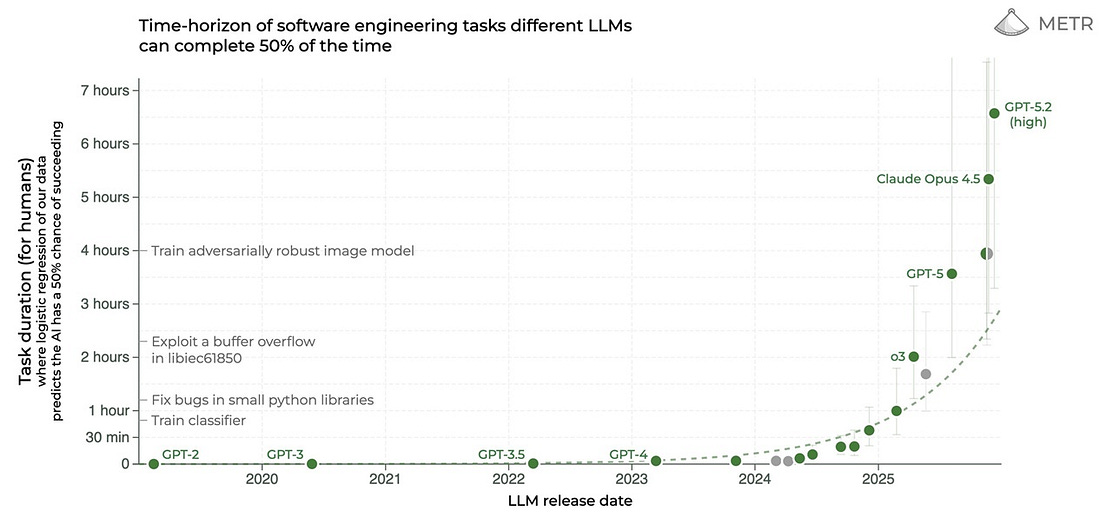 |
This is what’s behind all the “vibe coding” you’re hearing about. AI agents — basically, a program that keeps applying AI over and over until a task is complete — are now taking over much of software engineering. People just tell the AI what kind of software they want, and the AI pops it out. Human software engineers are still checking the code for problems, but as the technology improves, the cost of doing this is likely to become uneconomical; AI-written software will never be perfect, but it’ll be consistently much better than anything humans could do, and at a tiny fraction of the price.
Vibe coding is taking over fast. Spotify’s co-CEO recently revealed that the company’s best developers don’t write code anymore. Some journalists from CNBC, with no coding experience, vibe-coded a clone of the app Monday, and the company’s stock price promptly crashed. Meanwhile, AI is increasingly writing the next version of itself, and humans may not be in the loop for very much longer.
And all of this — ending software engineering as we know it, acing the hardest math tests, solving unsolved math problems, creating infinite apps at the touch of a button — is just the beginning. The amount of resources that the world is preparing to deploy to improve AI, this year and in the following few years, utterly dwarfs anything that it has deployed so far:
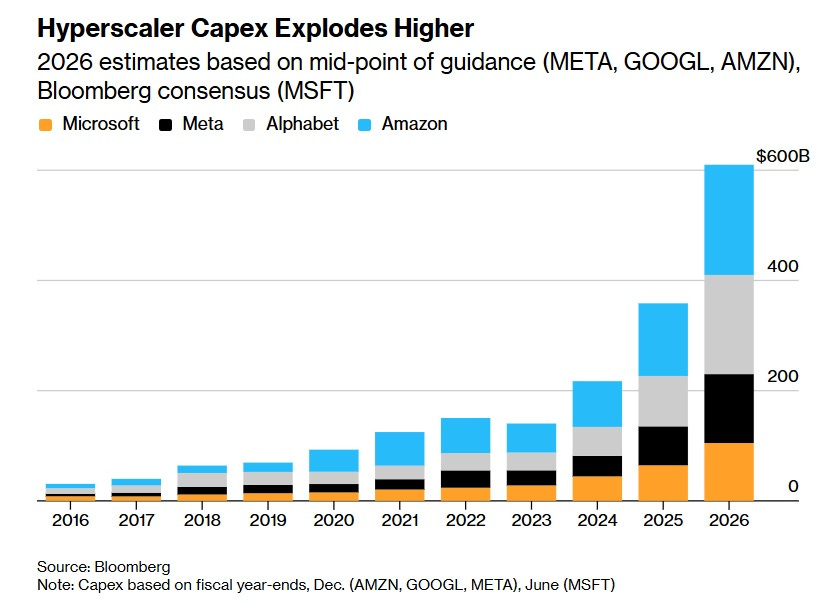 |
AI’s abilities scale with the amount of compute applied.² The amount of compute available this year will be much greater than the amount that’s producing all the miracles you see now. And then next year’s compute will be far greater than that. All the while, AI itself will be searching for ways to improve AI algorithms to better take advantage of increased compute.
Other weaknesses of AI — in particular, its lack of long-