|
 |
| ||




Walking around The Hill in Washington DC, I admit I felt sorta star struck. I guess it’s how lots of people feel when they visit a Hollywood studio. Like, “Wow, I guess this is where the shit actually goes down.” I might be a jaded old man about Hollywood. But walking up to the Capitol building, to the very seat of our democracy, I couldn’t help feeling a wave of idealism bubble up in me. I guess the grandly beautiful architecture was designed to elicit that kind of emotion. But does the American government really deserve any such admiration?
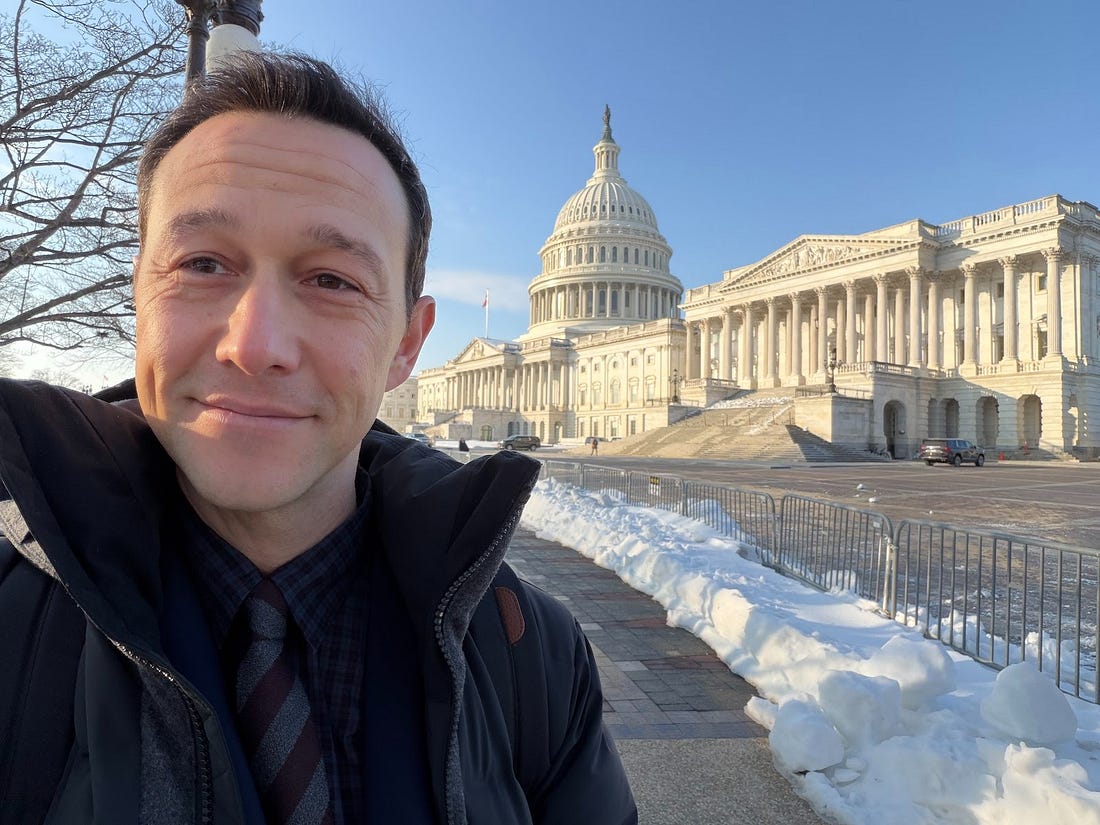 |
It’s tempting to say, absolutely not. I never had much faith in my country’s government. My dad was a journalist who reported on Watergate and the tragic absurdity of the Vietnam War. The first time I ever voted (the 2000 election), the Supreme Court handed the presidency to a guy who seemed incompetent and cruel. Throughout its history and to this very day, the American government has been guilty of immeasurable fault, failure, brutality, and worse. But for all of its shortcomings, I can’t quite dismiss it as 100% bad. It’s also done some good. Probably a lot of good, if we’re honest. Has the good outweighed the bad? I don’t feel like I really know one way or the other.
But isn’t that how it’s supposed to feel? Didn’t the founders want the American people to remain vigilantly skeptical of their own government? Isn’t that what democracy looks like?
I’m writing this on a plane flying home from a day in DC. Starting with an early breakfast in the Senate dining room, I went nonstop in I don’t know exactly how many meetings with Senators, Representatives, staffers, and advocates. We held a press conference. We checked in and out and back in again with hardworking and friendly security personnel. Later I went on CNN.
Did any of it make a difference? Maybe? I think so? Probably not as much as I’d like? But again, isn’t that how it’s supposed to work? That no single person can have too much influence? It’s slow, and it’s messy, but it’s of the people, by the people, for the people?
The people, that’s what struck me the most. Everyone I met, they were just people. When you hear words like “Senator” or “Member of the House of Representatives,” it conjures these larger than life figures who operate in some realm outside of normal human life. But no, I’m here to report, all the politicians I met had lives, just like everyone else does.
Even more striking, I’ll be honest — I met a bunch of people who I might normally consider “on the other team.” Republicans, Conservatives, the Red tribe. And you know what? They were all people too. I might disagree with them about a whole bunch of stuff. I might even disagree with them really, really strongly. But sitting down and talking with them face to face, they don’t feel like demons or crazy people, like they do when I read about them in the news or watch videos about them online. Of course, it helped that we were talking about an issue that we all basically agree on.
I do believe in what we were advocating for today. A great nonprofit called the Center for Countering Digital Hate invited me to join Senator Dick Durbin to support his bill (co-sponsored by his colleague from across the aisle, Lindsay Graham) to sunset Section 230. You can read what I said about it in the transcript below, and if you’re interested, here are a couple articles from some of my favorite thinkers about it.
I don’t think it’s possible for big businesses to serve the public good on their own. They’re not set up to prioritize anything but profits. They need guardrails—aka laws—and it’s the government’s job to put those in place. So however f’d up our government might be, I’m not sure how we build a bright future without it.
So I guess in the end, I’m grateful for the day I got to spend here in DC. I definitely remain skeptical. I’m not entirely sure I accomplished much today. But I did make some friends and connections, if nothing else, and I do believe most of the people I met genuinely care about making the world better. Ultimately, I think I’m leaving town with just a tad more hope than I might have had when I arrived. That definitely could have gone the other way—I could be leaving feeling more cynical than ever. And so I suppose that in itself is some kind of progress.
🔴
Here’s the speech I wrote for the press conference:
Good afternoon, ladies and gentlemen.
My name is Joseph Gordon-Levitt. I’m here to talk about the Section 230 Sunset Act.
If you don’t know and you’re watching, Section 230, what it does is basically says that a platform on the internet can’t be held liable for the content that it hosts, which I realize sounds sort of technical and boring.
So why did I come out here to Washington, D.C. to support this? Well, first and foremost, it’s because I’m a dad. as the senator said. I have a 10-year-old, an 8-year-old, and a 3-year-old. And a lot of people here today are parents whose kids… I just heard a couple stories that left me trying to keep myself together. These photos remind me of my kids. And the harm that was done to these kids online might have been prevented if certain big tech companies knew that they could be sued, but under Section 230, they cannot be.
So these amoral companies, they just keep allowing these awful things to happen on their platform, and they don’t do anything about it because they will always prioritize profits over the public good, even when it comes to kids. And beyond being a dad, you know, there’s nothing in the world I love more than my family. But I do have a certain kind of love for the internet. I do. I co-founded an online community called HitRecord. It’s still very dear to me. So I understand what Section 230 did to bring about the birth of the internet. That was 30 years ago. And I also understand how the internet has changed since then. Because back then, message boards and other websites with user-generated content, they really were more like telephone carriers. They were neutral platforms. But that’s not how things work anymore.
Today, the internet is dominated by a small handful of these gigantic businesses that are not at all neutral, but instead algorithmically amplify whatever gets the most attention and maximizes ad revenue. And we know what happens when we let these engagement optimization algorithms be the lens that we see the world through. We get a mental health crisis, especially amongst young people. We get a rise in extremism and a rise in conspiracy theories. And then, of course, we get these echo chambers. These algorithms, they amplify everything. the demonization of the other side so badly that we can’t even have a civil conversation. It seems like we can’t agree on anything. And yet, One of the only things that the American public seems to agree broadly on right
Now, left, right, and center, Republicans, Democrats, Independents, we all agree that we don’t trust these big tech businesses and we don’t like the influence they’re having on our lives and the lives of our kids. Well, if we want to do something about that, the right first step is to sunset section 230. It’s not going to solve everything. but it is the right first step. And I take a lot of hope being in this room today. This is truly a bipartisan group of people and it’s really representing the will of the American people. Despite the tech industry spending all kinds of money hiring lobbyists trying to kill this thing, we are here.
So I wanna thank Senator Durbin, Senator Graham for co-sponsoring this bill, and I have a message for all the other senators out there. I want to see this thing pass 100 to 0. There should be nobody voting to give any more impunity to these tech companies. Nobody. It’s time for a change. Let’s make it happen.
Thank you.
|