|
 |
This week, Popular Information was honored by the Harvard Shorenstein Center, which awarded this newsletter the 2025 David Nyhan Prize for Public Policy Journalism. From the announcement:
Praised as “timely, fearless, and factual,” Judd Legum is the founder and author of Popular Information, an independent newsletter dedicated to accountability journalism. Trained as a lawyer and steeped in practical political experience, Legum has built a model of journalism that combines meticulous investigative reporting with clear, accessible explanations of how power operates—and who benefits.
Through Popular Information, Legum has repeatedly shown how a single, well-documented story can spur tangible change. Nyhan Prize judges celebrated his dedication to digging up under-reported stories, and his ability to see a story with the eyes of both an editor and reporter.
…Through dogged reporting, clear-eyed analysis, and a steadfast focus on accountability, Judd Legum exemplifies the people-centered political journalism that the Nyhan Prize was created to honor.
Popular Information is published four times per week with no advertisements and no paywalls. We rely exclusively on support from readers. If you value this work, please consider upgrading to a paid subscription.


After months of denials, the Trump administration has admitted that staffers affiliated with the Department of Government Efficiency (DOGE) misused Social Security Administration (SSA) data. In an extraordinary court filing, “NOTICE OF CORRECTIONS TO THE RECORD,” government lawyers representing the SSA revealed that in March 2025, a DOGE staffer signed an agreement to share the private data of Americans with a “political advocacy group” seeking to “overturn election results in certain States.”
SSA determined in its recent review that in March 2025, a political advocacy group contacted two members of SSA’s DOGE Team with a request to analyze state voter rolls that the advocacy group had acquired. The advocacy group’s stated aim was to find evidence of voter fraud and to overturn election results in certain States. In connection with these communications, one of the DOGE team members signed a “Voter Data Agreement,” in his capacity as an SSA employee, with the advocacy group. He sent the executed agreement to the advocacy group on March 24, 2025.
The filing says that emails “suggest that DOGE Team members could have been asked to assist the advocacy group by accessing SSA data to match to the voter rolls.”
The use of government data for political purposes is unlawful. The Hatch Act prohibits a federal employee from using “his official authority or influence for the purpose of interfering with or affecting the result of an election.” In the filing, government lawyers say the DOGE employees involved were referred to the U.S. Office of Special Counsel for possible Hatch Act violations.
The filing does not reveal the identity of the two DOGE members involved in the scheme.
Antonio Gracias, a DOGE staffer who was embedded at the SSA, publicly spoke about using Social Security data to “expose” voter fraud. During a March 30 rally in Wisconsin alongside Elon Musk, Gracias — a billionaire and the Chief Investment Officer of Valor Equity Partners — made a variety of false and misleading claims.
During the rally, Gracias claimed that 2.1 million non-citizens obtained Social Security numbers and said that this was evidence of pervasive fraud. But these Social Security numbers were given to immigrants who were legally present and had work permits. Gracias claimed that he “took a sample and looked at voter registration records, and we found people here registered to vote in this population.”
Non-citizens with work permits are not able to use their Social Security numbers to register to vote, however. Nevertheless, Gracias claimed that he had identified non-citizens who had voted and “referred them [for] prosecution.” There are no known charges or convictions resulting from those alleged referrals.
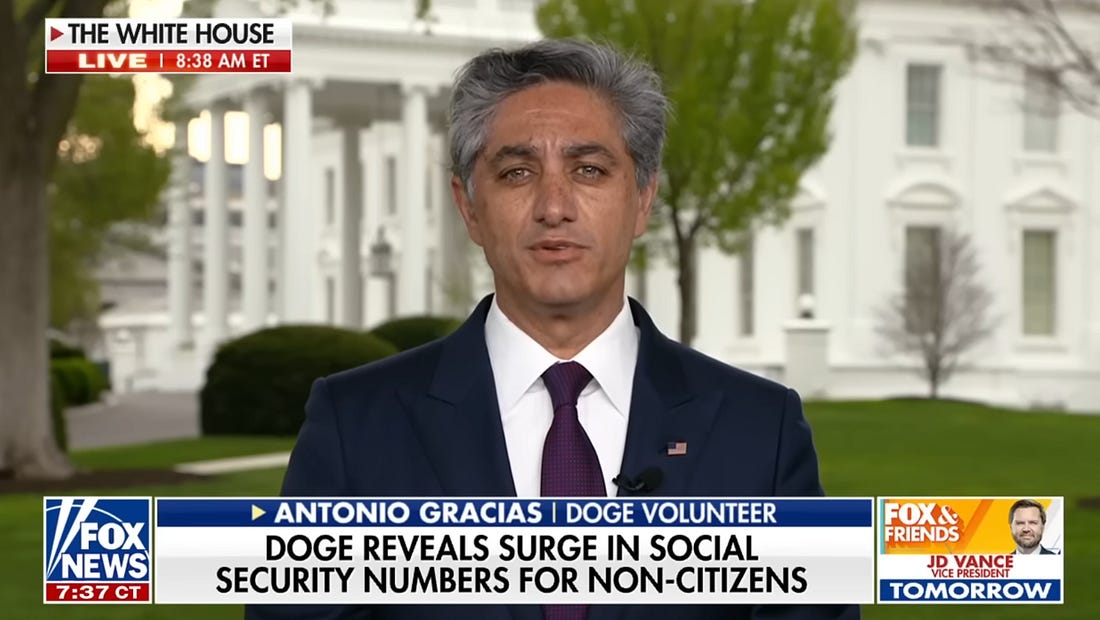
Gracias went on Fox News a few days later and, speaking from the White House lawn, made similar claims. He stressed the importance of allowing databases to “talk to each other.”
 |
Gracias also went on the All-In podcast, where he described the issuing of Social Security numbers to non-citizens — a standard practice for those with work permits and other categories of legal residents — as a “move to import voters.”
Another DOGE staffer embedded at SSA, Aram Moghaddassi, reached out to Florida officials in March 2025 to obtain voter registration data he could cross-check with government databases to identify voter fraud.
Which “advocacy group” seeking to overturn election results conspired with DOGE?
While the court filing does not name the “political advocacy group” coordinating with DOGE, there is evidence pointing to True the Vote, a right-wing group with a history of pushing false claims of election fraud. True the Vote published “An Appeal to DOGE” in March 2025, the same month that the DOGE staffer signed an agreement with the political group. In the open letter, published on the group’s website on March 5, True the Vote encouraged DOGE to investigate the country’s voter registration system. At the top of the letter, Democracy Docket notes, True the Vote Founder Catherine Engelbrecht wrote, “We’ve received word that this message is being carried forward.”
“Given DOGE’s mandate to enhance governmental efficiency and your recent insights into federal data discrepancies, we urge you to extend your investigative rigor to the nation’s voter registration systems,” True the Vote wrote in the letter. “By combining DOGE’s access to federal databases with our assembled voter roll information, we can efficiently identify discrepancies and work toward a cleaner, more reliable election system.”
True the Vote was heavily involved with pushing false claims of election fraud following the 2020 election. In November 2020, True the Vote filed lawsuits alleging voter fraud in Georgia, Michigan, Wisconsin, and Pennsylvania. Less than a week later, the group dismissed all four cases.
True the Vote was also involved in 2000 Mules, the debunked documentary from Dinesh D’Souza. 2000 Mules was based on claims made by True the Vote about alleged ballot stuffing during the 2020 election. The group claimed that it had bought geolocation data from electronic devices that showed that people were repeatedly visiting ballot dropboxes, and therefore were stuffing ballots. The claims were “thoroughly debunked by election and cyber experts.” In one example flagged by True the Vote, the Georgia Secretary of State found that a man was legally dropping off ballots for himself and his family members.