|
 |
24 Hours Alongside an ICE Protester in Minneapolis
Carolina Ortiz, an immigrant advocate, is preparing for ICE’s next onslaught.
|

| |||||||||||||||


 |
Minneapolis, Minnesota
SHE WILL NEVER FORGET the sight of Renee Nicole Good’s blood on the snow.
Carolina Ortiz is the associate executive director of Communities Organizing Latine Power and Action (COPAL),¹ a community-based organization that advocates for Latino families in Minneapolis; it leads the Immigrant Defense Network, a group of 106 organizations like COPAL across the Midwest. She first grasped that something was wrong on January 7 when a colleague known for her cool demeanor in high-stakes situations called Ortiz in a panic. Something horrific had happened.
Ortiz’s team grabbed their gear—neon vests that say “Immigrant Defense Network,” bullhorns, whistles, masks, and first-aid kits—and headed to the site where ICE agent Jonathan Ross had just killed Good.That snowy Minneapolis street has since become familiar to the millions of people who saw the disturbing videos on social media. But Ortiz and her colleagues couldn’t press pause or look away. They were there on the ground.
She witnessed one community member get yelled at and thrown on the ground by an ICE agent for recording, despite being a safe distance from the scene. For about forty-five minutes, the area was blocked off, and then it was cleaned up—long before it was cordoned off as a crime scene, an order of events that struck Ortiz as unusual.
Meanwhile, Ortiz’s staff and others in the growing crowd were starting to be shot at with chemical irritants. Some cried out in fear when the agents started their volley against the crowd; as the masked men shouted at them, Ortiz and her staff didn’t know if the projectiles being fired were chemical devices, rubber bullets, or real bullets. It was chaos.
But what will forever stick with Ortiz was all of the blood. She describes an “extensive” streak of blood across the ground; it painted the snow. The extent of it helps to explain why the cleanup took so long.
Ortiz felt unmoored, scared, and traumatized by what she and her staff saw. In the days since, her constant challenge has been putting those feelings aside to continue doing her work—not only for the sake of her staff, but for the people they’re trying to protect.
“Its scary as hell when you’re in the middle of that, but also scary when you have a staff there that you’re responsible for,” Ortiz told me. “It’s terrifying at a whole other level.” The day of Good’s death, she was trying to keep her team calm and disciplined, even as ICE agents appeared intent on doing everything possible to escalate the situation. She debated whether her people should leave for their safety.
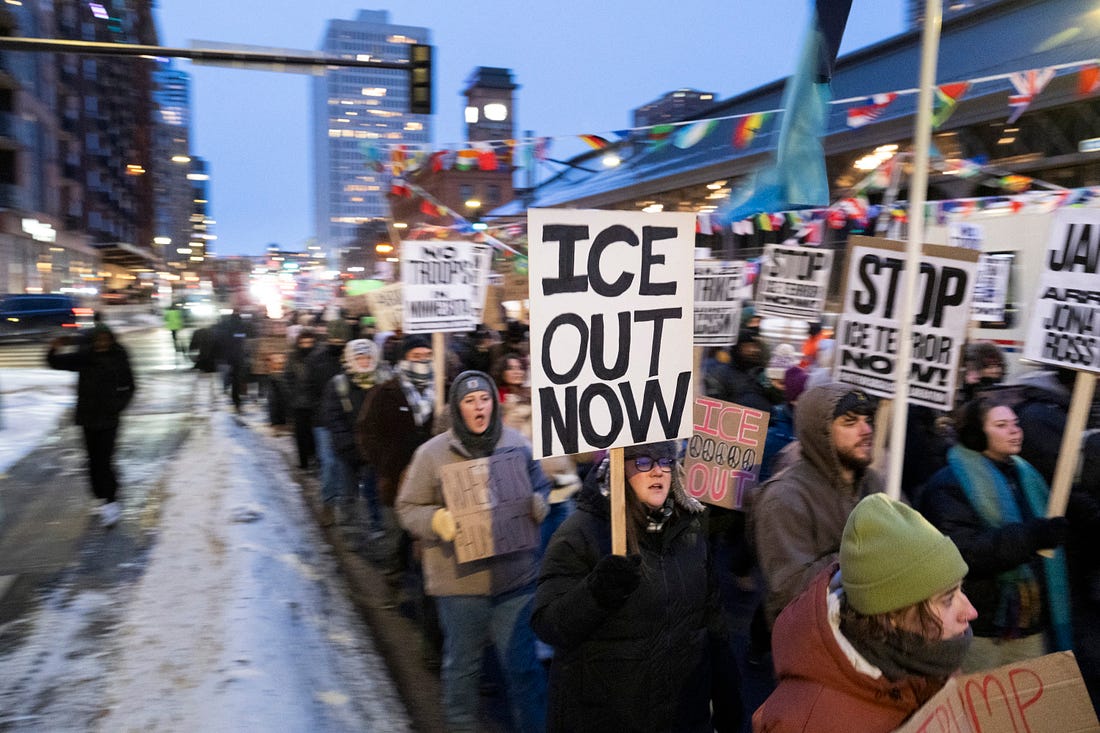
A week later, ICE descended upon Lake Street, a predominantly Latino business corridor. They showed up right outside Ortiz’s office, forcing her group to mobilize. COPAL members saw someone running down the block warning businesses to lock their doors, which many did. Outside, ICE vehicles seemed to appear on every corner. Ortiz jumped into her car to follow ICE and record what was going on, as a cacophony of whistles and honking horns filled the air.
It’s become a common sound in Minneapolis over the last few weeks.
After reading about and reporting on this escalating conflict since the events of January 7, I decided it was time to go to Minneapolis myself to report on the ground.
I spent the day after Martin Luther King Jr. Day with Ortiz. It turned out to be part of a relatively quiet forty-eight-hour period, which unnerved Ortiz and her team rather than calming them. They were still at the ready in case enforcement operations ramped up again.
Ortiz started driving at 5:30 a.m. to drop off groceries to three different people: a community member who had run out of food, plus a family member and a friend of hers who needed food but she also wanted to check in on. We met at 8:00 a.m. for breakfast.
8:18 a.m.: Eerily Quiet
We stop at El Mercado Central, a shopping mall that houses thirty-five Latino-led businesses. The place is usually bustling by this hour, with little parking available, but today we find it deserted. The owner informs us that they’re basically closed and only selling menudo. We head over to Midtown Global Market, another large retail complex that usually has everything inside, even a DMV. Also closed. I tell Ortiz that downtown Minneapolis has been eerily quiet since I arrived. It reminded me of the scenes of deserted streets in Atlanta from the pilot for The Walking Dead. “That’s exactly what it is,” she agrees.
8:28 a.m.: “Don’t Let Anyone Stop You From What You Know Is Right”
Ortiz came to the United States from Zacatecas, Mexico when she was 2 and eventually became a DACA recipient—one of those we call “Dreamers.” As we sit at Pineda Tacos for a chorizo breakfast burrito (one so good it gave me an out-of-body experience), I bring up the scene at Good’s shooting. I ask her about where her spiritual resilience (a term I’ve borrowed from my therapist) comes from—how she’s able to keep going in the face of something so dark. Is it a mantra, maybe, or some wise advice she remembers her abuela once uttered, or a physical item from which she draws encouragement?
The real source, she tells me, is a conversation she recently had with her father.
“As things started to get bad, I was nervous—not for me, but for my parents,” she says. “I talked to my dad and he had a really good conversation with me. He said, ‘I know what you’re doing. I know you’re brave, just do it, don’t let anyone stop you from what you know is right.’ That conversation allowed me to say, ‘Yep, let’s go all in.’”
She tells me more about her father, who is diabetic.
“My worst fear is he’s detained and his sugar levels spike,” she tells me, her eyes glassy, and rose-tinted on the edges. “I don’t know if he would be able to survive that, that is something that is hard to even imagine.”
This was the only time in our entire day together that Ortiz got emotional.