

January 16, 2026
How the Menil Collection used homes and wealth to preserve a Montrose neighborhood
Walk a few blocks around the Menil Collection in the heart of Montrose, and it’s easy to notice what isn’t there.
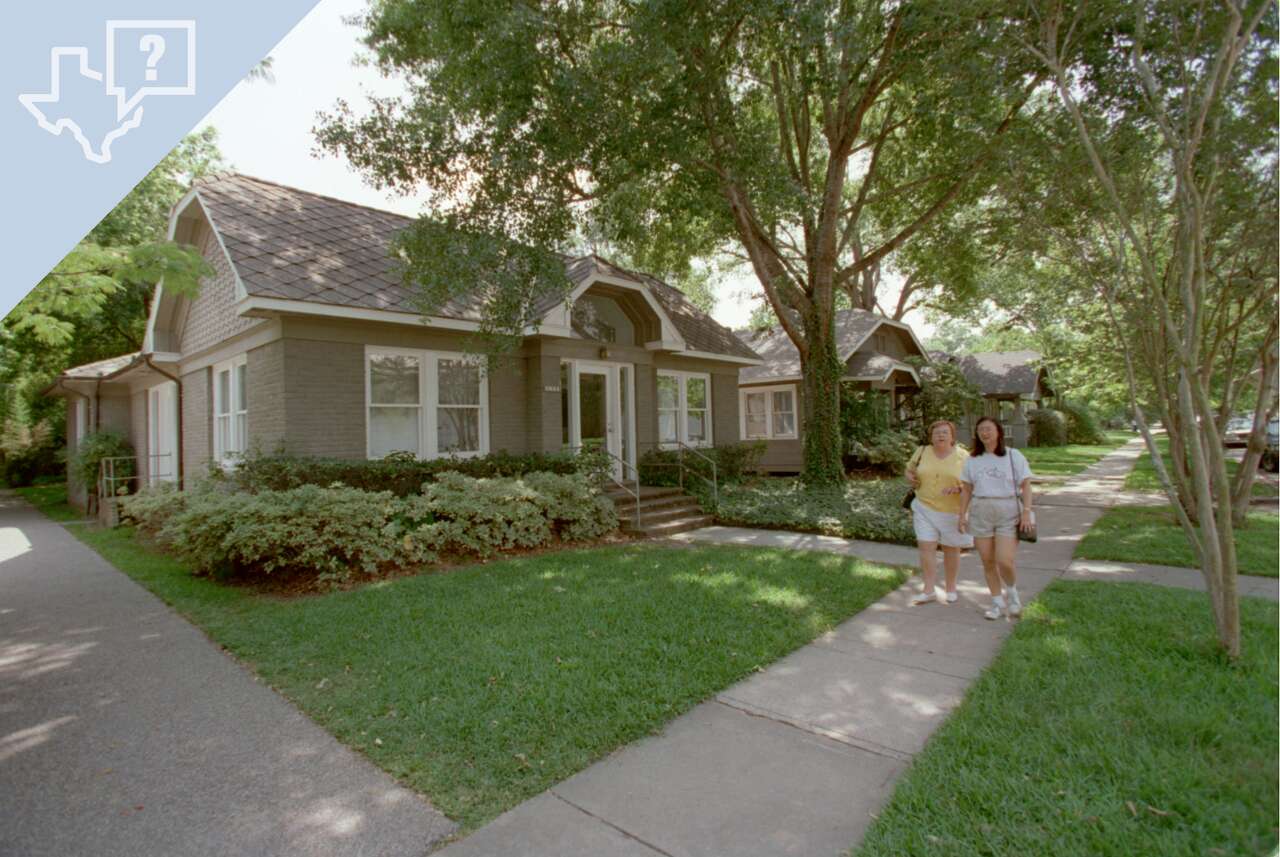
No towers, or parking garages rising like concrete cliffs. Instead, there are modest bungalows, all painted the same soft gray, evenly spaced trees and quiet streets that define the neighborhood as much as any gallery or pavilion.
Here’s the part many visitors don’t realize: Many of those houses were deliberately bought and held by the same people who built one of Houston’s premier art collections. Beginning in the 1960s, the de Menils and, later, the Menil Foundation acquired homes around the campus not to replace the neighborhood, but to shape and preserve it.
What we’re left with today is a carefully curated pocket of Montrose, molded by decisions made decades ago.
Who were the de Menils?
Dominique and John de Menil were French-born art patrons who became two of the most influential cultural figures in Houston after settling in the city in the 1940s.
Dominique de Menil, an heiress to the Schlumberger fortune and avid art collector, was the driving intellectual force behind their collecting and philanthropy. And John de Menil was an oil executive whose wealth came through Schlumberger, the oilfield services company founded by Dominique’s family.
They became known not just for the scale of their art collection, but for how deliberately they embedded art into Houston’s civic life. The de Menils supported education and backed civil rights causes at a time when doing so carried real social risk.
How was the Menil neighborhood assembled?
Beginning in the 1960s, the de Menils and, later, the Menil Foundation began buying small, single-family houses on the blocks surrounding what would become the Menil Collection campus.
These weren’t the sweeping eminent-domain land grabs by a government entity that one might be used to in the age of superhighways swallowing up entire neighborhoods, but incremental purchases by a couple of philanthropists who saw the value in promoting art.
One bungalow at a time, over years and decades, the de Menils took over.
Some properties were used for administrative purposes. Others were rented out as affordable housing for artists. Together, they formed a sort of uniform (the homes were painted gray in the early 1970s as a way to visually unify the neighborhood) buffer zone that kept the museum embedded in a residential landscape, rather than leaving the surrounding area subject to the whims of developers and others emboldened by Houston’s lack of zoning laws.
Also, yes — some of the bungalows are still lived in, but they aren’t typical private homes.
Menil-owned houses around the campus are used in a mix of ways: some function as offices, archives, program space for the museum and even the collection’s gift shop, while others are long-term rentals, often for visiting scholars, artists or people affiliated with the institution.
What preservation prevented
This area is proof that, in Houston, preservation is possible, but usually only when someone rich enough decides it should be.
To understand the impact of the de Menils’ choice to conserve this area, it helps to look just beyond its borders. Much of Montrose and nearby Midtown has been reshaped by apartment complexes and mid-rise developments. Blocks that once held quaint bungalows now hold hundreds of units.
But around the Menil, that wave of progress has stopped in its tracks thanks to the deliberate effort to limit that development. The result is a neighborhood that’s widely loved for its calm and cohesion, but doesn’t that also raise harder questions about how preservation works in Houston?
Like, who gets to decide what “progress” looks like in Houston, and who gets to stop it? Why was preservation possible here when other historic neighborhoods around Houston weren’t protected? Is this even preservation, or simply a different form of hogging land?
This place, as lovely as it is, wasn’t protected by zoning or public policy. It endured because a single vision had the private wealth and authority to hold it in place.
 | Jhair Romero, Houston Explained Host |
Recommended Reading
|




Unsubscribe | Manage Preferences

Houston Chronicle
4747 Southwest Freeway, Houston, TX 77027
© 2026 Hearst Newspapers, LLC