|
 |
Thank you for subscribing to Off Message. This is a public post, available to all so please share it widely. If you enjoy this newsletter, I hope you’ll consider upgrading to a paid subscription, for access to everything we do.
Alternatively, if you don’t want a Substack account, you can keep Off Message going with a donation. All support is appreciated, but donations of $75 or larger come with a comped annual subscription—all content unlocked and emailed to the address provided.
You make Off Message possible. Thanks again.
Speed Chess, Poor Sportsmanship, And The Trump Opposition
He's losing; and only he and his enablers are responsible for the collateral damage of his volatility.
|

| |||||||||||||||


 |
We are not right back where we were a year ago.
It might feel that way. Donald Trump and the people who issue orders in his name surely want to create that impression. That’s why they returned so conspicuously to the frenetic pace of his first weeks in office.
But to mistake today’s madness on all fronts for the madness of last year requires pretending that everything in between never happened. And it’s a lot. It’s overreach and economic deterioration and No Kings and corruption scandals and an approval rating that’s inverted from +12 to -16.
Demoralized and exhausted? I get it. So am I. It’s only human. But the fact that Trump’s actions now are as aggressive as they were before he squandered his good will doesn’t mean he’s reset the game board and started over.
This is what I was trying to convey in Tuesday’s newsletter: It’s an error to confuse flailing for forward momentum, but it’s also an error to grow complacent, simply because at this point in the game he’s closer to defeat. He’s also creating big problems that will be hard to fix in the future, when he’s gone.
But there’s one important caveat I didn’t address: the interim risk that he overturns the game board. That may be what he’s working himself up to do.
I love games and mind puzzles. The more challenging the better. I’ll even layer rules of my own creation on to whichever game I’m playing to augment the challenge. They’re a great Trump-era diversion. They’ve also become an essential part of my work flow. Ideally I’d have an editor. But as I must edit myself, I do my best to mimic the benefit of fresh eyes. I write in the afternoon, close up shop, then edit myself early in the morning, when I’ve built critical distance from whatever I drafted the day before. Games are a tool I use to clear my brain of morning fog, like warming up before exercise or revving an idle engine.
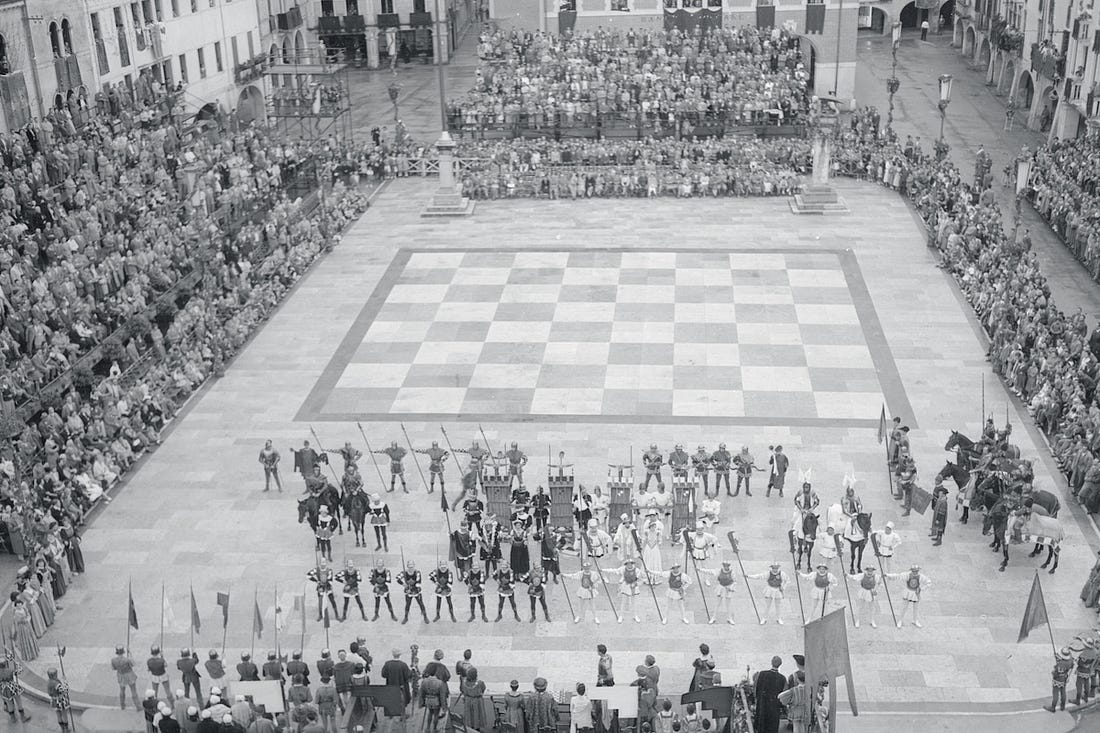
The only common game that really breaks my heart is chess, because I can never become good at it. I’ve been playing from a young age, and I’m fine as friendly chess playing goes. But I lack two critical skills everyone needs to play well: patience (which I can force upon myself if I really try) and visual search efficiency.
Show me a crowded bathroom countertop, ask me to grab the toothpaste, and I’ll scan for a good 30 seconds before finally locating it right in front of my nose. It’s very frustrating! For myself, as you might imagine, and for my wife, who has to help me find basically everything I didn’t place somewhere intentionally.
Drop me off at a grocery store I’ve never been to with a list of 10 common items, and (between wandering the aisles and scanning shelves) it’ll take me an hour to finish shopping.
This makes chess-playing—good chess-playing—almost impossible. I’m prone to dumb fuckups, particularly early in the game, because for all practical purposes, when the board is crowded, I can’t see the periphery. My playing is OK if I slow way down. I can recognize patterns and anticipate moves well enough. But in a normal-paced game, someone with similar skills will likely catch me in some obvious error, and put victory out of reach.
Ironically, I’ve found I can neutralize this debility by speeding things way up. In a game of speed chess, I’m still blinded by clutter, but a regular chess player is likelier to become flustered and screw up in their own right. The game becomes less about strategy and attention to detail than blunderbussing and mind tricks.
The arc of Trump’s second presidency so far resembles speed chess. Him, up against opponents who’d only ever played the game in competition, on a regular clock. First, shock and awe, then adaptation, then a reversal of fortune as his gambits fail. Suddenly he’s desperate.
Typically, in a friendly park-side table game, a player like that would lose with good sportsmanship and try again. The political equivalent would be to shake things up internally. Fire people. Extend a hand of friendship across the aisle. Whatever.
Trump is incapable of that kind of thing. He’d rather cheat, or sweep the pieces to the ground, than tip his king or admit to checkmate. It’s good that he’s losing. It’s not so good that he’d rather commit murder-suicide than accept defeat.