This issue: A debut novelist lets us in on the process of writing and publishing her book, new releases worth the cost of a hardcover, and some good news: Starting today, Book Gossip is going biweekly. |
|
|
| Senior newsletter editor, New York |
|
|
Madeline Cash Found Her Editor at a Party
“I think that this was all really unprecedented.” |
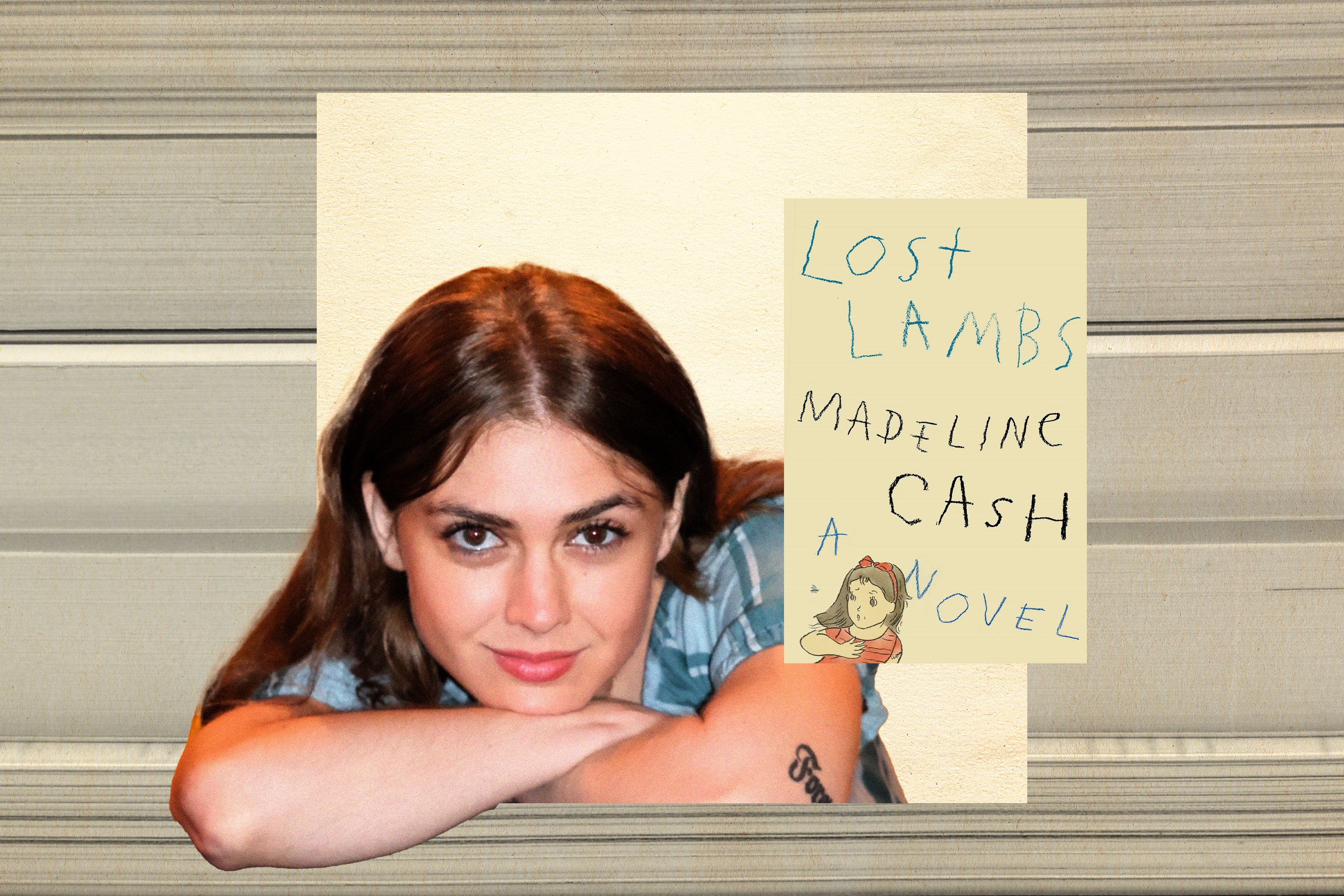
Photo-illustration: Vulture; Photos: Farrar, Straus and Giroux, Nat Ruiz |
|
|
In this Book Gossip series, authors get candid about what it took to publish their book. |
|
|
If you haven’t yet heard the alliterative title of Lost Lambs, you certainly will. Madeline Cash’s debut novel, a mordant yet affectionate Franzen-esque family story that inhabits each character’s point of view, has been drumming up excitement since mid-last year, and it’s hitting booksellers’ digital and IRL shelves today. The book takes place in an unnamed American port town, where parents Bud and Catherine are too busy test-driving their newly opened marriage to take much notice of their three daughters’ respective rebellions. While Abigail dates an older man and Louisa becomes embroiled with a sinister internaut, Harper, the precocious, conspiracy-minded youngest, keeps her nose firmly to the ground, determined to expose the town billionaire’s suspicious activity.
The 29-year-old Forever Magazine co-founder’s book has so far sold rights in 15 territories and, so I’m told, gotten a major writer-director acquisition. (Cash declined to share the financial details of her deal.) A few days ahead of publication, I called up Cash to get the lowdown on the process of writing and selling the book. |
|
|
I went to Sarah Lawrence and was a creative-writing major — they're very loose about majors, but that was my focus. In 2023, I published a short-story collection, Earth Angel, on a really, really small press when I was still living in L.A. at my mom's house. They spelled my name wrong in the first printing of the book; it was very unregulated. I did all of my own PR, but I was quite ambitious and kind of a squeaky wheel. I had Forever Magazine that I'd founded, and it was having a bit of a cult moment on a small scale. Forever first started in 2020 as a reading series in L.A., where I swear to God there weren’t a lot of readings going on. Ours had to be outside because it was the pandemic. The first one was in the Hollywood Forever Cemetery, which was why we called it Forever. I was a huge accolade of Giancarlo DiTrapano, the founder of Tyrant magazine. When he died, I was devastated by this loss in the counterculture. I was like, I'm going to carry the torch. I reached out to Tyrant writers who I think were a little bit at a loss for what to do next and asked if they would take a chance on me, and many people did. I coded a website — I didn't know how to code, but I had a lot of time and stimulus money — and I started making the magazine with Anika Jade Levy, who I went to high school with. We found that there was more fervor for a literary community in New York. Anika had just moved there for grad school and was basically like, “You need to come out here.” So I came out to visit her with a suitcase and never left.
|
|
|
It was about 2022 when I started writing Lost Lambs. I was 26. I wanted to challenge myself to write a complete work of fiction that had no purchase on my life or resembled it in any way. That was the initial impetus to write a pure, genuine capital-N novel. Then, things started coming together from different inspirations and things I was interested in, my obsession du jour. I put it together with Post-its and spreadsheets.
I had a day job at the time. I was the head copywriter for Jack in the Box, a West Coast fast-food conglomerate, and I also did freelance copywriting. It was a bit more flexible, so I could write during the day, but I would mostly write evenings and weekends. I am very organized and anal, so I had everything plotted out — the writing was filling in the blanks. I had a timeline for it.
For the final push, I felt like I needed to get out of my environment. (My environment is my apartment in Chinatown. It's 400 square feet and it is very cute and very small.) I have an Aunt Brenda, who I don't think is actually biologically related to me. I went to her apartment in Stuy Town, took work off, and spent a week there as a self-inflicted residency and finished the book. It took probably a year and a half from start to finish. We sold it in 2024. |
|
|
On Querying Agents and Editors
|
I knew a few media people and would reach out to them and be like, “By the way, I have this short-story collection, maybe you want to do a profile on me.” It was kind of a debasing process because I was pitching myself for publication and media. Sometimes it worked. Doing Forever really helped because I was able to say, “I also edit this magazine.” I emailed everyone and got a little bit of press drummed up around the collection.
I got an agent my age at Inkwell to read it, Michael Mungiello, and he took me on. He’s wonderful. I feel like we've kind of come up together. Being able to say “I have an agent” was like a suit of armor. He helped me get the book to my editor, Jackson Howard, but I essentially stalked Jackson to a party in a warehouse in Chinatown. I had always wanted to have a book out with FSG since I was a teenager. I loved Jonathan Franzen and Tom Wolfe and Philip Roth. I'm only naming old white men, but I saw the fish on the spines of all of the books that I loved. Then I found Jackson, who seemed cool and in my milieu, but he was also a senior editor at this press. I kind of begged him to read it. I don't think that he really wanted to, but he did. Thank God. We didn't send it anywhere else. My agent said, “It is kind of traditional to shop it around,” but I was like, “No.”
I was calling it The Corrections meets Eyes Wide Shut, which I think is funny and overly ambitious. Jackson called me before anything was signed, just to see if we would work well together — and probably to make sure that I wasn't a lunatic or a fascist or something. That weekend he called me and said that they were going to buy it, and I was just over the moon. Anika, who had just graduated from Columbia, brought me into an undergrad creative-writing course she was teaching at Pratt to talk about my collection when my agent called and said that they had made an offer. I was freaking out. I immediately called my mother, who is a docent at the Getty in L.A., and she was like, “I'm doing a tour. Do I need to call you back?” And I was like, “You must.”
Then it snowballed really quickly. After the initial sale, it was the London Book Fair, so we sold all of these international territories and then film rights. I went home and quit my job. I was supposed to write 500 headlines for a new kind of soft taco. It wasn't that I had made a bunch of money, I just was like, “I'm done now. I have to be done.” |
|
|
Mike, my agent, goes above and beyond what the average agent does in terms of editing. It was a lot of notes and dinners explaining the notes, and then me going back and addressing them. With Jackson, there were probably three rounds of edits that took six months. There was really high-level editing, and then another pass, and then really granular line editing. For the latter, I did this residency at the DiTrapano Foundation, the Tyrant founder’s ancestral home in Italy, for three weeks and knocked them out there. I kind of agreed with all of the edits and was amenable. There were a couple things that were hard to swallow, like getting rid of a character, but I wasn't too precious about it. I think I was just like, “I'm so happy to be here, whatever you say to make this a better book.” I don't think everyone's process is like that, but that's how mine was.
|
|
|
On Waiting and Self-Promotion
|
I didn't know that it would take two years to come out, but when we sold it, I was like, “Oh my God, I'm going to be almost 30 by the time this book comes out.” At first, every other day I was getting a phone call that was like, “We're selling your book in Serbia.” It was so exciting and everything was new, and then it quieted down. I guess I had to keep living my life, so I eventually figured out what I was going to do next and started the next book. Then in the past six months, I was just dying in anticipation of everything that's happening right now.
I'm not the best at being a front-facing figure, but I'm so grateful for everything. I'm also kind of sick right now, so it feels surreal because I'm on cough medicine, but self-promotion is hard. I asked my team in the U.K. to do media training with me. The publicity team at FSG does a good job handling marketing, so I just will do whatever they tell me to do. I'll be their puppet.
I wrote Lost Lambs so long ago now. I'm not embarrassed, I think of it affectionately, but it is an older piece of work. My brain wasn't even fully developed when I started writing the book. There are things that I kind of wince at, and then there are things that I'm proud of. As more and more people read it, it's really interesting to see their interpretations and what people assume is personal to me.
This is not an instruction manual for a debut writer. I think that this was all really unprecedented. I got really lucky, and I was really stubborn. I don't think this is traditionally how people get published, and it's probably how people get restraining orders. But that's what happened and everything right now rocks. |
|
|
Subscribe now to get unlimited access to everything New York, including subscriber-only newsletters, exclusive perks, the New York app, and more. |
|
|
The New Releases You Should Buy, Skip, or Put on Hold at the Library |
|
|
The School of Night, by Karl Ove Knausgaard
January 13
As a narrator, Kristian Hadeland is, at first, almost unbearable. The 20-year-old Norwegian student has just landed in London to pursue photography. While cobbling together a modest portfolio, Kristian cuts off all contact with his family after overhearing his father call him a narcissist, frequently forgets to wash, boils a dead cat, and sees everyone but himself as the problem. When he falls in with Hans, a strange older Dutchman, he starts to carve out a place for himself — until a violent altercation with an unhoused man upends his life and, probably, sanity. Being in this narrator’s head is exhausting; thankfully, at various points over the book’s 500 pages, it tips into being hilarious. The Faustian fourth installment of Knausgaard’s Morning Star probing the price of success is worth the necessary perseverance. Buy. —Jasmine Vojdani
Discipline, by Larissa Pham
January 20
On a book tour for her first novel, a writer named Christine hears from the man who inspired it: a former painting professor who went from being her mentor to, briefly, her lover. After they slept together, he mostly stopped talking to her, and she quit painting. In her novel, she’s so angry that she kills him — in real life, she mostly just retreats into herself, until a second-half twist I won’t spoil. Larissa Pham’s own first novel is a serious work, threaded with theories about artistic practice and descriptions of actual paintings. In the first section, when Christine is encountering a variety of strangers on her travels, it’s hard not to think about Rachel Cusk, which isn’t necessarily a bad thing. “My tone as a critic was diligent, well read, faintly old-fashioned,” the narrator says at one point, which applies here too. Read it if you consider yourself a rigorous person. Borrow. —Emma Alpern
|
|
|
|