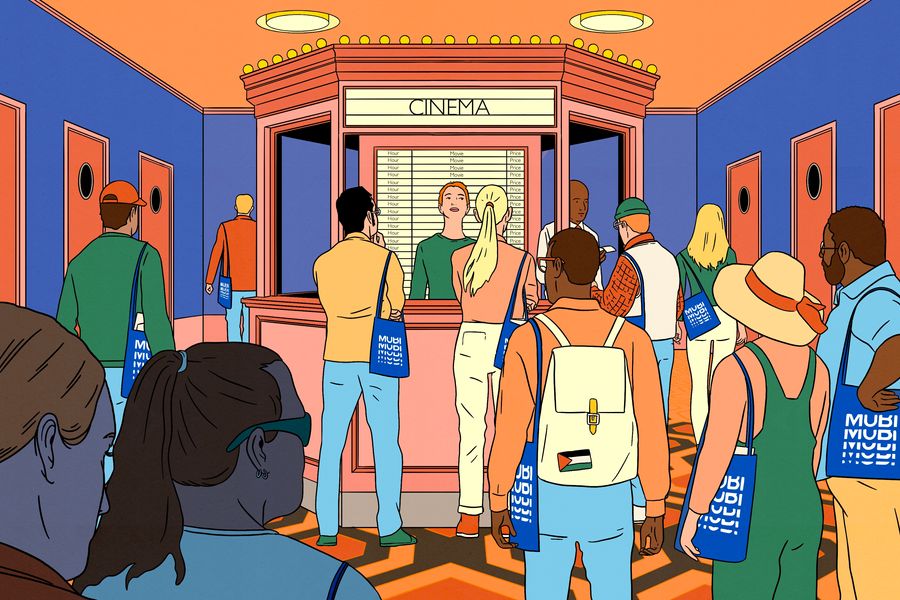
In July, the chef and food-media personality Eddie Huang woke up to a text message from Jason Ropell, a film executive at Mubi. It sounded urgent: “Let’s talk soonest.” Mubi, which distributes indie and foreign films and streams them to millions of monthly subscribers, had been preparing an August premiere for Huang’s documentary Vice Is Broke, which charts the rise and fall of his former employer Vice Media. Mubi had acquired rights to the film in January for a healthy six-figure fee, which included some theatrical screenings — a good deal for Huang in today’s documentary market. But, according to Huang, Ropell proceeded to tell him over the phone that those screenings were now canceled.
Mubi claims Huang all but requested to cancel the screenings himself. A day earlier, Huang had posted on Instagram about his opposition to venture-capital firm Sequoia Capital acquiring a 10 percent stake in Mubi for $100 million. The investment, announced in May, had caused an uproar in the indie-film community. Sequoia had invested in an Israeli defense company called Kela following the October 7 attack, amid Israel’s subsequent genocide in Gaza. In his Instagram post, Huang stated that unless Mubi properly addressed the situation, he would not promote his own film. “I’m not being dramatic or corny,” Huang wrote. “We have to start saying ‘NO.’”
In the end, Vice Is Broke premiered on Mubi’s platform in August, though without its theatrical screenings or Huang’s participation. But Mubi’s problems were only multiplying. An activist group called Filmworkers for Palestine launched an online campaign demanding that Sequoia partner Andrew Reed be removed from the company’s board. In the past six months, at least 10,000 Mubi users have unsubscribed in protest of the Sequoia investment. Festivals and brands have canceled or paused key partnerships with the streamer, hundreds of Mubi employees have voiced their dissent, and some filmmakers have even withdrawn their work from the platform and canceled deals that were in progress.
For Mubi’s founder and CEO, Efe Cakarel, the Sequoia backlash came as a surprise. Other film studios have received questionable investments without stirring up controversy. Last year, A24 secured a reported $75 million capital injection from Josh Kushner’s venture-capital firm, Thrive Capital, a major investor in Israeli start-ups and the military-AI company Anduril Industries. This did not dent the reputation of the studio responsible for Moonlight and Uncut Gems, described in a fawning New Yorker profile as a company where “even the money guys are cineastes.”
Mubi, however, is not like A24 or any other film studio. When Cakarel founded the company in 2007, Mubi was primarily known as a message board for hard-core cinephiles to discuss their favorite directors. His plan was both ambitious and unlikely: to make a globally dominant studio out of art-house cinema. Somehow, he succeeded. Mubi became a powerful indie distributor in the U.S., releasing some of the most innovative American films of the past decade, such as Zia Anger’s My First Film and Ricky D’Ambrose’s The Cathedral, and masterpieces like Radu Jude’s Do Not Expect Too Much From the End of the World. It connected with a younger generation of fans that was attracted to the company’s willingness to show some of the world’s most outré and marginal films and that forged an organic community whose views on politics skewed heavily toward the left.
However, as Mubi’s ambitions grow — its 2024 film The Substance grossed more than $80 million at the box office and was nominated for multiple Academy Awards — it could alienate the very community that made it successful. For Cakarel, the Sequoia investment was supposed to be proof that Mubi could give art-house cinema mass appeal. But art-house cinema was niche for a reason: It demands deep engagement with artists and their works. By turning art house into a global brand, Mubi risked emptying the values that made the genre niche in the first place …