| | The US economy surges on consumer spending, rare footage of a defiant Chinese general’s trial leaks,͏ ͏ ͏ ͏ ͏ ͏ |
| |  ULAANBAATAR ULAANBAATAR | BEIJING |  BANGKOK BANGKOK |
 | Flagship |  |
| |
|
The World Today |  - US economic growth surges
- China’s ‘unfair’ chip trade
- WH targets asylum claims
- Drugs in fruit shipments
- Chinese general’s trial video
- Costs of Mongolian cashmere
- Near-collision of satellites
- Mars rover is driving itself
- The far right’s favorite novel
- AI could doom ad firms
 An energy billionaire’s American Western art collection, and a crime show that helped Semafor’s Congress bureau chief better understand the US. |
|
US economic growth surges in Q3 |
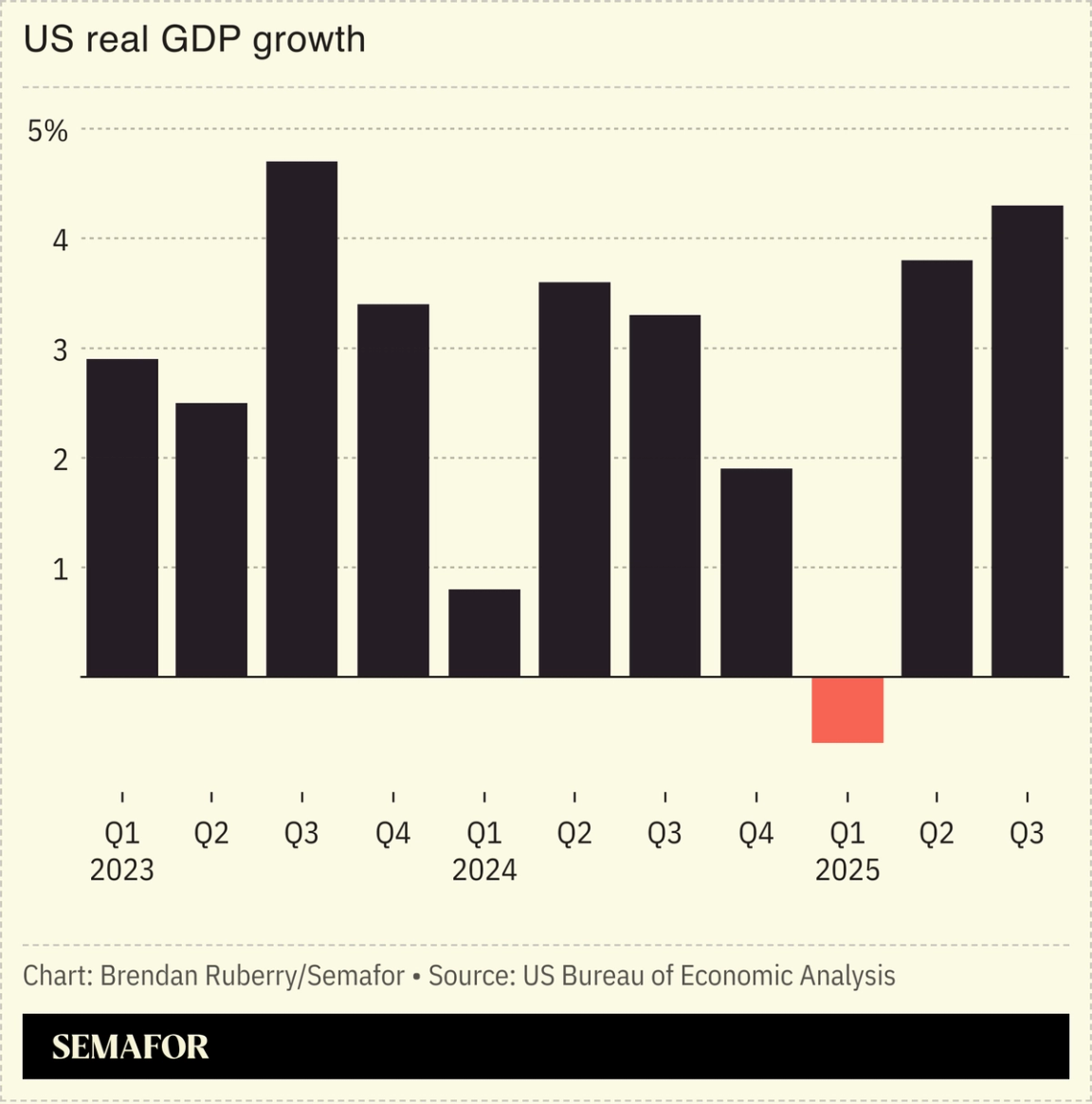 The US economy grew in the third quarter at its fastest pace in two years, driven by strong consumer spending. Tuesday’s data, which was delayed by the government shutdown, exceeded economists’ expectations amid lingering uncertainty over the impact of President Donald Trump’s tariffs and growing concerns about affordability. The figures showed that Americans continued to spend on services like health care, even as consumer confidence declines. The mixed signals reflect “a layer of policy chaos built on top of an economy that seems surprisingly resilient to that chaos,” a co-host of Bloomberg’s Odd Lots podcast told Ezra Klein. “Maybe at some point, all that uncertainty… eventually will hit.” |
|
WH holds off on new China chip tariffs |
 Tingshu Wang/Reuters Tingshu Wang/ReutersThe US accused China of unfair trade practices in the semiconductor industry, but held off on imposing new tariffs on Chinese chip imports amid the uneasy trade truce between the superpowers. Washington’s nearly-yearlong inquiry into China’s chip sector found that Beijing was employing “increasingly aggressive” policies to dominate the industry. The US suggested that future duties were on the table, creating leverage for Washington if the trade deal with Beijing falls apart, Bloomberg wrote. US curbs on selling advanced chips to China have only hastened Beijing’s march toward technological self-sufficiency, but those efforts have come at cost, The Wall Street Journal wrote: Large parts of China’s economy are struggling, as billions of dollars are spent on boosting domestic technology. |
|
Trump’s new immigration tactics |
 David ‘Dee’ Delgado/Reuters David ‘Dee’ Delgado/ReutersThe US is canceling thousands of asylum claims by citing deportation agreements with “safe” third countries, CBS News reported, one of several new approaches the Trump administration is adopting to curtail immigration. The legal end-around, which the government said is to curb asylum fraud, risks undercutting legitimate claims from those fleeing persecution, lawyers warned. President Donald Trump is changing the ways in which people are targeted and deported, The New York Times wrote: His adviser Stephen Miller is spearheading an offensive against birthright citizenship by arguing that even the children of immigrants are prone to criminality, while ICE is working with the White House to pump out viral raid videos that promote its mass deportation strategy, The Washington Post reported. |
|
Smuggling cocaine in banana shipments |
 Daniel Noboa. Santiago Arcos/Reuters Daniel Noboa. Santiago Arcos/ReutersDrug traffickers used the Ecuadorian president’s family banana export business to smuggle cocaine. Balkan gangsters boasted in intercepted chats about how they had exclusive rights to use shipping containers from the Noboa Corporation, owned by President Daniel Noboa, according to the Organized Crime and Corruption Reporting Project’s investigation; one message described a 950lb drug shipment. The findings prove awkward for Noboa, who has called for the US to back his “war” against “narco-terrorists.” Washington temporarily deployed troops to Ecuador last week, despite Ecuadorians recently voting against establishing foreign military bases. Ecuadorians aren’t “swayed by the simplistic narrative that a permanent US military presence in their country would help end gang violence,” the country’s former foreign minister argued in Project Syndicate. |
|
Video of Chinese general’s trial leaks |
 王志安/YouTube 王志安/YouTubeA video of the secret trial of a Chinese general who refused to use force against Tiananmen Square protesters in 1989 was leaked onto YouTube. Hundreds, or perhaps thousands, of people were killed during the pro-democracy demonstrations in Beijing. But General Xu Qinxian refused to lead the 38th Army into the capital to clear protesters. In the video, he says he would “become a sinner in history” if such an assault led to bloodshed. Footage of Chinese military procedures is almost unheard of, The New York Times reported, and discussion of the massacre is heavily censored. Xu was stripped of command and sentenced to five years. Under a new commander, the 38th “became notorious for its bloody advance into Beijing.” |
|
Mongolia’s cashmere trade on the brink |
 ASW/tan/Reuters ASW/tan/ReutersMongolia’s cashmere trade is at risk of imploding, New Lines Magazine reported. After the USSR’s collapse, Mongolia opened to global markets, and small herders eschewed crop and livestock diversity in favor of raising goats for the booming cashmere market. The country became the world’s second-largest producer after China, its output increasing sixfold over 30 years. While relentless demand for the coveted fiber has raised herders’ quality of life, it’s also exposed them to greater precarity: Many are indebted, and one storm away from losing their herds. The grazing of 22 million goats has ravaged pastures, 76% of which exhibit signs of desertification. “I feel abused by the price of cashmere,” one herder said. “It’s a job destined to become unsustainable.” |
|
A near-collision of two satellites |
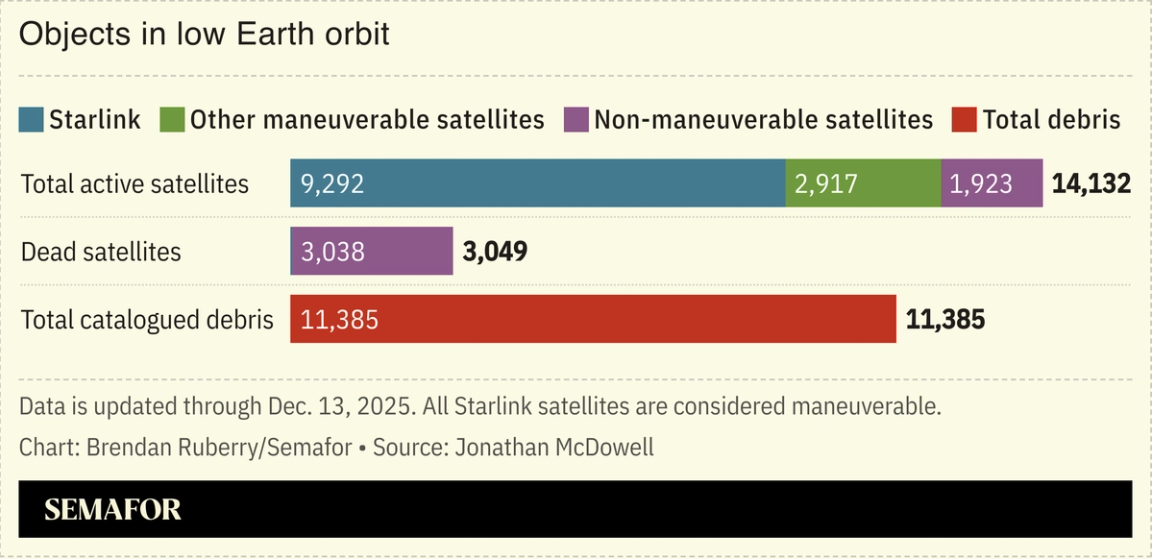 Two satellites, one Starlink and one Chinese, nearly collided this month as low Earth orbit fills up. The two came within some 650 feet of each other. There are at least 24,000 objects, including debris and satellites, in LEO, and there could be 70,000 satellites by 2030. Close passes are increasingly common: Two satellites pass within a kilometer (0.62 miles) of each other every 22 seconds, new research suggested. The potential outcome is “Kessler syndrome,” in which one collision creates a debris cloud, causing other collisions and eventually filling low orbit with shards of metal traveling at five miles a second. Satellites can adjust their positions to avoid crashes, but need to know where other objects are to do so. |
|
 Semafor will be on the ground in Davos next month for the World Economic Forum, the annual gathering where the world’s most powerful come together to strike deals, tout their good deeds, and navigate the snow — sometimes getting stuck long enough to share a scoop or two with us. We’ll deliver exclusives on the high-stakes conversations shaping the world. Expect original reporting, scoops, and insights on all the deal-making, gossip, and lofty ambitions — with a touch of the pretentious grandeur Davos is famous for. |
|
Mars rover is driving itself |
 NASA/JPL-Caltech/MSSS/Handout via Reuters NASA/JPL-Caltech/MSSS/Handout via ReutersNASA’s Mars Perseverance rover has traveled nearly 25 miles after five years, a new milestone, in part because of its self-driving capabilities. Scientists choose the rover’s destinations, but it now travels mostly autonomously, traversing unexpected obstacles as it collects samples. Similar to (earthbound) self-driving cars, the robot can scan for potential hazards up to 50 feet ahead of it. It may be a solo act for a while: Despite hopes that the US would send another spacecraft to retrieve the Perseverance’s Martian rock specimens by 2026, “no one is building such a lander,” and NASA’s strategy for such a project, which would cost billions, remains undecided, Ars Technica wrote. The good news: The rover appears to be in excellent health. |
|
Far right’s favorite dystopian novel |
 Reuters/Cheney Orr/Reuters Reuters/Cheney Orr/ReutersA dystopian French novel from the 1970s recently retranslated into English offers a lens for understanding today’s nationalist right. Jean Raspail’s The Camp of the Saints depicts the violent destruction of Western civilization by an “armada” of dark-skinned peoples that sets sail from India. The book counts among its influential adherents figures like White House adviser Stephen Miller — an architect of the Trump administration’s hardline immigration policies — as well as MAGA commentator Steve Bannon and French nationalist leader Marine Le Pen, who keeps a copy in her office. In its apocalyptic vision, Raspail’s novel expresses the “profound fear that European-American civilization… faces an existential threat from migration,” The Atlantic wrote, “and that extraordinary measures can be justified in response.” |
|
|


