Thanks for reading The Briefing, our nightly column where we break down the day’s news. If you like what you see, I encourage you to subscribe to our reporting here.
Greetings!
Sometimes people’s greatest weakness can be their biggest strength. And in AI, it is turning out that what we thought was a weakness for Google—the fact that it had both a search portal and an AI chatbot—is actually an advantage. People use search and AI chatbots interchangeably, to be sure, but it’s become clear through the course of this year that an AI chatbot is not a replacement for a search engine. Sometimes people want a very quick, simple answer that is best coming from a search engine, not a chatbot.
This issue is a particular problem for OpenAI, as we detailed in this story today. The AI leader has poured research into developing reasoning models that are good at complicated tasks, our story explained, but aren’t suited for queries calling for a quick, simple answer. OpenAI staffers realized they had a problem when they noticed that improvements to the underlying AI model didn’t matter much to users, many of whom used ChatGPT to ask basic things rather than the complicated math and science questions the model was suited for.
None of this will come as a surprise to top executives at companies like Google. In April, in a period when some (including us) were wondering whether Google would eventually combine its Gemini chatbot with Google search—as a way to avoid consumer confusion—CEO Sundar Pichai sent a different signal. He told an analyst call that while there were “some areas of overlap” between search and Gemini, they had “very, very different use cases.” Amazon, by the way, has a similar issue and likely has come to the same conclusion. Its shopping site has a search engine that is distinct from its Rufus AI chatbot. If you’re searching for a book you want, the search engine is a far better conduit than asking Rufus, which will take longer to tell you stuff you don’t necessarily need to know.
OpenAI‘s realization that model improvements didn’t always mean much to users also highlights the risks of focusing too obsessively on advancing AI for the sake of doing so, rather than on how AI advances can enhance products. Our story today highlights signs of a schism between research and product at OpenAI, and there have been reports of similar differences at Meta lately. It’s a good bet Google has endured the same kind of debate. There’s nothing new about researchers and product people feuding, of course. But in AI, the costs of everything are magnified.
Making Money in Entertainment
The boards of Warner Bros. Discovery and Netflix are doing a good job right now of losing money for their shareholders. The stock of WBD fell 2% on Thursday to $27.61, down from $29.98 last Friday, thanks to the WBD board’s rejection of Paramount Skydance’s $30 a share offer. WBD prefers Netflix’s $27.75 offer, which doesn’t include WBD’s cable channels.
Netflix shareholders, meanwhile, remain unhappy about the company’s deal to buy WBD. Netflix stock has been slowly falling another 0.8% on Thursday to $93.99, which means it is down 24% since early October, when co-CEO Greg Peters seemed to dismiss the possibility of a WBD bid for Netflix. Good job!
In Other News
• Brett Adcock, CEO of robotics startup Figure AI, has started a new AI lab called Hark, which he will fund with $100 million of his personal capital, The Information reported.
Today on The Information’s TITV
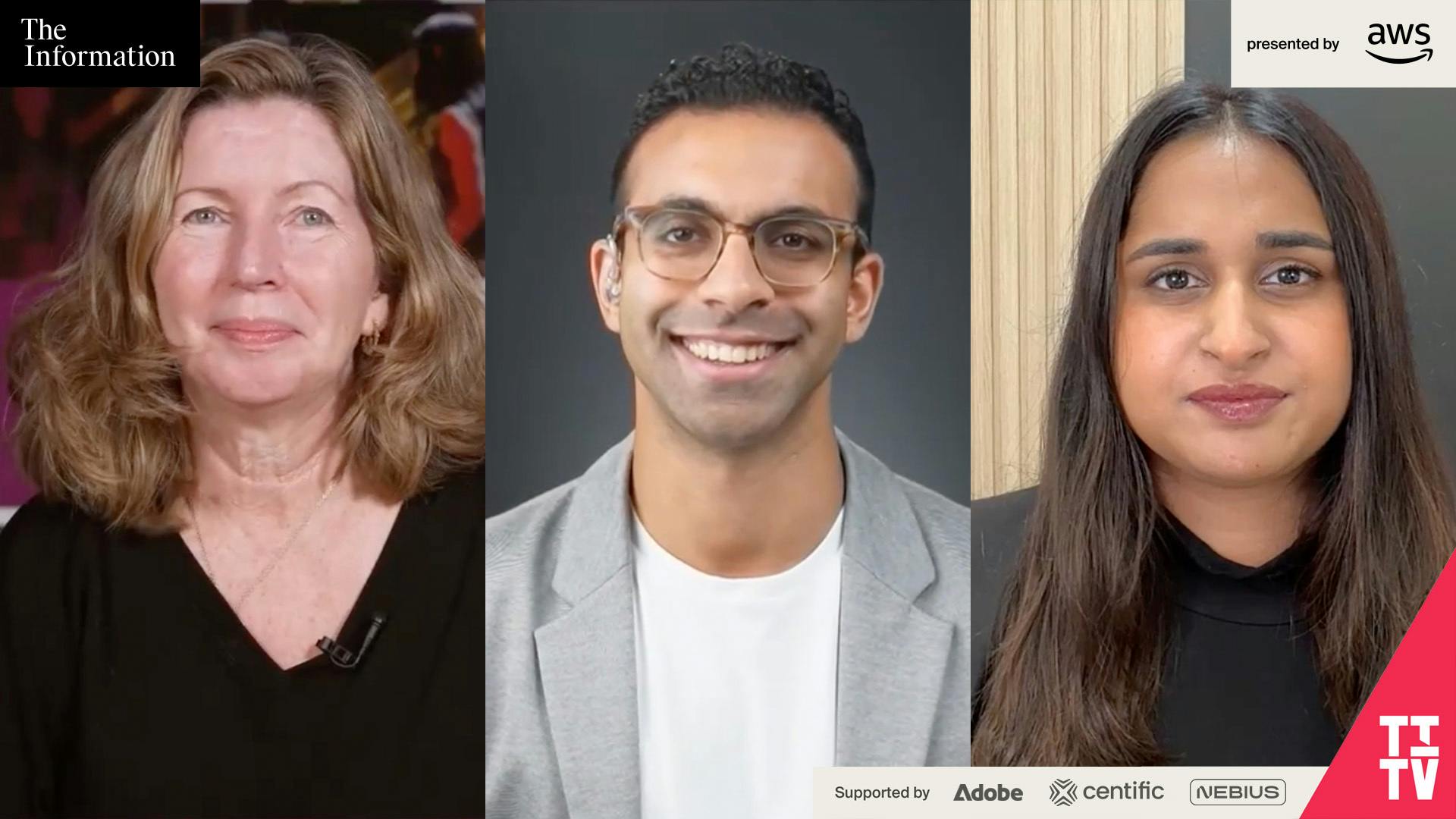
Check out our latest episode of TITV in which we ask the CFO of Lyft about how the company’s autonomous vehicles ambitions will affect margins.
Recommended Newsletter
Start your day with Applied AI, the newsletter from The Information that uncovers how leading businesses are leveraging AI to automate tasks across the board. Subscribe now for free to get it delivered straight to your inbox twice a week.