| | | | |  | By Megan R. Wilson | Was this newsletter forwarded to you? Sign up here to get it in your inbox. In today’s issue: The GOP revolt in the House over the enhanced Affordable Care Act subsidies. … The latest WP Intelligence report breaks down why health costs will continue rising next year. … A Washington Post exclusive detailing the cancellation of millions of dollars in federal grants to a doctors’ group critical of the administration … and more. Hello everybody, and welcome to the Health Brief newsletter. We’re getting ready for several big Trump administration announcements expected this week — including potential action on marijuana and new drug pricing deals — and gathering intel. What are you hearing? Send any tips, scoops or other health policy leads to megan.wilson@washpost.com, or message me securely on Signal at megan.434. This newsletter is published by WP Intelligence, The Washington Post’s subscription service for professionals that provides business, policy and thought leaders with actionable insights. WP Intelligence operates independently from The Washington Post newsroom. Learn more about WP Intelligence. |  | | Rep. Michael Lawler (New York) is one of the Republicans who joined all House Democrats in support of a measure to force a vote to extend the enhanced Affordable Care Act subsidies for three years without any reforms. (Jessica Hill/AP) | | | |  | The Lead Brief | Republicans should be preparing for an at-home pressure campaign centered around Obamacare over the holidays. Earlier today, four frustrated moderate Republicans bucked their leaders to join all House Democrats on a discharge petition to force a vote on their proposal, which would extend the enhanced Affordable Care Act premium subsidies for three years — without any of the reforms many GOP lawmakers have been demanding. If all 218 lawmakers who’ve signed the discharge petition vote for the legislation, it will pass the House. A vote on the three-year extension isn’t expected until next month, and the gap creates time for advocates to make their case. My colleagues Marianna Sotomayor, Kadia Goba and Riley Beggin in The Washington Post newsroom have a breakdown of what’s happening in the House. These are the Republicans who broke ranks: Reps. Brian Fitzpatrick (Pennsylvania), Michael Lawler (New York), Rob Bresnahan (Pennsylvania) and Ryan Mackenzie (Pennsylvania). “To me, the clean three-year extension is not ideal,” Lawler said. “But doing nothing is not an answer.” My colleagues report that additional House Republicans are ready to support the measure: Rep. David G. Valadao (California), another vulnerable incumbent, told The Washington Post he also wanted to sign the petition. But the reality is: The Senate already voted down a similar proposal from Democrats to provide a clean three-year extension just last week — a point noted Wednesday by a spokesman for Senate Majority Leader John Thune (R-South Dakota). Still, a small group of moderate Republicans in swing districts is sending a message to their leaders that they’re willing to partner with members across the aisle on extending the enhanced subsidies, a likely midterm election issue. → Could the dynamics change in the Senate following a House passage? Thune told reporters Wednesday that “we’ll cross that bridge when we come to it.” It would certainly put pressure on Republican leadership to move forward with considering the proposal again — and lawmakers having time back in their districts to hear from constituents whose monthly premiums are increasing may only raise the stakes even more. The House will vote today on the GOP proposal, which doesn’t include an extension of the enhanced subsidies or the health savings accounts favored by Senate Republicans. Instead, it includes proposals such as funding so-called cost-sharing reductions that would reduce monthly premiums for some lower-income Americans who choose silver-level plans. However, it could ultimately increase costs for other people. | | | | | | Executive Health Brief | The Department of Health and Human Services is nixing millions of dollars’ worth of federal grants to the American Academy of Pediatrics, a group suing Health Secretary Robert F. Kennedy Jr. over his approach to vaccine policy, The Post’s Lena H. Sun and Paige Winfield Cunningham scoop based on documents they obtained. The Trump administration has terminated seven of AAP’s grants, which were focused on reducing sudden infant deaths, improving adolescent health, preventing fetal alcohol syndrome and identifying autism early. Administration officials cited a range of reasons, my colleagues report, including its use of “identity-based language,” such as references to racial disparities and “pregnant people,” and insufficient focus in at least one grant program on nutrition and chronic disease prevention, which they said do not align with the agency’s priorities. “The sudden withdrawal of these funds will directly impact and potentially harm infants, children, youth, and their families in communities across the United States,” Mark Del Monte, AAP’s chief executive and executive vice president, said in a statement to The Post. The organization is exploring options to push back, he said, including a legal challenge. Additional info from Lena’s notebook: Some health agencies — including the Centers for Disease Control and Prevention — amended language in October that allows agencies to terminate grants “if an award no longer effectuates the program goals or agency priorities,” she tells me. Translation: This could be the first wave of grant cancellations to come. → AAP is leading a lawsuit filed by medical groups, challenging Kennedy’s unilateral changes to coronavirus vaccine policy and calling for members of the federal vaccine advisory panel — handpicked by Kennedy — to be replaced. The group, which represents pediatricians nationwide, has been critical of Kennedy’s overall leadership of the agency, arguing his actions on vaccines endanger public health. Kennedy, meanwhile, has accused AAP with acting on the behest of pharmaceutical companies. When the group maintained that children should continue receiving annual covid shots, Kennedy called on the group to disclose conflicts of interest “so that Americans may ask whether the AAP’s recommendations reflect public health interest, or are, perhaps, just a pay-to-play scheme to promote commercial ambitions of AAP’s Big Pharma benefactors.” → AAP received $18.4 million in federal grants from HHS this year, The Post reported, citing a federal grants database. Read Lena and Paige’s full report: “American Academy of Pediatrics loses HHS funding after criticizing RFK Jr.” | | | | | | WP Intel File | Health care spending in the U.S. is expected to grow even higher over the next several years — even absent the spike in premiums expected as a result of an expiration of the enhanced ACA premium subsidies. Rebecca Adams, the lead health care analyst at WP Intelligence, explains why in her latest report. And we’re putting it over the paywall for you. | 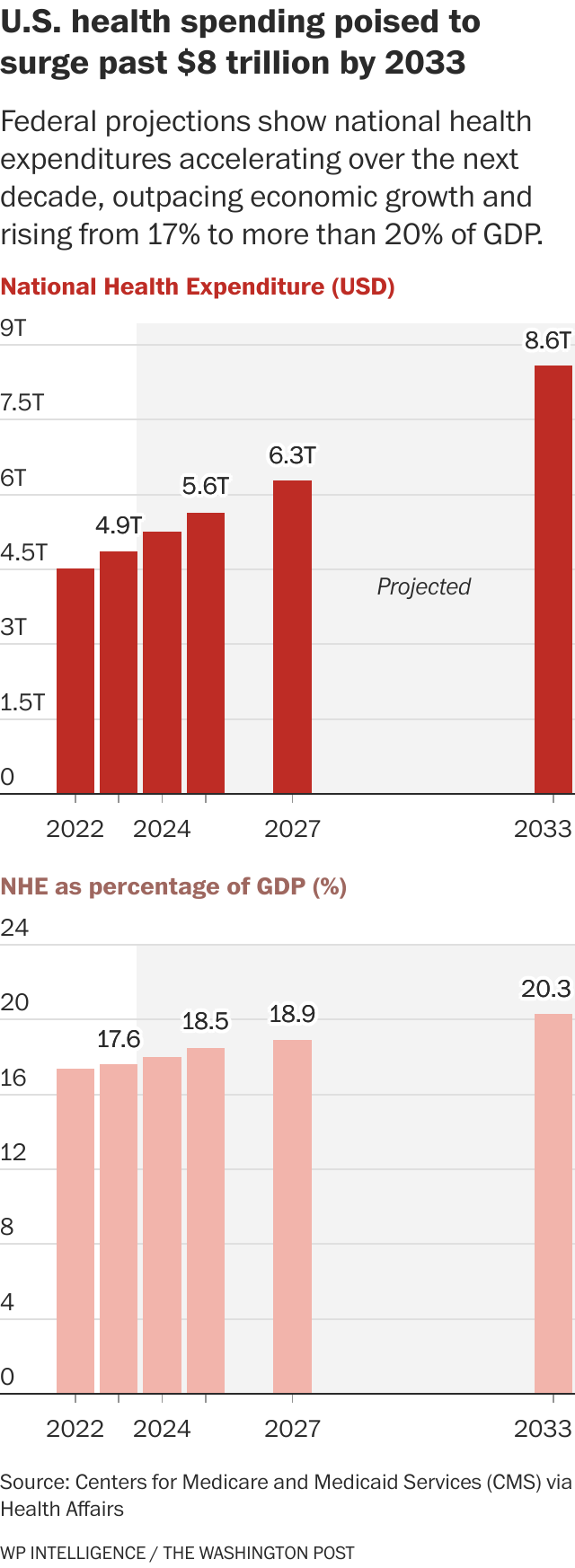 | | Here are the topline points from Rebecca’s report: - The consolidation of medical providers drives up prices as larger health systems wield more negotiating power with insurers. Looming changes in President Donald Trump’s tax-and-spending law could spur more consolidation.
- Private equity investments have led to increased costs, according to research Rebecca has found — and those cost increases reportedly don’t come with similar increases in quality. For example, one study examined 423 cancer treatment practices acquired by 82 private equity firms between 2013 and 2022. Prices rose by 50 percent for radiation therapy at the private equity-backed firms when compared to independent oncology practices. Chemotherapy prices at the private equity-acquired practices rose by 28 percent.
- The development of expensive new therapies, such as obesity drugs, gene therapies and cancer treatments, contributes to a rise in prescription drug spending.
- Labor shortages, which could be exacerbated by new immigration restrictions that are reducing the availability of health care workers, add to the cost of care.
- Health insurance premiums — and concerns about them — are spiking in both employer-sponsored insurance and the ACA markets. The largest increase in 15 years for work-sponsored insurance is expected next year, even after companies raised deductibles and took other steps to shift costs to workers, according to survey findings of more than 2,000 businesses.
| | | | | | Immunization Update | The CDC approved a recommendation from a federal vaccine panel to nix the universal birth dose of the hepatitis B vaccine, but declined the panel’s guidance that would have urged parents to consider testing for antibodies before moving to other shots in the three-dose hepatitis B schedule. The Post’s Lena H. Sun has the full story, including the backlash from many doctors, state health departments and medical groups: “CDC approves major child vaccine change, rejects controversial one.” Two weeks ago, the CDC’s Advisory Committee on Immunization Practices (ACIP) held a set of contentious votes about the changes to long-standing hepatitis B vaccine recommendations. The CDC has now officially adopted the panel’s recommendation that mothers who test negative for hepatitis B could, in consultation with their health care provider, delay their baby’s initial dose of the vaccine to at least 2 months of age. A recommendation for babies to get the shot at birth remains in place when mothers either test positive for the disease or their status isn’t known. Why it matters: It’s the largest shift to the childhood vaccine schedule under Kennedy, a longtime critic of the number of shots children receive. The universal birth dose recommendation — established in 1991 — is credited with nearly eliminating hepatitis B in children. “This recommendation reflects ACIP’s rigorous review of the available evidence,” acting CDC director Jim O’Neill said in the agency’s announcement. “We are restoring the balance of informed consent to parents whose newborns face little risk of contracting hepatitis B.” Meanwhile, medical groups have expressed alarm, arguing it is not based in science. Some health experts say that adults — including relatives and caretakers — who don’t know they’re positive can inadvertently pass the virus to newborns, as it can live on surfaces such as toothbrushes and nail clippers. What this means for providers: Some pediatricians worry that the recommendations could cast doubt on the efficacy of the vaccine. Lena reports that some clinicians say they’re spending more time countering confusion and misinformation — including questions prompted by the vaccine advisers’ recommendation — without the institutional backing of federal health agencies they once relied on. What it means for insurers: Insurance groups including the Blue Cross Blue Shield Association and AHIP have said they will maintain coverage through 2026 for any shots the federal government had recommended before ACIP began making changes. What it means for states: States led by Democratic governors are in uncharted territory. Many have split off from the federal government — forming regional coalitions — and established their own public health guidelines, which is likely creating more confusion for patients. Lena reports that several state health departments — including in Colorado, Connecticut, Maryland, Massachusetts, Michigan, New York and Rhode Island, in addition to newly formed regional health alliances — still recommend that all babies receive a hepatitis B vaccine within a day of being born. | | | | |


_tstmp_1756933376-1920-1080.png)