Hi! Spoilers from space: Google Earth satellite imagery captured the set of Apple TV’s “Pluribus” during filming, unknowingly revealing a major plot point to fans of the show. Today we’re exploring: |
-
Tale of two shoppers: Both high- and low-income consumers are flocking to discount stores.
- Lump sum: Global coal demand is set to decline through 2030.
- To the moon: SpaceX is now valued at ~$800 billion ahead of its slated 2026 IPO.
|
Have feedback for us? Just hit reply - we'd love to hear from you! |
Aldi is winning over high- and low-income shoppers — increasingly, so is Walmart |
With festivities in full swing, millions of bargain-hunting Americans are venturing to Walmart for discount decorations, dinner hauls, and stocking fillers. Some are also heading to the retailer for some bougier (boulangerie-r?) items.
In Walmart’s third-quarter earnings, executives outlined a croissant craze that led the retailer to “remove the shelf” for the baked goods due to the sheer volume being shifted. The example highlighted the growth driven by “upper- and middle-income households,” dubbed the “gentrification of Walmart” by Quartz.
|
Sales have been booming at discount chains like Dollar General, Dollar Tree, and Walmart in recent quarters — to be expected considering the rising cost of goods and increasingly difficult job market.
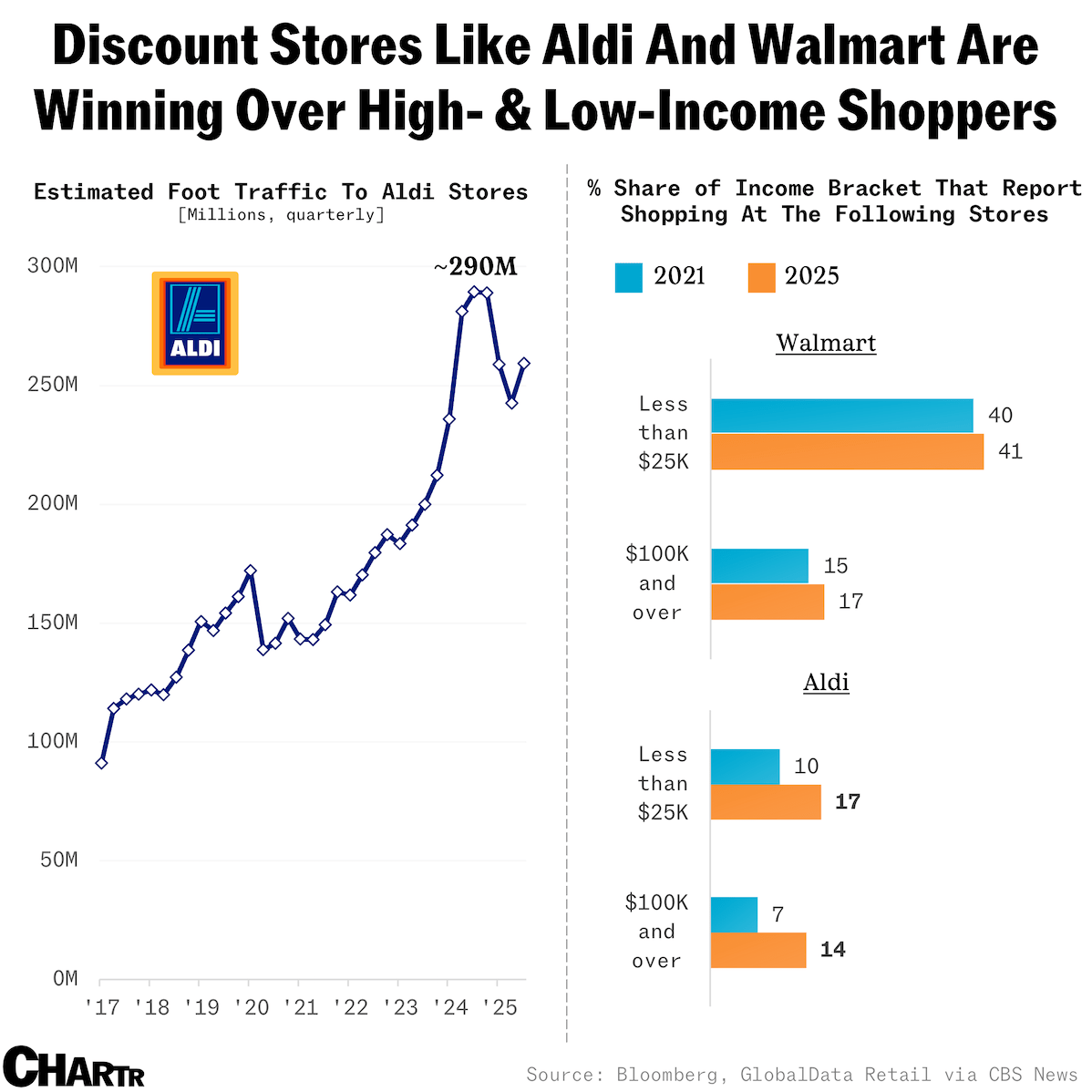
Perhaps less expected, though, is the increasing proclivity of richer cohorts to hunt for bargains. Data from GlobalData Retail via CBS News showed almost 28% of high-income consumers reported shopping at discount stores this year, up from 20% four years ago. |
One case study is Aldi, which has effectively doubled its consumer base with incomes over $100,000 since 2021, per GlobalData, as well as gaining ground with households earning less than $25,000. The German grocer has seen store traffic climb as it undergoes a rapid US expansion, with plans for over 3,200 stores by the end of 2028. Like Walmart, many of Aldi’s offerings, including organic produce and pantry staples, are appealing to a growing share of higher-income shoppers.
Still, while additive-free products have helped ensnare some pocket-lined patisser-ati, ultimately Aldi can credit competitively low prices for its soaring sales — with value deals enticing both ends of the earnings spectrum. |
This year was peak coal, as global consumption is set to decline through 2030, per new report |
Humans have been burning coal to warm our homes, fire our hearths, and move machinery for more than a millennium — a relentless energy-creating practice that fueled much of the industrial revolution.
But, finally, it seems we have reached peak coal, with global consumption set to “decline slightly” through the end of the decade after reaching “a plateau” in 2025, amid rising competition from renewables, natural gas, and nuclear power, according to the International Energy Agency’s Coal 2025 report. |
The agency estimates that global coal demand will rise 0.5% in 2025 to a record 8.85 billion tonnes, with the US providing the largest boost as higher natural gas prices and a slowdown in plant retirements have lifted the country’s coal use, breaking a 15-year decline.
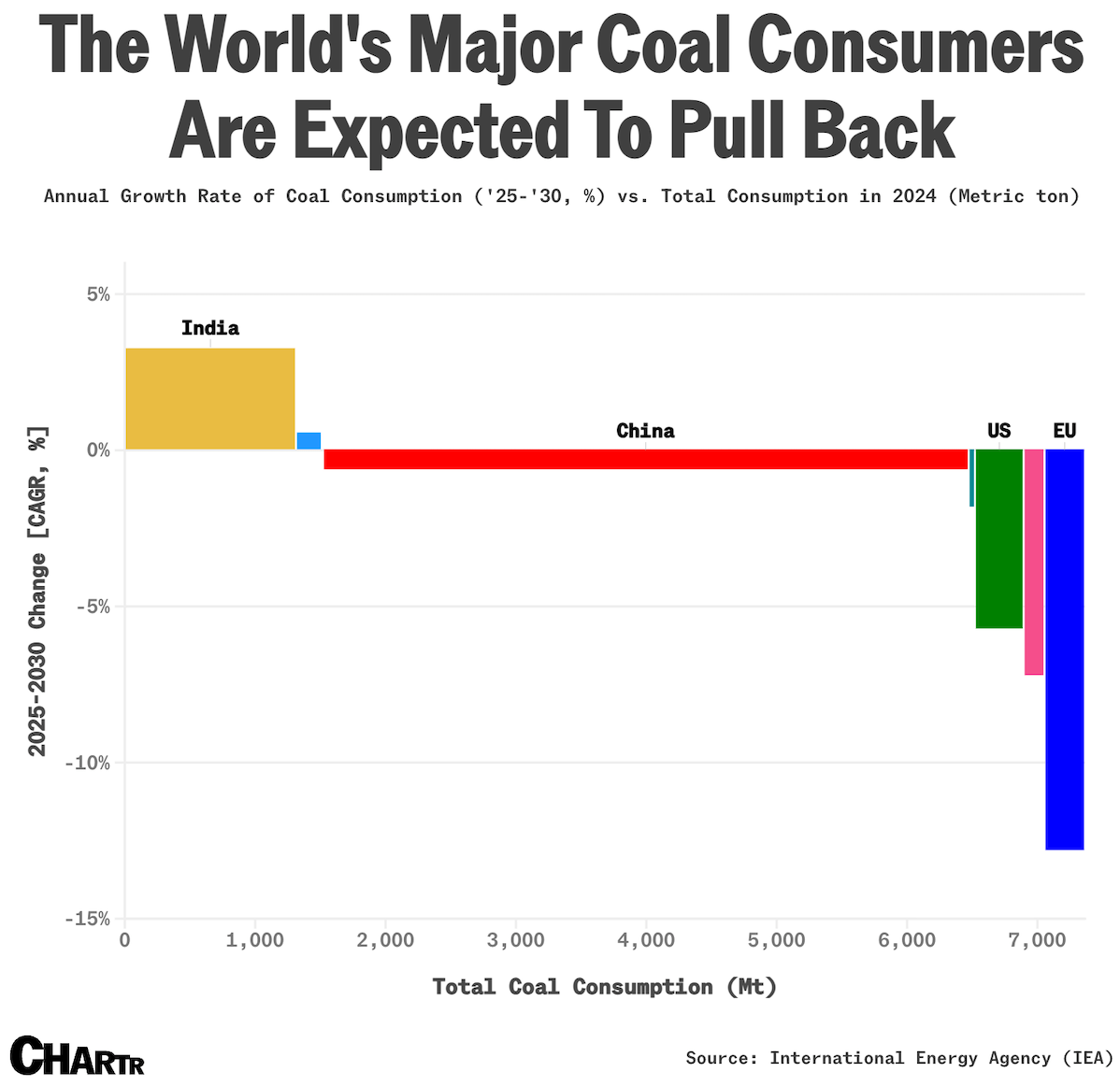
Beyond this year, however, a pullback is expected, with global coal consumption forecast to slip by about 3% by 2030. That’s led by some of the world’s biggest users — most notably China, which accounts for more than half (56%) of global demand. |
While the IEA expects China’s demand to edge down by less than 1% per year to 2030, even that modest decline would carry an outsized impact given its scale. Indeed, the country not only consumes but also produces more coal than all others combined, and remains the world’s largest importer. The forecast comes as China rapidly expands renewable energy capacity and the government pushes to reach peak coal consumption before 2030. Meanwhile, other advanced economies are set to see sharper declines in coal use, including the EU, the US, and Japan, where cleaner power sources are increasingly replacing coal.
Those declines are expected to offset strong growth elsewhere, most notably India. The country is set to post the largest absolute increase in coal demand, adding over 200 million tonnes by 2030 as electricity demand surges.
Still, the IEA cautions that the outlook remains highly uncertain — especially in China — as a stronger push into coal-to-chemicals projects and slower integration of renewables could keep coal demand higher for longer. |
|
|
SpaceX is reportedly valued at around $800 billion, sending Musk’s net worth soaring |
Recently, there’s been a lot of noise around Elon Musk’s rocket ship and satellite internet company, SpaceX — so much so that employees received an internal email informing them that the business is entering a “regulatory quiet period,” per Bloomberg reporting this morning.
SpaceX was founded in 2002 and has notched impressive firsts in the decades since, including being the first private company to send humans to the International Space Station five years ago. Now, workers are being asked to refrain from talking publicly about plans for a potential blockbuster IPO next year, the company’s growth, and its valuation.
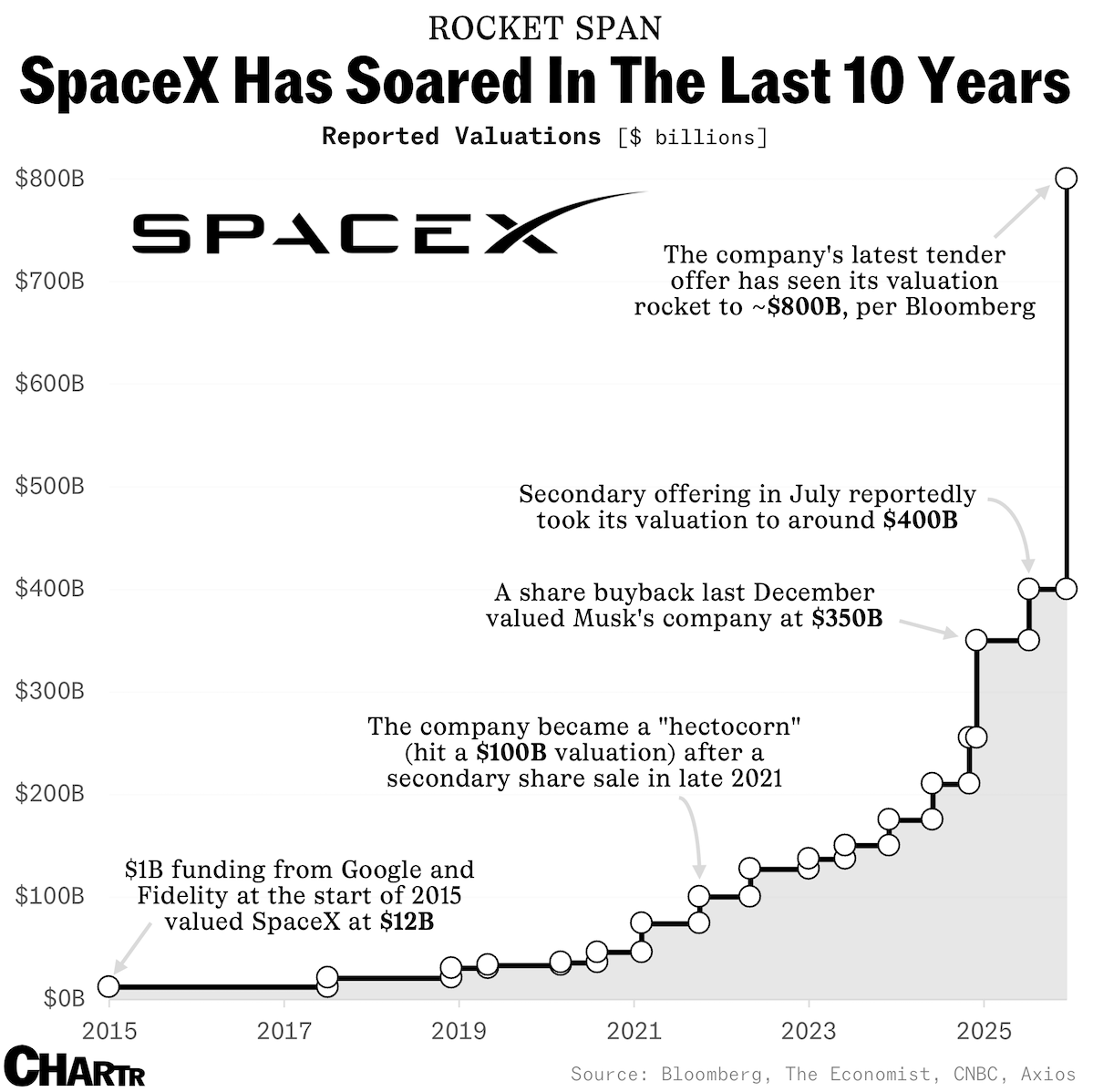
Thanks to a mid-December insider tender offering, we have a good idea of just how much the latter has jumped in recent years. |
Back in July of this year, the company was reportedly selling shares and raising money at a $400 billion valuation, a figure that’s doubled in the months since. In that period, SpaceX has continued its domination across the industry with more affordable space launches and exploration ambitions; per Forbes, the company “now launches more payload into orbit than the rest of the world combined.”
All of this is, obviously, pretty huge for Elon Musk, the SpaceX founder, CEO, and richest person on Earth, who also saw one of his other companies, Tesla, close at a record high yesterday for the first time in almost exactly a year. Indeed, his 42% stake in the $800 billion SpaceX business means that the majority of his reported $648 billion net worth — on paper, as we first noted in February — comes from what had once been a bit of a side hustle alongside his booming EV business.
|
|
|
-
Amazon is reportedly in talks to invest at least $10 billion in OpenAI, in a deal that could see the ChatGPT parent company use the e-commerce giant’s AI chips.
-
Happy new fears! A Bankrate report has found 1 in 3 Americans think their financial situation will get worse in 2026 — the most pessimistic people have been since the survey began in 2018.
-
Warner Bros’ board has told shareholders to turn down Paramount’s “inadequate” hostile takeover bid, urging them to instead accept Netflix’s ~$83 billion offer.
-
Scottie Scheffler was named the PGA Tour Player of the Year for a fourth consecutive time, making him the first golfer to achieve this since Tiger Woods’ record five-year streak.
-
More money than cents: The final batch of minted US pennies sold for over $16.76 million at an auction on Thursday.
|
|
| -
Sherwood News explores how health startups are turning blood testing into a sales funnel.
- Eras tour? This visual maps out the rise and fall of civilizations back to 2000 BC.
|
Off the charts: What are America’s top three favorite Christmas movies? [Answer below]. |
Not a subscriber? Sign up for free below. |
Sherwood Media, LLC produces fresh and unique perspectives on topical financial news and is a fully owned subsidiary of Robinhood Markets, Inc., and any views expressed here do not necessarily reflect the views of any other Robinhood affiliate... See more |
|
|
SHERWOOD MEDIA, LLC, 85 Willow Road, Menlo Park, CA 94025 |
|
|
|