|



Solve Enterprise Auth, Identity, and Security for Your App (Sponsored)
 |
Enterprise customers expect SSO, Directory Sync, RBAC, and Audit Logs, but building and maintaining that infrastructure slows teams down and pulls focus from core product work.
WorkOS provides these features through simple APIs and a hosted Admin Portal that integrates with every identity provider. You get production-ready enterprise capabilities without owning the complexity yourself.
Trusted by OpenAI, Cursor, Vercel, 1000+ more. Your first million MAUs are free.
Disclaimer: The details in this post have been derived from the details shared online by the LinkedIn Engineering Team. All credit for the technical details goes to the LinkedIn Engineering Team. The links to the original articles and sources are present in the references section at the end of the post. We’ve attempted to analyze the details and provide our input about them. If you find any inaccuracies or omissions, please leave a comment, and we will do our best to fix them.
Recruiting is a profession that demands both strategic thinking and meticulous attention to detail. Recruiters must make high-value decisions about which candidates are the best fit for a role, but they also spend countless hours on repetitive pattern recognition tasks. Sorting through hundreds of resumes, evaluating qualifications against job requirements, and drafting personalized outreach messages are all essential activities. However, they also consume enormous amounts of time that could otherwise be spent on relationship-building and strategic hiring decisions.
LinkedIn’s Hiring Assistant represents a new approach to solving this challenge.
Rather than replacing recruiters, this AI agent is designed to handle the repetitive, time-consuming aspects of the recruiting workflow, freeing professionals to focus on what they do best: connecting with people and making critical hiring choices.
The most labor-intensive parts of recruiting fall into three main categories.
First, sourcing candidates requires searching through LinkedIn’s network of over 1.2 billion profiles to identify qualified individuals.
Second, evaluating candidates involves carefully reading resumes and profiles to assess whether each person meets the specific requirements of a role.
Third, engaging candidates means drafting and sending personalized communications to potential hires, answering their questions, and maintaining ongoing dialogue throughout the hiring process.
To address these challenges, LinkedIn built the Hiring Assistant with three core capabilities.
The system delivers value at scale by efficiently searching across billions of profiles and handling enterprise-level workloads reliably.
It enables interactive communication by understanding recruiter intent through natural conversation, asking clarifying questions when needed, and adapting its behavior based on real-time feedback.
Lastly, it also features continuous learning by improving over time based on observing what recruiters do, learning individual preferences, and remembering past interactions and decisions.
In this article, we will look at the architecture and technical building blocks of LinkedIn’s Hiring Assistant.
Better Deals, By Design with Verizon This Holiday (Sponsored)
 |
This holiday season, the equation is simple: everyone gets a better deal with Verizon. Best devices. Best plans. Add that to an award-winning network, and you have the best deals. Period.
Unbeatable Deal: Switch to Verizon and get four lines on Unlimited Welcome for $25 per line/month (on Auto Pay plus taxes & fees) and get four of the newest, premium devices like the iPhone 17 Pro, Samsung Galaxy S25+, or Google Pixel 10 Pro XL all on Verizon.
Enjoy flexibility and save money this holiday season because every dollar you spend matters.
Explore Holiday Deals. See here for full terms.
The High-Level Architecture
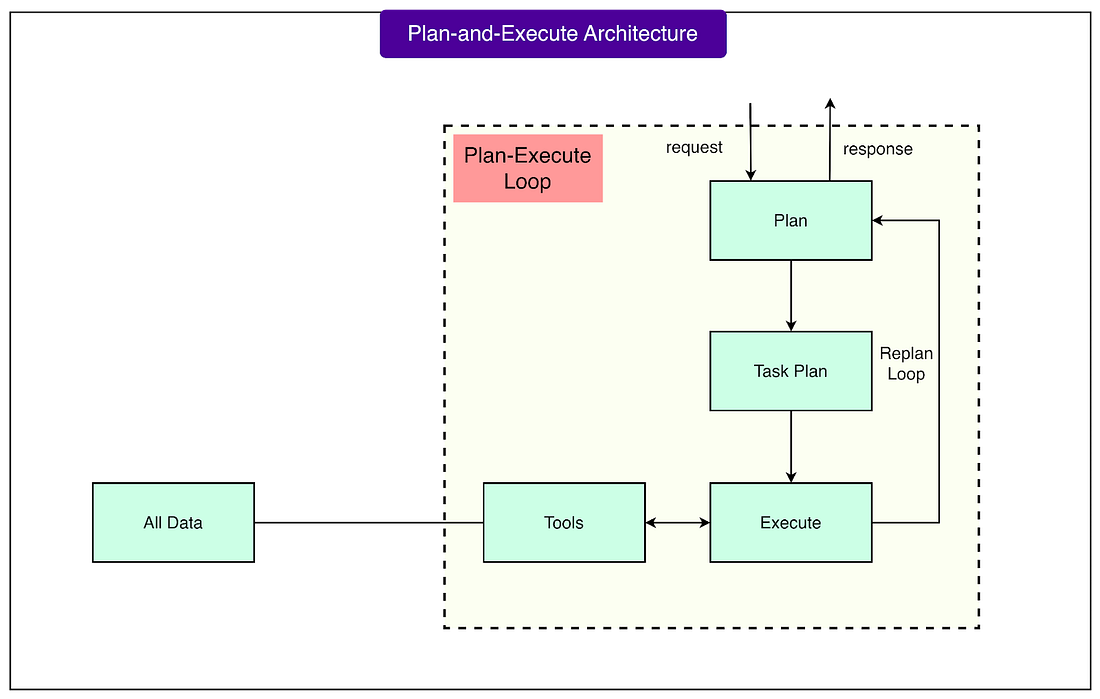
At its core, the Hiring Assistant is built on what LinkedIn calls a “plan-and-execute” architecture as shown in the diagram below:
 |
To understand why this matters, it helps to know what they avoided. A simpler approach, known as ReAct, would have the AI try to handle everything at once in a single continuous loop. While straightforward, this method runs into problems when tasks get complex. Large language models, the AI systems that power tools like this, can become unreliable when asked to juggle too many things simultaneously.
See the diagram below for the ReAct pattern.
 |