|



Power your company’s IT with AI (Sponsored)
 |
What if you could spend most of your IT resources on innovation, not maintenance?
The latest report from the IBM Institute for Business Value explores how businesses are using intelligent automation to get more out of their technology, drive growth & cost the cost of complexity.
Disclaimer: The details in this post have been derived from the details shared online by OpenAI, Gemini, xAI, Perplexity, Microsoft, Qwen, and Anthropic Engineering Teams. All credit for the technical details goes to OpenAI, Gemini, xAI, Perplexity, Microsoft, Qwen, and Anthropic Engineering Teams. The links to the original articles and sources are present in the references section at the end of the post. We’ve attempted to analyze the details and provide our input about them. If you find any inaccuracies or omissions, please leave a comment, and we will do our best to fix them.
Deep Research has become a standard capability across modern LLM platforms.
ChatGPT, Gemini, and Claude all support tasks that run for long periods of time and gather information from large portions of the public web.
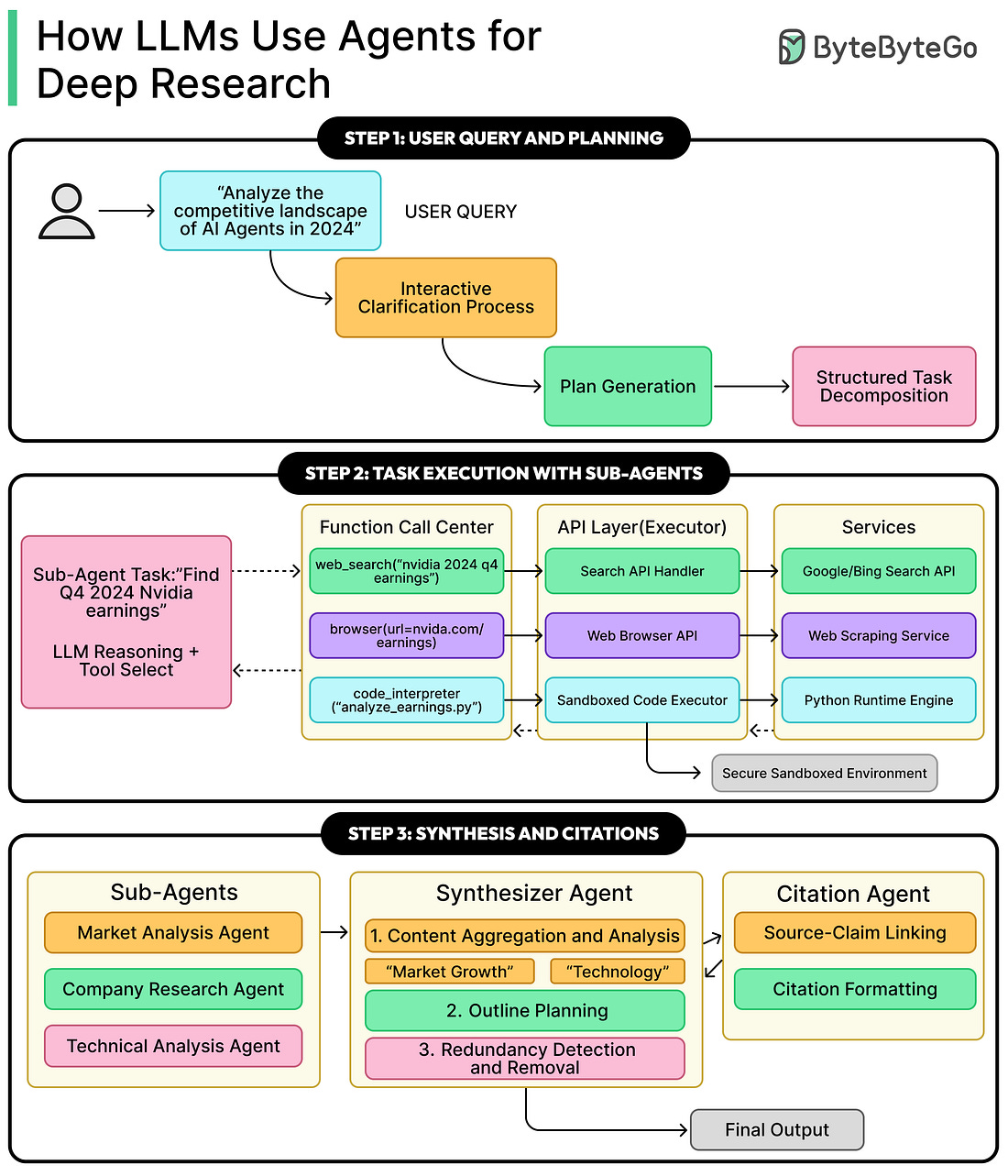
A typical deep research request may involve dozens of searches, several rounds of filtering, and the careful assembly of a final, well-structured report. For example, a query like “list 100 companies working on AI agents in 2025” does not rely on a single search result. It activates a coordinated system that explores a wide landscape of information over 15 to 30 minutes before presenting a final answer.
This article explains how these systems work behind the scenes.
We will walk through the architecture that enables Deep Research, how different LLMs implement it, how agents coordinate with one another, and how the final report is synthesized and validated before being delivered to the user.
 |
High-Level Architecture
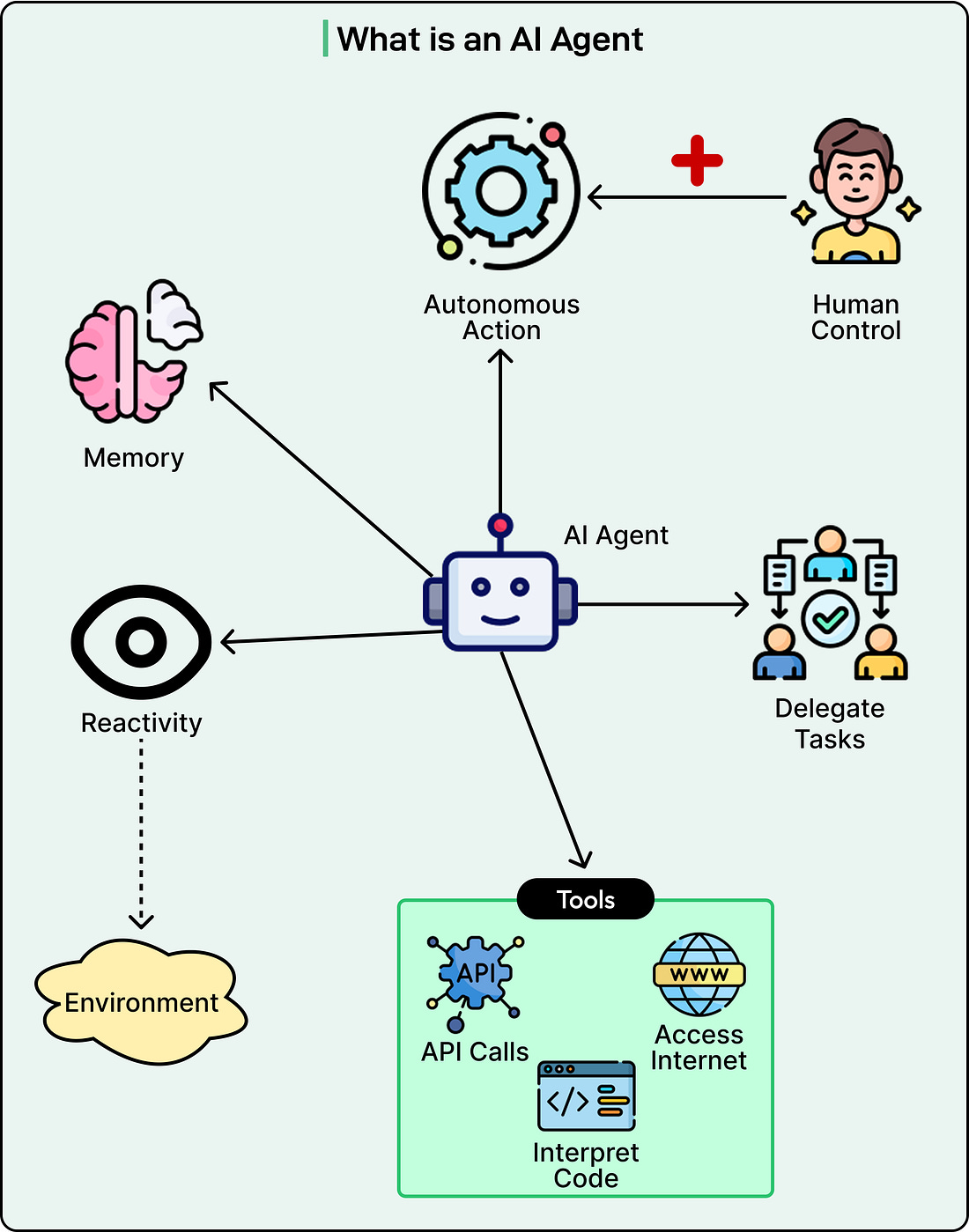
Deep Research systems are built from AI agents that cooperate with each other. In this context, an AI agent is a service driven by an LLM that can accept goals, design workflows to achieve those goals, and interact with its environment through tools such as web search or code execution.
See the diagram below to understand the concept of an AI Agent:
 |
At a high level, the architecture begins with the user request. The user’s query is sent into a multi-agent research system. Inside this system, there is usually an orchestrator or lead agent that takes responsibility for the overall research strategy.
The orchestrator receives the query, interprets what the user wants, and then creates a plan for how to answer the question. That plan is broken into smaller pieces and delegated to multiple sub-agents. The most common sub-agents are “web search” agents. Each of these is instructed to search the web for a specific part of the overall topic or a particular sub-task, such as one region, one time period, or one dimension of the question.
Once the web agents finish their work, they return two things:
The content they have extracted. This typically takes the form of text snippets, summaries, or key facts.
Citations that record exactly where that content came from, such as URLs and page titles.
These results then move into what we can call the “synthesizer” flow. This stage often contains two agents: a synthesizer agent and a citations agent. In some systems, the orchestrator itself also acts as the synthesizer, so a separate agent is not required.
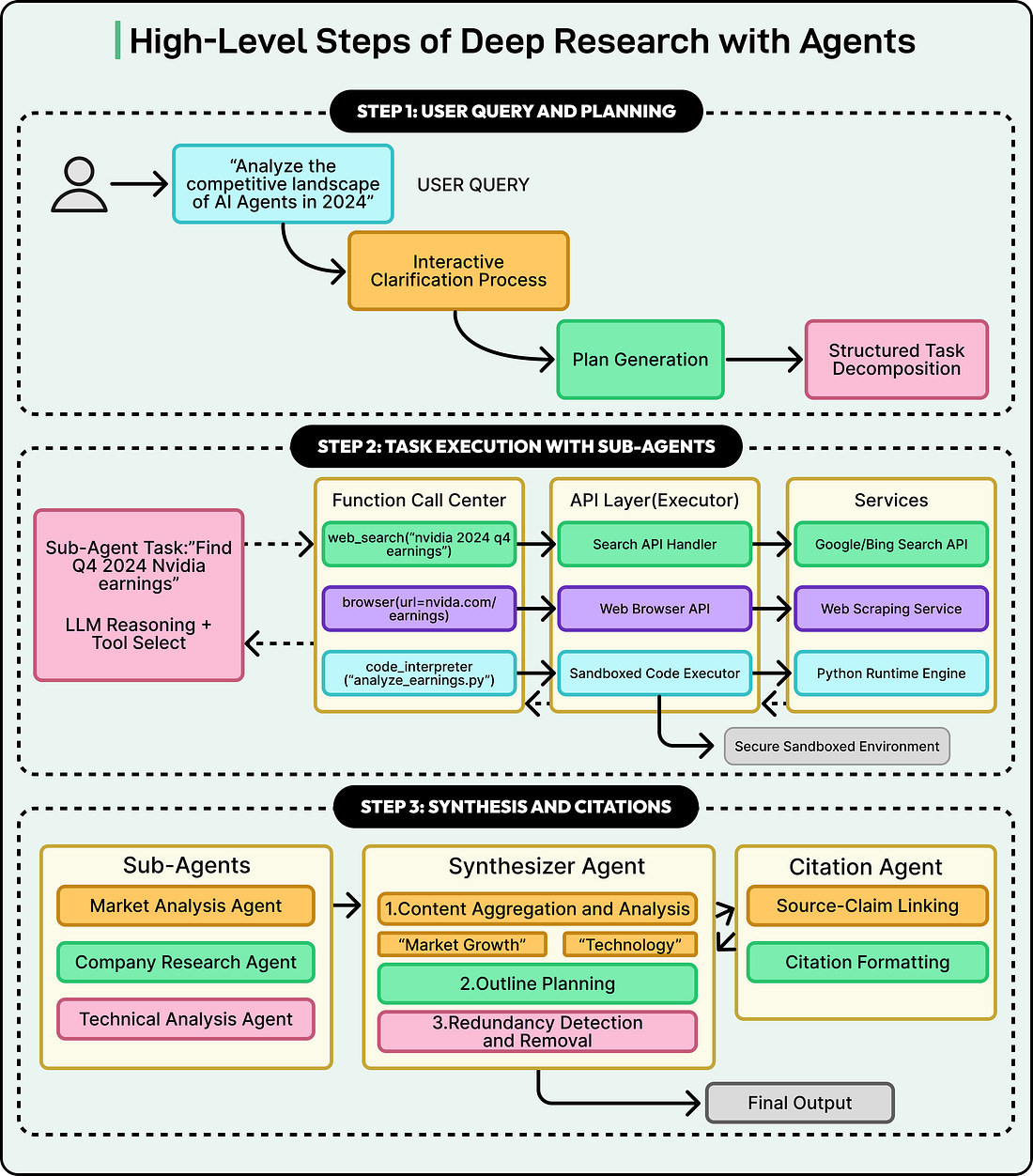 |
The synthesizer agent takes all the content returned by the web agents and converts it into the final research report. It organizes the information into sections, resolves overlaps, and builds a coherent narrative. The citations agent then reads through the synthesized report and makes sure that each statement is supported by the correct sources. It inserts citations in the right locations in the text, so that the final report is thoroughly backed by the underlying material.
After this synthesis and citation process is complete, the synthesizer (or orchestrator) returns the final, fully cited research report to the user.
Anthropic has published a high-level diagram of its “Advanced Research” mode, which illustrates such a multi-agent research system in action. It shows the lead agent, the various sub-agents, and the data flowing between them through planning, research, and synthesis.
 |