It's that time of year again: Best-of lists, Spotify Wrapped (plus every other platform rolling out its own version), and the slow, slightly desperate crawl toward the New Year. On the podcast front, my year-end list somewhat follows what we did last time: Ten shows that, in our view, defined the medium in 2025. The goal is to capture how podcasting has evolved amid its pivot to video and its absorption into the broader entertainment and digital economy; that is, how it has become central to American media culture (for better or worse), and how it continues to innovate around the edges.
Of course, that framework leaves out a major part of what the medium still represents for many listeners: the audio-centric narrative storytelling that once shaped how I engaged with, and curated, this space. That tradition isn’t especially visible in this list; I’ll be revisiting it in a separate, complementary roundup publishing next week. Let’s get to it. |
|
|
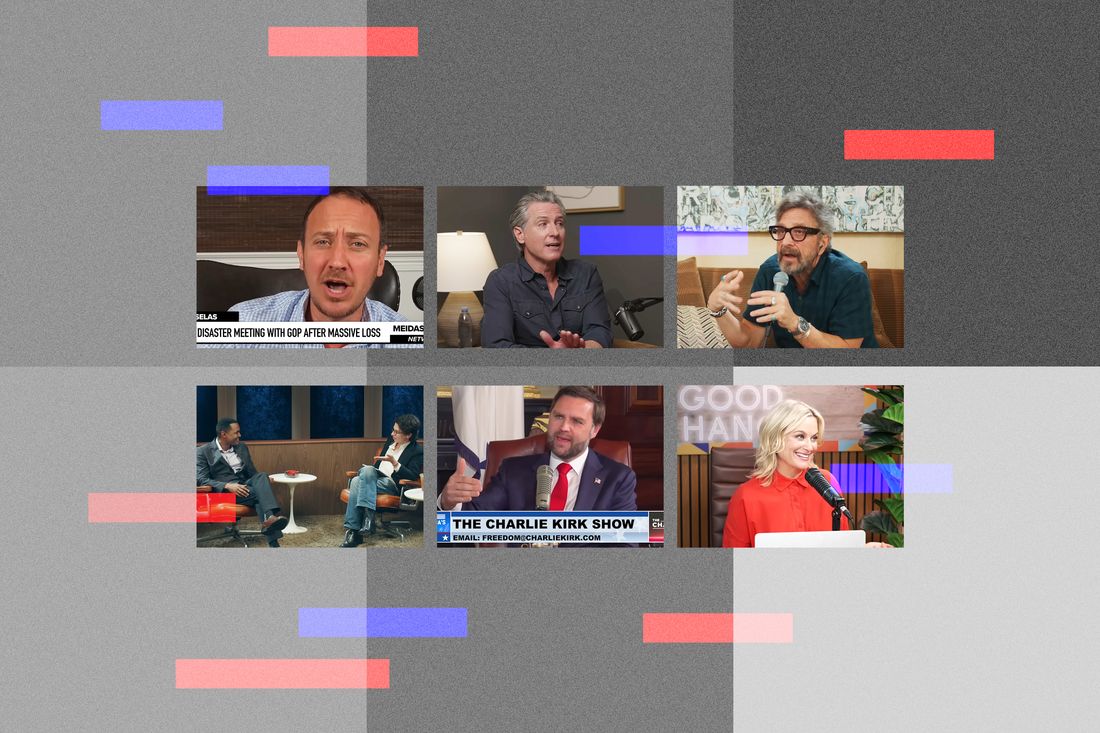
Photo-Illustration: Vulture; Photos: YouTube (MeidasTouch, This is Gavin Newsom, Barack Obama, The Adam Friedland Show, Charlie Kirk, Good Hang with Amy Poehler) |
Having completed its metamorphosis into a more defined sub-genre of YouTube, or a cheaper, looser form of television, the podcast world feels like it’s stumbling into yet another uncertain future. Consider, for example, how the medium, now in some ways just a format, seems poised to be absorbed by yet another totalizing platform: Netflix. Big Red’s recent announcement of its partnership with The Ringer, and the spate of reporting indicating that it’s approaching more big podcasters, emphasizes just how much the terms of competition have changed. The podcast platform wars used to revolve around Spotify and Apple; these days, it’s just one of many duels fought between YouTube and Netflix.
Meanwhile, podcasting, however defined, is now unambiguously central to American political culture. We’re still living in the long tail of last year’s “podcast election,” when audio and video shows became a full-fledged battleground for political messaging. Podcasters now run various arms of government; outside the Trump administration, key ideological fights, like the ongoing Republican struggle over whether to embrace the neo-Nazi Nick Fuentes, are being prosecuted, in part, through podcast mics. And the trend keeps deepening: across the spectrum, from the left’s growing power to the right’s fractures, podcasting is where arguments are shaped, tested, and turned into movements.
This isn’t to say the older idea of podcasting has vanished. There are still great audio documentaries and small upstart experiments: there’s a new season of In the Dark floating around, and Alternate Realities from journalist Zach Mack and NPR’s Embedded might be the best thing I heard all year. But I’m just going to keep repeating myself observing that the center of gravity has shifted far elsewhere. The word “podcast” now describes a broad layer of digital-native media that has more in common with Substack, YouTube, and TikTok than with radio. The form has reorganized itself around video, personality-driven programming, and an ever-tighter confluence with influencer media. It feels fitting that Marc Maron chose this year to hang up the mic, a symbolic passing between eras. Meanwhile, the Golden Globes has officially added a podcast category, and even though no one quite knows what to make of it, folks seem dazed enough to roll with it nevertheless.
Still, it’s myopic to be doomy and gloomy about all this. Podcasts are central to so many media diets now, and shows both new and old are hitting milestones each passing month. The messy, expansive, complicated nature of podcasting reflects contemporary American life. To capture all of this, instead of assembling a conventional year-end best-of, I’ve put together a list of ten shows that had big moments illustrating where the medium has been, and where it might be heading. |
10. Good Hang with Amy Poehler Bursts into the Celebcast Genre |
There’s always money in the Smartless lane. By which I mean, the safe, dependable celebrity chat-cast where stars feel comfortable dropping in and brands feel even more comfortable buying ads. (See: Armchair Expert, Office Ladies, and the collected works of Team Coco.) This year, Hollywood crowned Good Hang with Amy Poehler as Hollywood’s big, new entry in that space. Poehler has always been an interesting presence: amiable but with a slight spikiness, warm with just enough bite. In an endlessly crowded celebrity-chatcast field, shows live and die by curation, and Poehler’s booking lane is unusually well-defined, mixing together her gifted generation of SNL peers (kicking things off with Tina Fey), her television rolodex (Mike Schur), and a smattering of more contemporary gets who feel like genuine personal interests (Ariana Grande, Cole Escola, the Giggly Squad). With moments from her sit-downs with Grande and Aubrey Plaza making the viral rounds, that blend gives the show a clear identity of its own, which perhaps makes it no surprise that Good Hang topped Apple Podcasts’ list of new shows this year.
|
9. WTF with Marc Maron Locks the Gate For the Last Time |
After sixteen years, nearly 1700 episodes, and several industry cycles, the landmark interview show and cornerstone of podcasting is turning off the lights. In October, Maron published his last episode, a sit-down with former President Barack Obama that brings a big, influential moment for the show full circle (though, as I wrote at the time, I really see his penultimate episode, where he reflects on the arc of his project, as the true closer). The comedian himself isn’t going anywhere, of course. Alongside his stand-up career, he’s developing a few different projects and has been steadily building an on-screen acting career for some time. Yet it still feels like a hinge between eras: The end of WTF also reads as a goodbye to a purer, stranger, more interesting period in the podcast spirit, one where you could be genuinely searching and uncertain and still be rewarded for it. Maron and producer Brendan McDonald leave behind a magnificent historical archive of conversations with comedians, directors, actors, and artists across generations, plus, of course, the occasional president. But perhaps more importantly, they leave behind the legacy of a fiercely independent spirit, one that resisted getting swept up in the waves of podcast networks, Spotify, and now the pivot to video podcasting.
|
8. In Crisis, Bloomberg’s Odd Lots Gets Its Moment to Shine |
It’s strange but true: The best news podcast today is a hyper-wonky finance and economics show that offers effortless deep dives into topics like restaurant supply chains, freight shipping across Alaska, why modular home-design keeps failing to help solve the housing crisis, or the inflation politics of the Fed. Odd Lots, hosted by Tracy Alloway and Joe Weisenthal, had an especially big moment earlier this year when the Trump administration’s so-called “Liberation Day” tariffs sent global markets scrambling, leading to a week with little sleep and questionable amounts of Zyn for the hosts. That bump in their profile owes a lot to how Alloway and Weisenthal have created a space that feels essential; rather than shy away from the complexity of the week’s events, they leaned into it. The show turns ten this year, and its design remains resolutely old-school: no video pivot (yet), no attempts to tighten conversations, no instinct to dumb anything down. Its style now reads like a throwback to an earlier vision of podcasting, and internet publishing more broadly, built on faith in the power niche wonkiness: attractive for those who already understand the terrain, and aspirational for those who want to. While new-generation business pods like TBPN are gaining attention for making a game out of the power scramble among market elites, count on Odd Lots stubbornly insists on substance in a media economy hell-bent on dumbing things down.
|
7. MeidasTouch Isn’t the Joe Rogan of the Left, But Directionally… |
If the first Trump presidency birthed Crooked Media as the normie center-left’s podcast empire, the second has given rise to MeidasTouch — an evolution in pace, form, and packaging, even if it’s still hosted by three somewhat interchangeable white guys. In a reflection of where digital media sits today, MeidasTouch is as close as you get to a fully YouTube-optimized organism of the Democratic Party faithful, pumping out videos with headlines like “GOP Leaders LOOK FOR EXIT as Trump DESTROYS PARTY” and “Trump NEXT MOVES Exposed by his OWN Pardon SCHEMES…,” wrapped in a visual aesthetic that borrows just enough from MSNBC to legitimize something that otherwise looks filmed in a bunker. The idea that “the left needs its own Joe Rogan” or “its own Charlie Kirk” was already tired from the second it was fired off someone’s keyboard for the first time, but in this case, it somewhat applies. Really, what we’re looking at here is the mainstream left’s analog to Steve Bannon’s War Room.
|
6. This is Gavin Newsom’s Pseudo-Presidential Address |
It’s so clear he’s running for President. It’s equally clear that, these days, the communications arm of the election campaign requires more than working the fading institutional press. 2028 hopefuls also have to run the gauntlet of the ever-expanding constellation of new-media authorities: the podcasters, Twitch streamers, Substackers, short-form video hustlers, the Theo Vons and Hasan Pikerses and Joe Roganses and Kara Swisherses and Alex Cooperses of the world. And in some ways, perhaps more crucially, one might have to become one of these authorities themselves. Of course, this isn’t entirely unprecedented as a phenomenon. Right-wing talk radio hosts have been jumping into politics since roughly the dawn of mass media. But the contemporary shape of this dynamic is far more pungent, pervasive, and powerful than ever before. With This is Gavin Newsom, the California governor is obviously working to position himself as some sort of aisle-bridging but Trump-antagonizing candidate, an acquiescent project that involves booking Steve Bannon one week and Ezra Klein the next. Whether any of this will meaningfully drive discernible outcomes is the question, but for now, it’s worth grappling with this possibility that your next president might literally be a podcaster.
|
|
|
|
A newsletter about the perpetual Hollywood awards race. |
|
|
https://linkst.vulture.com/oc/5fe2723ceb617545f4336b08pl2xy.236/df911815
|
|
|
|