Hi! Google's annual Year in Search report dropped yesterday — if you (somehow) guessed that the top trending person in 2025 was d4vd, well done. And if you (again, somehow) were sure enough to take to Polymarket to back your hunch, enjoy the $1.2 million in your account. Today we’re exploring:
|
- This just out: More US adults are taking a break from constant breaking news.
- Big spenders: Tech now makes up some of the S&P 500’s most capital-intensive businesses.
- Smellmaxxing: Estée Lauder’s Jo Malone is debuting an “AI Scent Advisor.”
|
Have feedback for us? Just hit reply - we'd love to hear from you! |
Headline-fatigued Americans are tapping out of the news cycle |
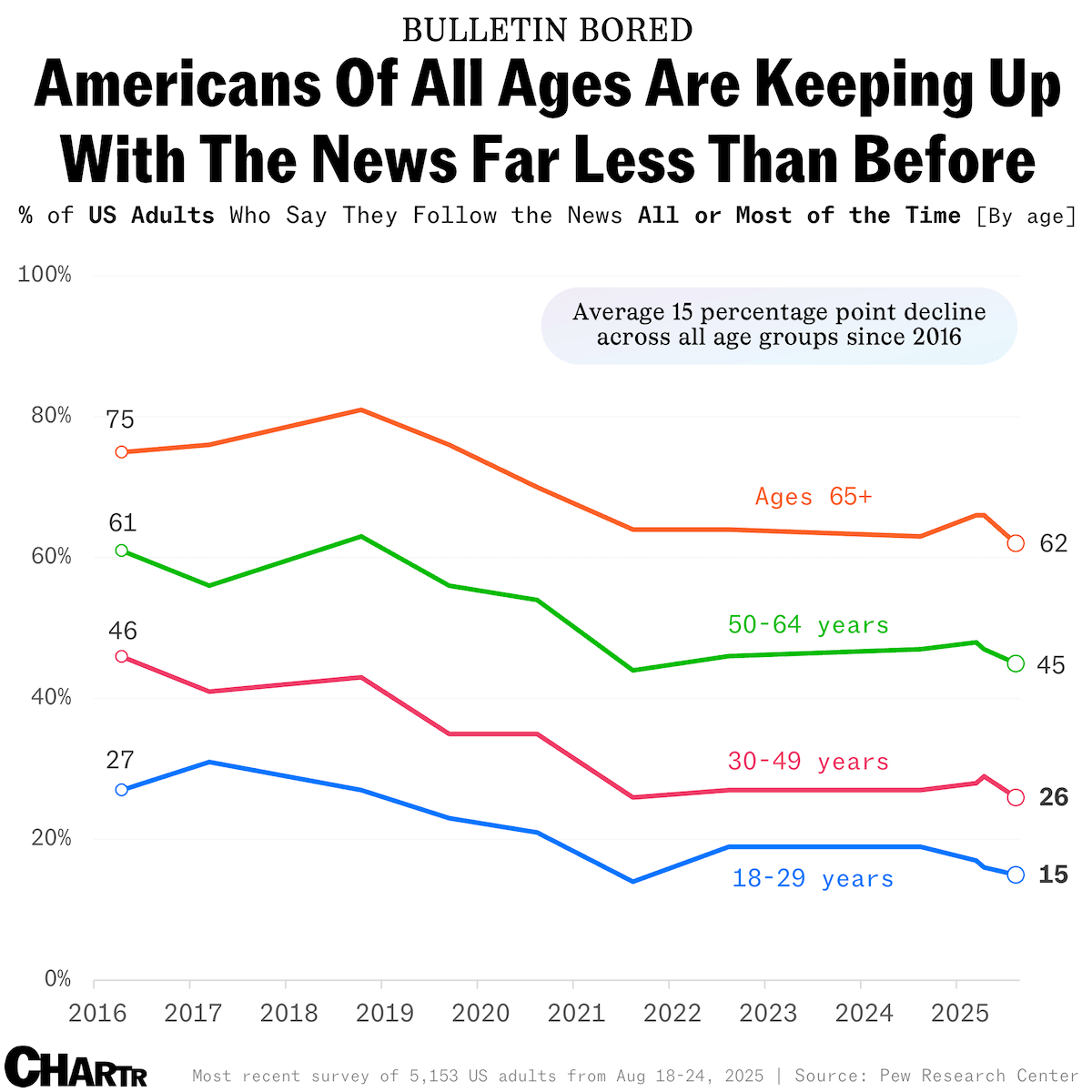
News has never been more within reach than it is today; however, constant updates and push notifications are now causing a growing portion of Americans to consciously keep current affairs at arm’s length.
A survey update from Pew Research Center, published Wednesday, found that the overall share of US adults who reported following the news all or most of the time fell to 36% in August 2025 — a significant drop from the 51% recorded in 2016. |
What’s striking is that this trend tracks across all age cohorts, including those considered to be the most plugged in. From the Pew data, 30- to 49-year-olds have seen the biggest drop-off from 2016, with 20% fewer respondents in that age group saying that they keep up with news all or most of the time, while the share of 50- to 64-year-olds saying the same slumped 16% in that period. |
“Brain rot” social media consumption that’s often blamed for the increasingly fragmented news landscape is most commonly associated with Gen Z.
And though young adults do follow the news less closely than other age groups, and a growing number of middle-aged Americans are using social media as a news source, the practice of active avoidance might lend just as much insight into the drop-offs as increasing time spent on apps like TikTok.
Indeed, the Reuters Institute’s 2025 Digital News Report found that news evasion is at a record high globally, with 40% of respondents saying they sometimes or often avoid the news, up from 29% in 2017 — citing a “negative effect on their mood” and being “worn out by the amount” as top reasons for swerving the headlines.
|
Technology giants don’t look like they used to |
Spin up a website; throw a few bucks at a server; buy some Facebook ads; get a million downloads for your app; and then kick back and enjoy the fruits of the super-lean business model. The economics of tech have been alluring for decades, in part because they haven’t required huge swaths of investment. Think: Airbnb doesn't own hotels, Uber doesn’t have any cars (still true-ish).
AI throws all of that into question, as the power-guzzling data centers that suck up every spare investment dollar and watt of electricity change everything.
Indeed, Big Tech’s AI infrastructure build-out is so enormous that some of America’s most valuable tech companies, like Oracle and Meta, now screen more like energy companies, with Wall Street expecting them to spend $56 and $45, respectively, on capital expenditures for every $100 in revenue over the next 12 months. Oracle’s splurge, in the interests of delivering on its end of an eye-watering contract with OpenAI, is creating some particularly head-turning accounting distortions.
|
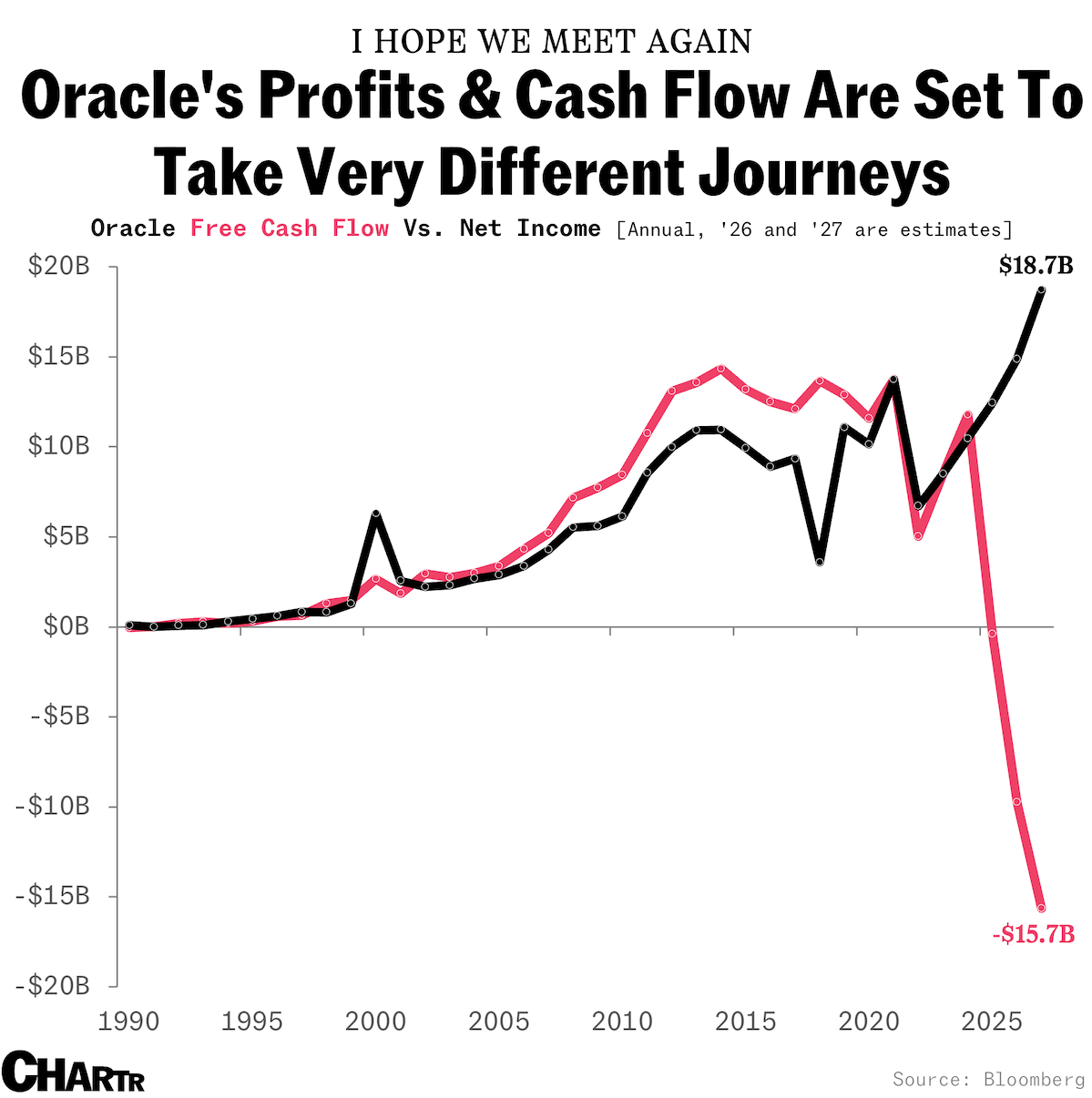
Wall Street thinks Oracle is going to have a wildly profitable year in 2027, making more than $18 billion in net income — but it’s still going to end the year with nearly $16 billion less cash than it started with. No wonder some investors are getting jittery about its debt.
To be clear, none of these accounting distortions are illegal, or even remotely shady. Free cash flow and net income routinely diverge, but what’s so eye-catching about this is simply the scale. Indeed, one company’s investment in capex to buy AI chips is another company’s — often Nvidia’s — revenue.
The crux of the debate on Wall Street, then, is two-fold: just how long are these chips and data centers going to last, and will they actually drive serious economic efficiencies? The answer to those questions is hard to know, but the fact that Big Tech’s asset-light era is waning seems more certain. |
|
|
Capture the future of computing with CHPX |
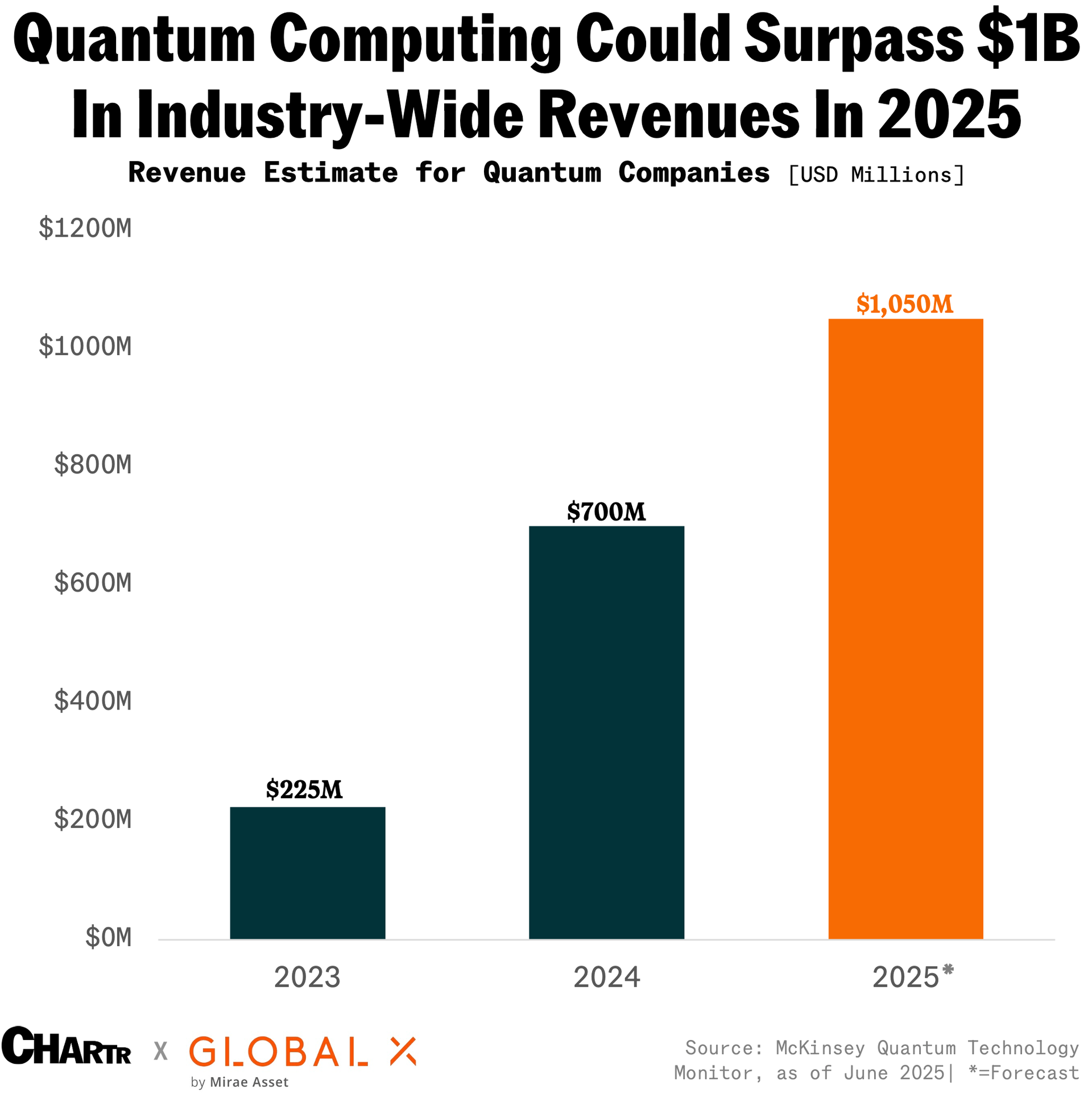
AI is redefining computing today, and quantum will likely reshape it tomorrow. Behind these shifts is the hardware ecosystem: semiconductor and quantum innovators building systems setting the trajectory for next-generation computing. Quantum technology is still nascent — but revenues are forecast to surpass $1 billion this year1 and scale to $10 billion by 2030.2 |
The Global X AI Semiconductor & Quantum ETF (CHPX) invests in companies reshaping the computing landscape to deliver AI. The fund invests in hardware companies, targeting advanced chips, memory/network providers, systems enablers, and quantum computing pioneers in an effort to represent the full hardware stack.
As of December 5th 2025, CHPX consists of 90% AI semiconductors and 10% quantum computing. This balance seeks to provide exposure to semiconductors that enable AI model training and inference, while also capturing the development of quantum technologies — an area with potential to complement and amplify the capabilities of even the most advanced AI models.
|
|
|
Estée Lauder’s Jo Malone is launching an “AI Scent Advisor” |
Gen Z is driving something of a fragrance boom at the moment, and Estée Lauder is looking to continue cashing in by debuting an “AI Scent Advisor,” developed with Google Cloud.
The company is hoping to convince online shoppers to spend north of $100 on fragrances through a chatbot that tries to capture the intangible experience of smelling. Perhaps a dream-come-true moment for the so-called “frag heads” who look for seriously unique scents to match bizarre situations, or even memes.
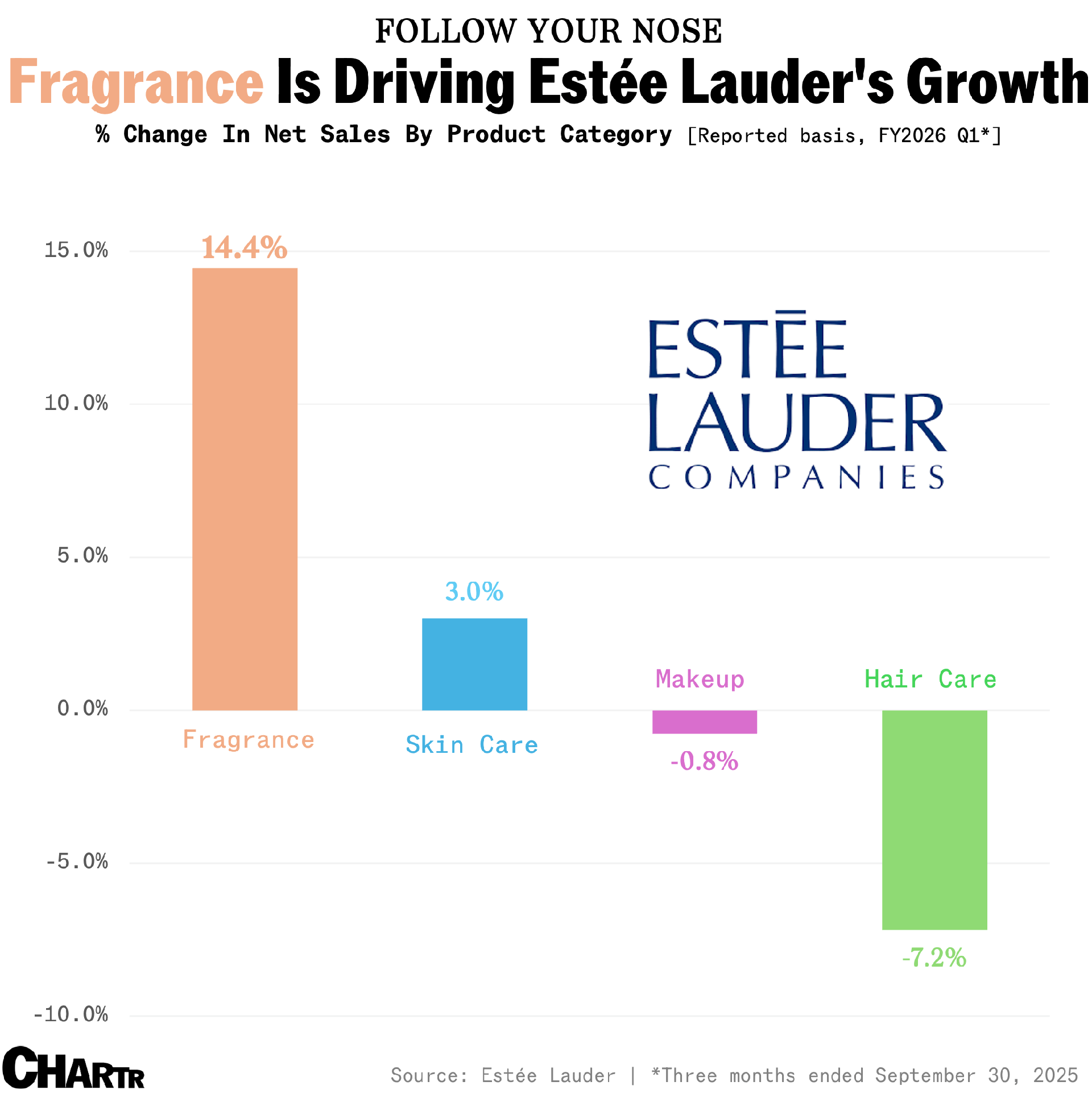
The launch gives another avenue for Estée Lauder to grow its stable of fragrance brands — a roster that includes Tom Ford, Frédéric Malle, Le Labo, and Kilian. Indeed, the debut marks a pivotal step for a company that was late to go all-in on online retail, but has been catching up quickly, with fragrances now the company’s fastest growing division. |
Fragrance’s digital focus is not new: Spanish beauty giant Puig’s fragrance and fashion segment, with labels like Carolina Herrera and Byredo, is doubling down on the visual appeal of perfume. Last year, 26% of Puig’s revenues came from digital channels, more than the company had anticipated five years ago, thanks to the brand’s film-like marketing strategy… and teenage boys who became “obsessed with fragrance” through TikTok, in CEO Marc Puig’s words.
|
Indeed, annual fragrance spending reportedly jumped some 44% for teenage boys last year, per Piper Sandler research. And thanks to increasingly popular review websites like Fragrantica and social media, many of these younger consumers are buying fragrances without smelling them, following new trends like “scent layering” and “smellmaxxing” that are translating into, well, a lot of money for perfume’s old guard.
|
|
|
-
Netflix just announced that it’s won the bidding war for Warner Bros. beating out competitors Comcast and Paramount in a deal worth $83 billion, or $27.75 per share.
-
High block: Lego is bringing out a 2,842-brick life-sized version of the FIFA World Cup trophy next year as part of its new deal with the soccer governing body.
-
There are more billionaires than ever, with a new UBS report counting a record 2,900 in 2025, and they hold ~$1.8 trillion more wealth than they did just last year. Yay!
-
Beast Industries, the company behind Mr Beast, could one day IPO, with its CEO saying they want the creator’s ~1.4 billion active viewers to get the chance to own the company.
-
No shade, but… Pantone just named “Cloud Dancer” — or white, as most of you probably know it — as the color of the year for 2026.
|
|
|
Quantum computing is still nascent, but industry-wide revenues are forecast to surpass $1 billion in 2025.1 CHPX from Global X gives investors pure-play exposure to players across the AI semiconductor and quantum ecosystem. Learn more. |
|
|
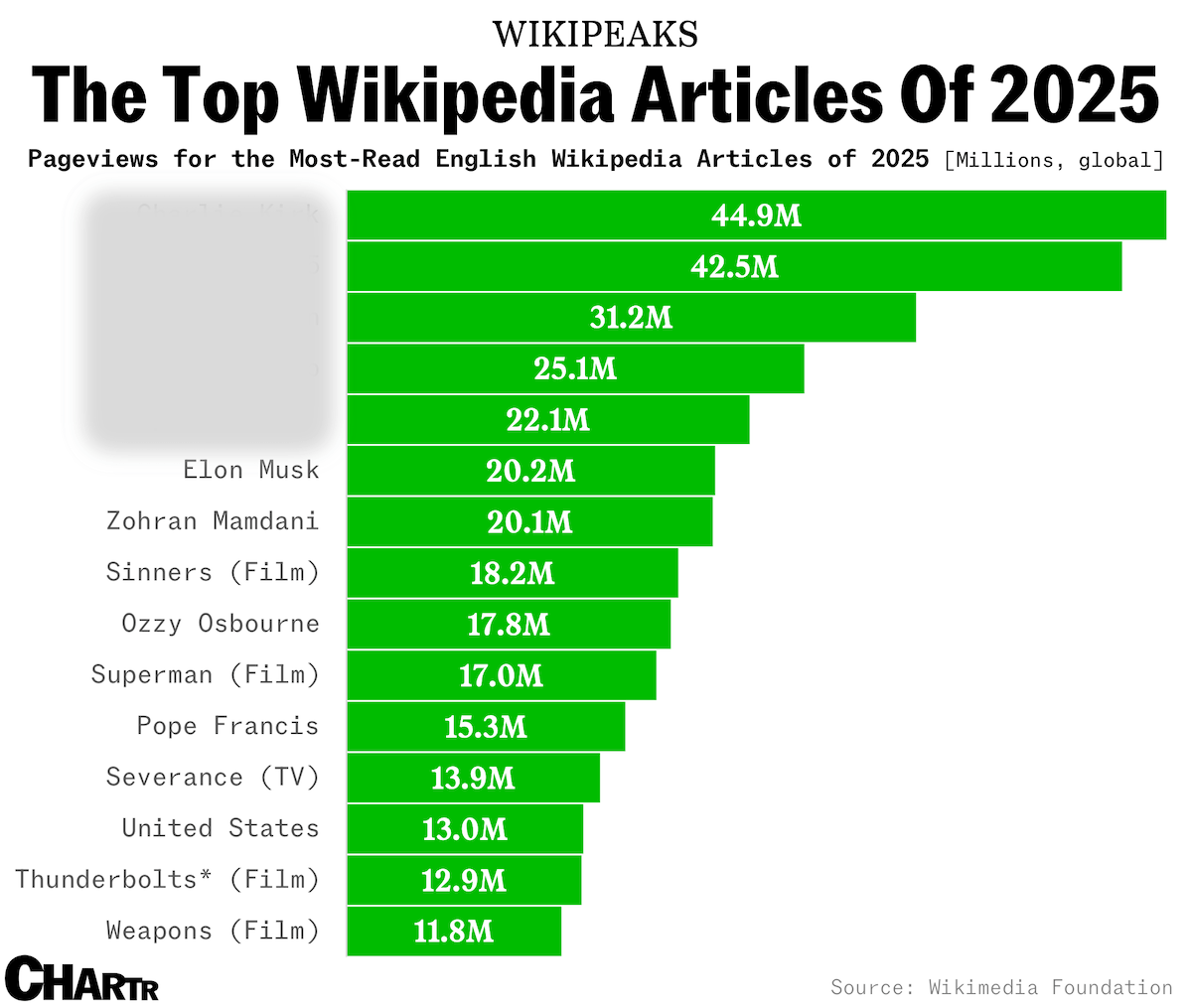
Off the charts: Earlier this week, Wikipedia revealed the most read English articles on the site, but how many of the top 5 can you get? [Answer below]. |
Not a subscriber? Sign up for free below. |
|
|
|